Sustainable Development Strategy
of National Aerospace University
«Kharkiv Aviation Institute» for 2026–2030
Approved by:
The Academic Council of
National Aerospace University
«Kharkiv Aviation Institute»
Minutes No. 1 dated August 19, 2026
Enacted by Rector's Order No. 316 dated August 19, 2026
General Principles
The Sustainable Development Strategy of National Aerospace University «Kharkiv Aviation Institute» (hereinafter referred to as the Strategy) defines a long-term conceptual model for the transformation of the University as a high-tech research, innovative, and socially responsible higher education institution integrated into the European Higher Education Area and the European Research Area.
The Strategy has been developed in accordance with the provisions of: UN 2030 Agenda for Sustainable Development (UN Agenda 2030), principles of UNESCO Education for Sustainable Development (ESD 2030), provisions of the European Green Deal, the Bologna Process, strategic recommendations of the European University Association (EUA), as well as national strategic documents of Ukraine regarding the development of education, science, digital transformation, and post-war recovery of the state.
National Aerospace University «Kharkiv Aviation Institute» (hereinafter - KhAI; the University) considers sustainable development as a systemic model of strategic management that ensures the balanced integration of educational, research-revenue, innovation, financial-economic, social, digital, security, and environmental components of institutional development. Such an approach forms the basis for long-term sustainability, adaptability, and global competitiveness of the University under conditions of high uncertainty, technological changes, and geopolitical transformations.
As the leading aerospace university of Ukraine, KhAI defines its strategic role in shaping the intellectual, technological, and innovation potential of the state, developing the aerospace sector, and defense high-tech manufacturing. The University's Sustainable Development Strategy is directly linked to the processes of national economic recovery, strengthening Ukraine's technological sovereignty, and forming the technological foundation of national security and defense capability. The University positions itself as an institution of strategic technological resilience of Ukraine.
The conceptual model of KhAI's institutional transformation is realized through the consistent development of five interconnected strategic dimensions:
1) Safe University implies the development of protected educational infrastructure, ensuring the continuity of the educational process in secure University spaces, establishing crisis management systems, civil protection, cybersecurity, and institutional resilience under conditions of military, technogenic, and hybrid threats, as well as functioning in a frontline region;
2) Digital University aims at the digital transformation of management processes, integration of artificial intelligence technologies, data analytics, modern digital educational technologies, management automation, and the development of digital competencies within the academic community;
3) Sustainable University ensures the integration of ESG principles (environmental, social, and governance), implementation of energy-efficient solutions, development of a «green» campus, rational use of resources, and greening of internal processes;
4) Global Aerospace University focuses its development on international integration into educational, scientific, and technological ecosystems of the aerospace industry, expansion of academic mobility, international research consortia, and strategic partnerships;
5) University Serving Society realizes its third mission through public service, social responsibility, development of inclusivity, support for communities, veterans, youth, internally displaced persons, evacuated population, and other vulnerable groups, shaping an active role of the university in the state's recovery and sustainable development.
The fundamental principle of implementing the Strategy is human-centeredness, which defines the human being as the primary value of institutional development. This involves creating a safe, inclusive, barrier-free, psychologically comfortable, and academically honest environment that ensures equal opportunities for study, professional realization, and personal growth for all members of the university community.
The principle of academic excellence defines the priority of high-quality education, development of research competencies, integration of science and education, academic mobility, interdisciplinarity, lifelong learning, and alignment of educational programs with global technological and labor market trends.
The principle of innovation and technological leadership is realized through the development of priority scientific and technological directions of the University, particularly in the fields of aviation, space technology, unmanned systems, robotics, materials science, energy systems, digital platforms, cybersecurity, and artificial intelligence. The University's innovation activities are focused on developing deep-tech solutions, technology transfer, commercialization of research results, and supporting technological entrepreneurship.
The principle of responsible governance and institutional sustainability involves implementing modern management models based on transparency, accountability, risk management, strategic analytics, digital security, and financial diversification. Special attention is paid to the development of the internal quality assurance system, corporate culture, and adaptive management mechanisms.
The principle of environmental responsibility integrates the environmental dimension into all areas of University activities through the development of a «green campus,» energy-efficient infrastructure, responsible resource consumption, waste management, process decarbonization, and fostering an environmental culture within the academic community in accordance with the «Green University» concept.
The principle of global integration and partnership defines the development of international cooperation as a strategic tool for enhancing academic reputation, technological competitiveness, and University participation in global knowledge and innovation value chains. This involves active participation in international consortia, grant programs, university alliances, academic mobility, joint research, and industry partnerships.
Implementation of the Strategy is carried out based on the concept of «5P (People, Prosperity, Planet, Peace, Partnership) UN Sustainable Development Goals,» ensuring comprehensive integration of seventeen Sustainable Development Goals into strategic areas of University activities. Institutional integration of the Sustainable Development Goals into University activities is carried out according to the NAU «KhAI» Sustainable Development Goals Mapping (SDG Mapping) (Appendix), which defines the University's strategic focus, institutional indicators, priority levels, and mechanisms for implementing SDGs in educational, scientific, managerial, social, and infrastructure activities.
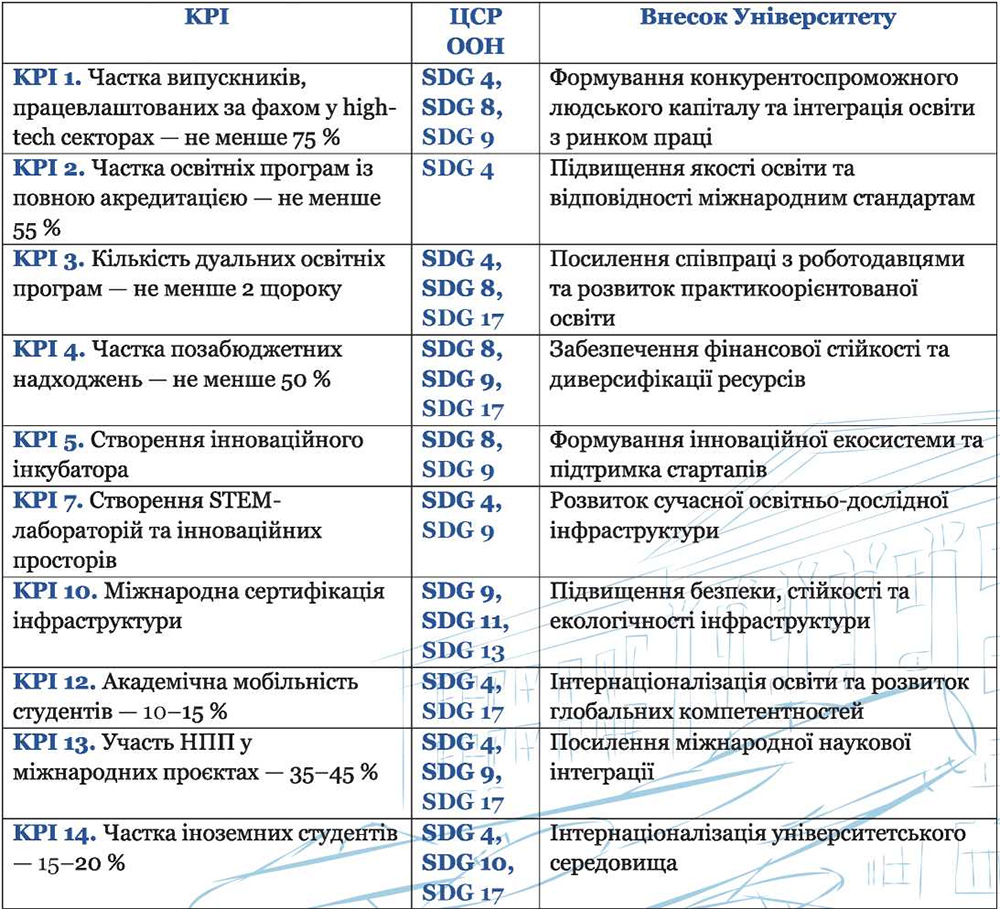
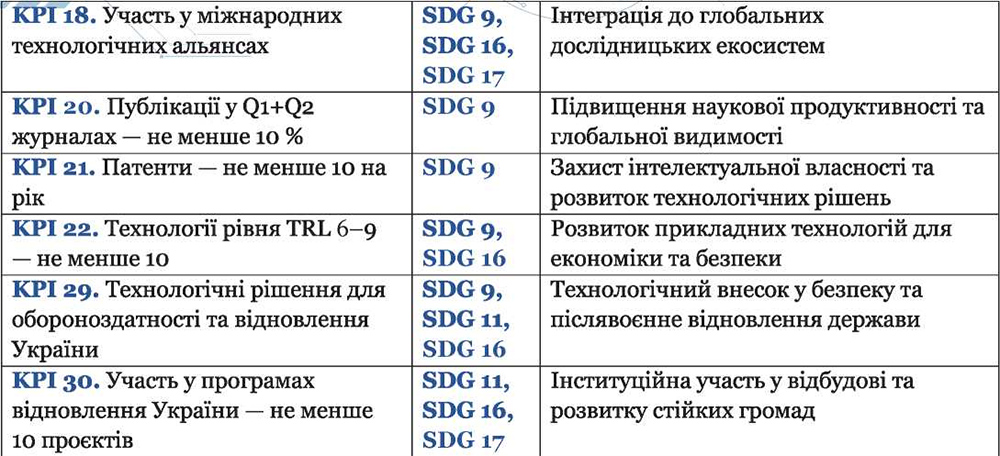
Strategic goals, operational tasks, and principles defined in this Strategy align with the University Development Strategy and form a unified system of institutional sustainable development management aimed at achieving long-term academic, scientific, technological, social, and economic sustainability, ensuring the achievement of key performance indicators (KPIs) specified in the University Development Strategy (Appendix).
Realization of the Strategy will contribute to establishing KhAI as a leading next-generation European aerospace university capable of generating knowledge, creating innovations, developing leaders, and making a strategic contribution to the sustainable development of Ukraine, Europe, and the global community.
Mission
To build human capital, generate new knowledge, and create innovative aerospace and high-tech solutions by integrating sustainable development principles into education, science, management, and social interaction. To promote the strengthening of a safe, inclusive, and resilient educational-scientific environment, the reconstruction of Ukraine, the development of global partnerships, and the training of responsible leaders capable of ensuring the sustainable and secure development of the state and the world community.
Vision
By 2030, National Aerospace University «Kharkiv Aviation Institute» is a sustainable, safe, innovative, and globally integrated aerospace research university of European level, combining academic excellence, technological leadership, digital transformation, environmental responsibility, and public service, developing human capital, generating breakthrough knowledge, and creating innovations for sustainable, safe, and technologically sovereign development of Ukraine and the global community.
Strategy Implementation Model
The implementation of the Strategy is carried out through a system of interconnected strategic goals, strategic tasks, priority implementation areas, and key performance indicators (KPIs) aligned with the University Development Strategy and the Sustainable Development Goals Mapping of NAU «KhAI» (SDG Mapping) (2026-2030): Institutional Framework for Sustainable Development.
Strategic Goals
1. Develop human capital, ensure quality, inclusive, and safe education (People). Creation of a human-centered educational environment, development of professional, digital, and leadership competencies, support for well-being, academic integrity, equal opportunity, and lifelong learning.
2. Enhance the scientific-innovation potential and economic sustainability of the University (Prosperity). Development of fundamental and applied research, innovation ecosystem, technology transfer, technological entrepreneurship, digital transformation, financial diversification, and efficient resource management.
3. Integrate environmental responsibility and green transformation principles into all areas of University activities (Planet). Green campus development, implementation of energy-efficient solutions, decarbonization, rational resource utilization, waste management, and environmental culture.
4. Ensure safety, institutional resilience, and responsible governance (Peace). Development of safe educational infrastructure, ensuring operational continuity, crisis management, civil defense, cybersecurity, transparency, accountability, and adaptability of management processes.
5. Expand global integration, strategic partnerships, and public service (Partnership). Enhancement of international cooperation, academic mobility, participation in global scientific and educational networks, development of cross-sectoral partnerships, and implementation of the University's third mission in the reconstruction and sustainable development of Ukraine.
Operational Tasks for Strategic Goals
Strategic Goal 1. Develop human capital, ensure quality, inclusive, and safe education (People)
1.1. Modernize educational programs in accordance with the needs of the aerospace sector, digital economy, and global labor market.
1.2. Develop a system of continuous education and lifelong learning.
1.3. Enhance digital, managerial, and leadership competencies of students.
1.4. Ensure inclusivity, barrier-free access, and equality of opportunities in the educational environment.
1.5. Develop academic mobility and international educational opportunities.
1.6. Foster a culture of academic integrity and ethical responsibility.
1.7. Develop a support system for the physical and mental health of the university community.
Strategic Goal 2. Enhance the scientific-innovation potential and economic sustainability of the University (Prosperity)
2.1. Support and develop the scientific schools of the University.
2.2. Expand interdisciplinary research in priority areas of the aerospace and high-tech sectors.
2.3. Increase publication activity in international scientometric databases.
2.4. Develop technology transfer mechanisms and commercialization of research results.
2.5. Strengthen grant activity and participation in international research programs.
2.6. Build an ecosystem for technological enterprise and startup culture.
2.7. Diversify funding sources and increase financial sustainability.
Strategic Goal 3. Integrate environmental responsibility and green transformation principles into all areas of University activities (Planet)
3.1. Develop the green campus concept and environmentally safe infrastructure.
3.2. Increase the energy efficiency of buildings and laboratory complexes.
3.3. Implement principles of rational resource management and responsible consumption.
3.4. Develop a waste sorting and management system.
3.5. Integrate the environmental component into educational programs and scientific research.
3.6. Foster environmental culture and responsibility within the academic community.
Strategic Goal 4. Ensure safety, institutional resilience, and responsible governance (Peace)
4.1. Develop safe educational spaces and civil defense infrastructure.
4.2. Ensure educational process continuity and institutional adaptability under crisis conditions.
4.3. Implement modern risk management and crisis response systems.
4.4. Strengthen cybersecurity, digital protection, and information resilience.
4.5. Improve the internal quality assurance system for education.
4.6. Ensure transparency, accountability, and efficiency of management processes.
4.7. Develop corporate culture based on trust, responsibility, and openness.
Strategic Goal 5. Expand global integration, strategic partnerships, and public service (Partnership)
5.1. Expand University participation in international educational, scientific, and professional networks.
5.2. Develop strategic partnerships with business, state institutions, and international organizations.
5.3. Strengthen the integration of the University into the European Higher Education Area and European Research Area.
5.4. Develop dual education mechanisms and cooperation with employers.
5.5. Implement the third mission of the University by supporting communities, veterans, youth, and vulnerable population groups.
5.6. Contribute to the post-war recovery of Ukraine through education, science, and innovation.
Priority Areas of Strategy Implementation
Implementation of the Sustainable Development Strategy of the University is carried out through a system of interconnected priority areas that ensure the achievement of strategic goals, the integration of the UN Sustainable Development Goals, and align with the NAU «KhAI» SDG Map (2026-2030): Institutional Framework for Sustainable Development.
The priority implementation areas include:
1. Educational resilience. Ensuring continuity, quality, innovativeness, and accessibility of the educational process, developing modern educational programs, digital competencies, academic mobility, dual education, and lifelong learning.
2. Scientific and innovation development of the University's potential, development of priority scientific fields, technology transfer, innovation ecosystem, technological entrepreneurship, and commercialization of research results.
3. Human capital development. Creating a human-centered, inclusive, safe, and motivating university environment, developing professional potential of staff, supporting well-being, health, academic integrity, and equality of opportunities.
4. Institutional resilience, financial capacity, and responsible governance. Developing an effective management system, financial diversification, risk management, transparency, accountability, internal quality assurance system, and adaptive governance.
5. Digital transformation and cybersecurity. Developing digital infrastructure, integrating artificial intelligence technologies, data analytics, management automation, digital services, and ensuring a high level of cybersecurity.
6. Environmental responsibility and green transformation. Implementing principles of energy efficiency, decarbonization, rational resource utilization, environmental modernization of infrastructure, development of the «green campus,» and fostering environmental culture.
7. Global integration and strategic partnerships. Expanding international cooperation, integrating into the European Higher Education and Research Area, developing international academic mobility, participating in global consortia and cross-sectoral partnerships.
9. The University's third mission and public service. Strengthening the interaction of the University with communities, state, business, and civil society, participating in Ukraine's recovery processes, human potential development, STEM education, and social cohesion.
Appendix
Sustainable Development Goals Mapping of NAU «KhAI» (SDG Mapping)
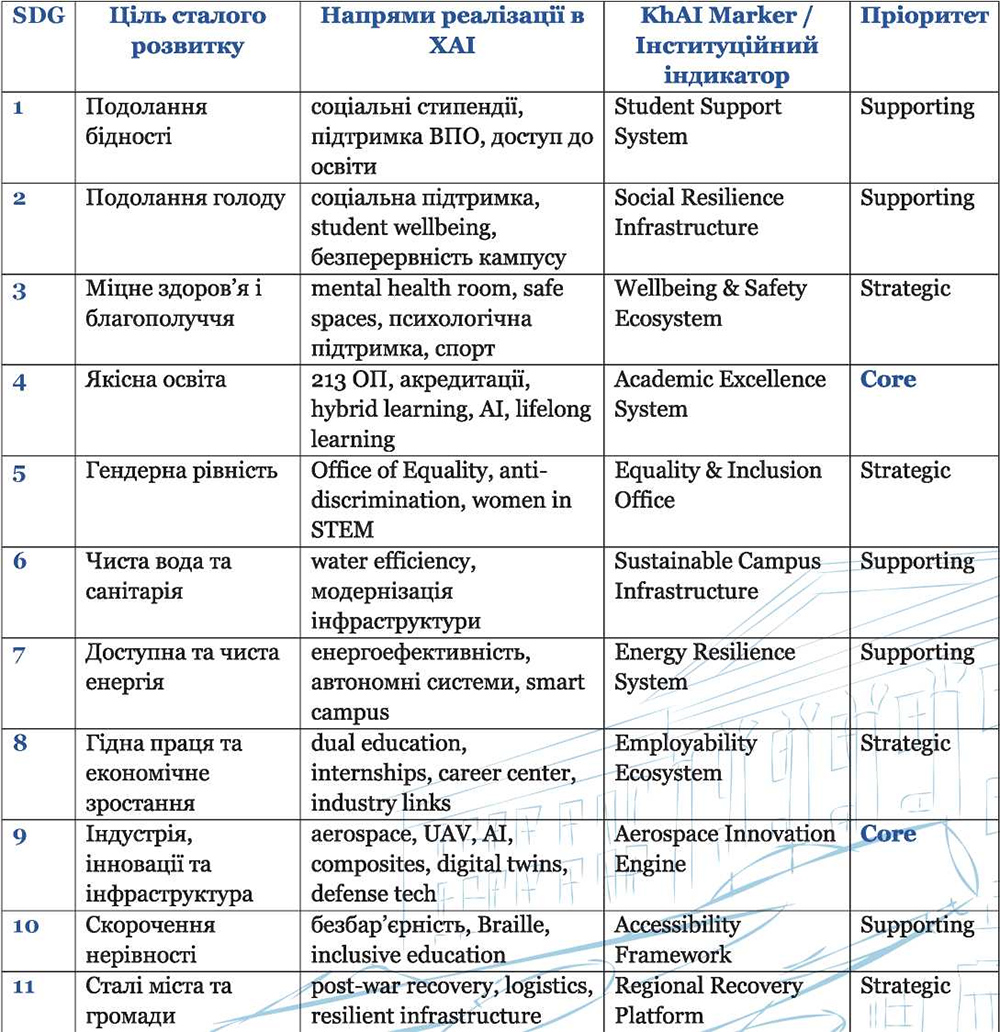
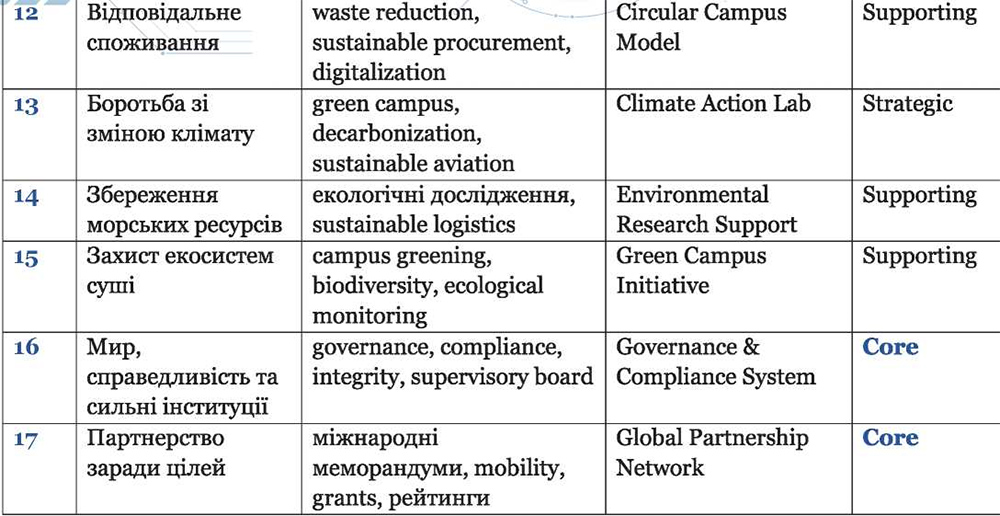
KhAI Strategic Concentration

Matrix of Key Performance Indicators (KPIs) and Their Alignment with UN SDGs
Performance evaluation of the Strategy implementation is carried out through a system of key performance indicators (KPIs) reflecting the University's contribution to achieving the UN Sustainable Development Goals and aligning with the university-wide strategic monitoring system.