Statute
of National Aerospace University
«Kharkiv Aviation Institute»
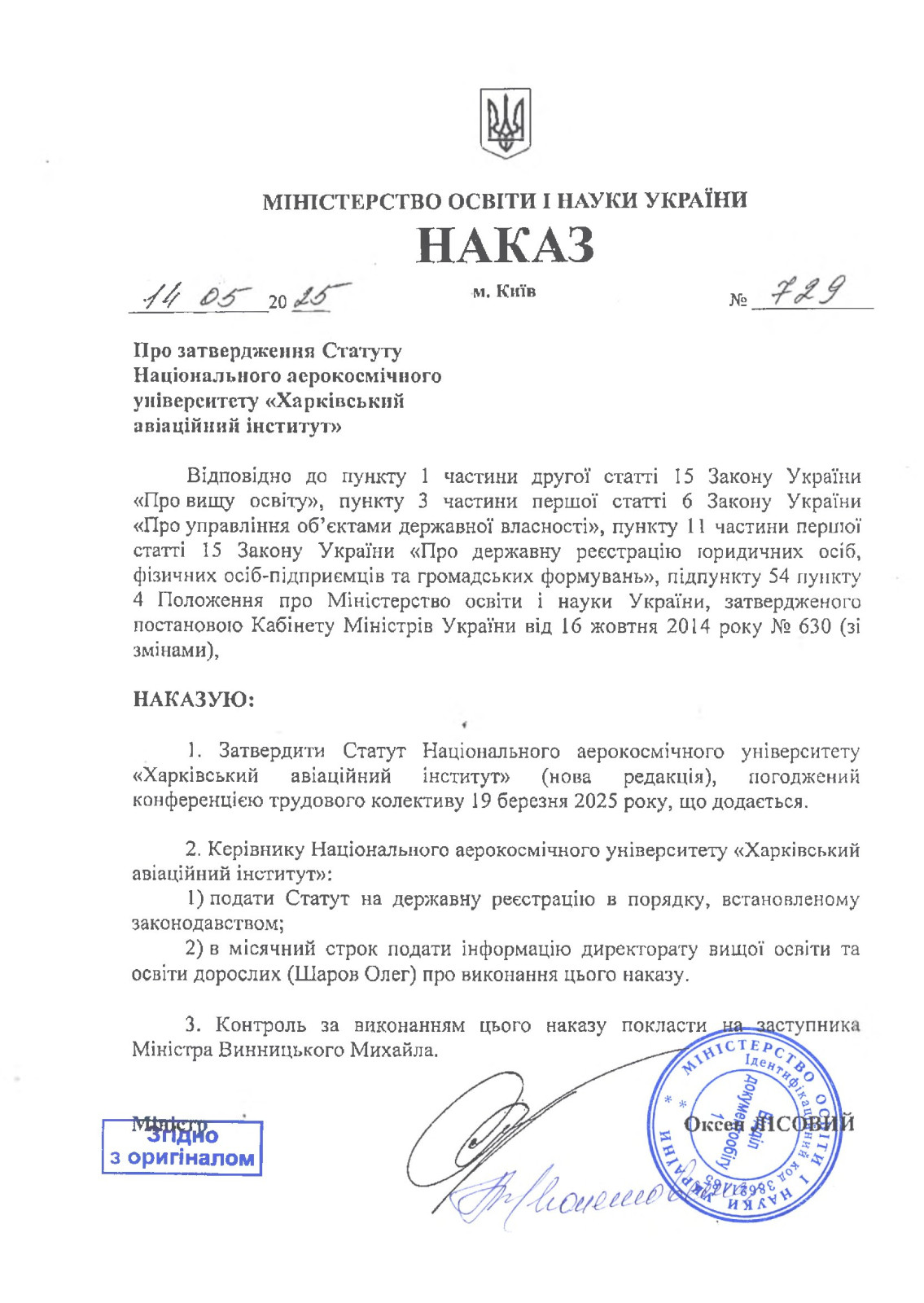
APPROVED
by Order of the Ministry of Education and Science of Ukraine
dated May 14, 2025 No. 729
Identification Code 02066769
Approved by the conference of the labor collective
of National Aerospace University
"Kharkiv Aviation Institute"
March 19, 2025. Protocol No. 2
I. General Provisions
1.1. This Statute of the higher education institution is developed in accordance with the legislation and is a document regulating the activities of the National Aerospace University «Kharkiv Aviation Institute» (hereinafter referred to as the University).
Kharkiv Aviation Institute was founded pursuant to Order No. 1240 of the Supreme Council of National Economy of the USSR dated April 17, 1930 «In furtherance of the resolution of the Presidium of the SCNE of the USSR on the creation of sectoral higher technical educational institutions».
According to Resolution No. 76 of the Council of Ministers of the Ukrainian SSR dated January 31, 1978 «On naming the Kharkiv Aviation Institute after M. Y. Zhukovsky», it was named after M. Y. Zhukovsky. Pursuant to Resolution No. 1246 of the Cabinet of Ministers of Ukraine dated August 07, 1998 «On the creation of the State Aerospace University named after M. Y. Zhukovsky «Kharkiv Aviation Institute», the State Aerospace University named after M. Y. Zhukovsky «Kharkiv Aviation Institute» was established on the basis of the Kharkiv Aviation Institute. According to Decree No. 1059 of the President of Ukraine dated September 11, 2000 «On granting national status to certain higher educational institutions», the University was granted national status.
Pursuant to Order No. 401 of the Ministry of Education and Science of Ukraine dated March 03, 2025 «On renaming the National Aerospace University named after M. Y. Zhukovsky «Kharkiv Aviation Institute», the University was renamed National Aerospace University «Kharkiv Aviation Institute».
The University is the legal successor of the Kharkiv Aviation Institute, the State Aerospace University named after M. Y. Zhukovsky «Kharkiv Aviation Institute», and the National Aerospace University named after M. Y. Zhukovsky «Kharkiv Aviation Institute».
In accordance with Order No. 811 of the Ministry of Education and Science of Ukraine dated July 17, 2021 «On the reorganization of the separate structural unit of the State University of Telecommunications», the University is the legal successor to all property, rights, and duties of the Separate Structural Unit «Kharkiv Vocational College of Information Technologies of the State University of Telecommunications».
The University is a multidisciplinary (technical) higher education institution that conducts innovative educational activities at various higher education levels (including Doctor of Philosophy), carries out fundamental and/or applied scientific research, serves as a leading scientific and methodological center, possesses a developed infrastructure of educational, scientific, and research-production units, promotes the dissemination of scientific knowledge, and conducts cultural and educational activities.
The University falls within the sphere of management of the Ministry of Education and Science of Ukraine.
1.2. Name of the University:
Full official name of the University in Ukrainian: Національний аерокосмічний університет «Харківський авіаційний інститут».
Full official name of the University in English: National Aerospace University «Kharkiv Aviation Institute».
Abbreviated name of the University: in Ukrainian – ХАІ; in English – KhAI.
1.3. Location of the University: Vadym Manko Street, Building 17, Kharkiv, Kharkiv Region, 61070, Ukraine; phone: (057) 788-40-00; fax: (057) 315-11-31; email: [email protected]; official website: khai.edu/ua/.
1.4. The main tasks of the University are:
1) conducting high-level educational activities that ensure the acquisition of higher education of the appropriate degree by individuals in their chosen specialties;
2) conducting scientific activities through scientific research and supporting the creative endeavors of educational process participants, training highly qualified scientific personnel, and utilizing the results obtained within the educational process;
3) participating in ensuring the social and economic development of the state through human capital development;
4) shaping personality through patriotic, legal, and environmental education, instilling moral values, social activity, civic stance and responsibility, healthy lifestyle habits, independent thinking skills, and self-organization in modern conditions among educational process participants;
5) ensuring an organic combination of educational, scientific, and innovative activities within the educational process;
6) creating necessary conditions for educational process participants to realize their abilities and talents;
7) preserving and multiplying society's moral, cultural, and scientific values and achievements;
8) disseminating knowledge among the population and raising the educational and cultural level of citizens;
9) establishing international ties and carrying out international activities in education, science, sports, arts, and culture;
10) studying labor market demand for specific specialties and assisting with graduate employment.
1.5. Legal Status of the University.
The University is a state institution, which is a legal entity of public law, capable of acquiring property and personal non-property rights, bearing obligations, and acting as a plaintiff and defendant in court under its own name. The University is a state-owned higher education institution.
The University is a budgetary institution operating on a non-profit basis. It is prohibited to distribute received income (profits) or portions thereof among founders, University employees (except for labor remuneration and single social contribution accruals), members of University governing bodies, and other related persons. Income (profits) of the University shall be spent exclusively for funding expenses required to maintain the University, fulfill statutory tasks, and achieve the University's goals.
The University carries out its activities in accordance with the legislation and this Statute.
The University maintains an independent balance sheet, holds special registration accounts opened with the territorial body of the central executive authority in the field of treasury service of budget funds and with banking institutions, including settlement, current, deposit, foreign currency, and other accounts, an estimate, official seal with coat of arms and other seals bearing its name, trademarks (service marks), letterheads and stamps with details, and other legal entity attributes.
1.6. Structure of the University.
The structure of the University, the status, and functions of its structural units are determined by this Statute and regulations on the respective structural units of the University. Structural units are formed by a decision of the Academic Council of the University.
The main structural units of the University are faculties, departments, and the scientific and technical library.
The separate structural units of the University are:
Interbranch Research Institute for Flight Modes Physical Simulation Problems of National Aerospace University «Kharkiv Aviation Institute», location: Vadym Manko Street, Building 17, Building 48, Kharkiv, Kharkiv Region, 61070, Ukraine;
Student Campus of National Aerospace University «Kharkiv Aviation Institute», location: Vadym Manko Street, Building 1, Kharkiv, Kharkiv Region, 61070, Ukraine;
Health and Sports Camp «Ikar» of National Aerospace University «Kharkiv Aviation Institute», location: Novoseliv Street, Building 3A, Rybache Village, Alushta, Autonomous Republic of Crimea, 98522, Ukraine;
Separate Structural Unit «Kharkiv Vocational College of Information Technologies of National Aerospace University «Kharkiv Aviation Institute» (hereinafter – Vocational College), location: Kooperatyvna Street, Building 7, Kharkiv, Kharkiv Region, 61003, Ukraine.
The Vocational College has the right, in accordance with license(s), to provide specialized secondary education of professional and academic orientation, vocational (vocational-technical) and/or initial level (short cycle) higher education in accordance with the legislation.
The Vocational College has powers, rights, obligations, goals, tasks, and operational principles provided by the Law of Ukraine «On Professional Pre-Higher Education» and other legislative acts for a professional pre-higher education institution, provided that its right to conduct educational activity in the field of professional pre-higher education is specified in the University's license and that the main type of activity of the Vocational College is educational activity in the field of professional pre-higher education.
The Vocational College is granted certain rights of a legal entity, in particular the right to maintain a separate balance sheet and estimate, accounts and network code in the territorial body of the State Treasury Service of Ukraine, current bank accounts, a seal and stamp with its own name, and to introduce its own symbols and attributes.
The Vocational College carries out its activities on the basis of regulations approved by the Academic Council of the University; the Director of the Vocational College reports to the Rector of the University and acts on the basis of an appropriate power of attorney.
Information about the Vocational College is entered into the Unified State Register of Enterprises and Organizations of Ukraine and the Unified State Electronic Database on Education. The Vocational College conducts educational activities according to its own educational (educational-professional) programs and issues educational documents bearing its own name.
Structural units of the University may include:
1) scientific, educational-scientific, research, research-production and design institutes, educational-scientific-production centers (sectors, divisions, complexes, etc.), experimental stations, design bureaus, postgraduate and doctoral study departments, educational-production plants, experimental enterprises, legal clinics, a scientific park, technology parks, and other units ensuring the practical training of specialists in certain specialties and/or conducting scientific research;
2) preparatory departments (units), units for retraining and advanced training of personnel, institutes of postgraduate education, laboratories, educational and methodological rooms, computer and information centers, educational-production and creative workshops, educational-research farms, production structures, publishing houses, sports complexes, cultural and community facilities, student sports centers;
3) a special educational and rehabilitation unit established to organize an inclusive educational process and special educational and rehabilitation support for higher education applicants with special educational needs, ensuring their access to high-quality higher education taking into account functional limitations;
4) other units whose activities are not prohibited by legislation.
1.7. The University may be the founder (co-founder) of other legal entities that conduct their activities according to the directions of educational, scientific, production, innovation, or other activities of the University and/or ensure the fulfillment of its statutory tasks.
II. Concept of Educational Activity of the University
2.1. Educational activity at the University is aimed at organizing, providing, and implementing the educational process and is conducted to ensure the acquisition of higher and postgraduate education, as well as to satisfy other educational needs of educational process participants. The educational activity of the University is based on the conceptual principles of the National Doctrine for Development of Education approved by Presidential Decree No. 347/2002 of April 17, 2002, the Laws of Ukraine «On Education», «On Higher Education», «On Scientific and Scientific-Technical Activity», Resolution of the Cabinet of Ministers of Ukraine No. 896 of November 03, 1993 «On the State National Program "Education (Ukraine 21st Century)"» (as amended), legal acts of the Cabinet of Ministers of Ukraine in the field of education, and regulatory documents of the Ministry of Education and Science of Ukraine.
In order to achieve compliance of educational activity conditions and learning outcomes with legislative requirements, higher education standards, professional and/or international standards (if available), as well as the needs of stakeholders and society, which is ensured through internal and external quality assurance procedures, the University provides for the implementation of the following procedures and measures:
1) defining principles and procedures for higher education quality assurance;
2) monitoring and periodically reviewing educational programs;
3) annual evaluation of higher education applicants, research-pedagogical, and pedagogical staff of the University, and regular publication of evaluation results on the official website of the University, information boards, and by any other means;
4) ensuring professional development/advanced training for pedagogical, scientific, and research-pedagogical staff;
5) ensuring the availability of necessary resources for organizing the educational process, including independent study of students, for each educational program;
6) ensuring the availability of information systems for effective management of the educational process;
7) ensuring public availability of information regarding educational programs, higher education degrees, and qualifications;
8) ensuring an effective system for preventing and detecting academic plagiarism in scientific works of University staff and higher education applicants at the University, including establishing and operating an effective system for preventing and detecting academic plagiarism, self-plagiarism, fabrication, falsification, cheating, deception, undue advantage, and subjective evaluation in scientific works of scientific, research-pedagogical, pedagogical, other staff, and higher education applicants, which is based on the principles of scientific rigour, mutual trust, respect, and responsibility.
The internal system of quality assurance of higher education and educational activity at the University is regulated by separate regulations approved by the Academic Council of the University.
2.2 Ensuring Academic Integrity at the University.
2.2.1. Academic integrity at the University is a set of ethical principles and rules defined by legislation that must guide participants in the educational process of the University during learning, teaching, and scientific (creative) activities in order to ensure trust in learning outcomes and/or scientific (creative) achievements.
2.2.2. Adherence to academic integrity by pedagogical, research-pedagogical, and scientific staff of the University entails:
1) referencing information sources in case of using ideas, developments, statements, or data;
2) complying with the provisions of legislation on copyright and related rights;
3) providing reliable information on research methodologies and results, sources of used information, and their own research-pedagogical (pedagogical, creative) activities;
4) monitoring adherence to academic integrity by higher education applicants at the University;
5) objective evaluation of learning outcomes.
2.2.3. Adherence to academic integrity by education applicants at the University entails:
1) independent completion of educational tasks, as well as tasks of ongoing and summative assessment of learning outcomes (for individuals with special educational needs, this requirement applies taking into account their individual needs and capabilities);
2) referencing information sources in case of using ideas, developments, statements, or data;
3) complying with the provisions of legislation on copyright and related rights;
4) providing reliable information about the results of their own educational (scientific, creative) activities, research methodologies used, and sources of information.
2.2.4. For violations of academic integrity, research-pedagogical, pedagogical, and scientific staff of the University, as well as higher education applicants, may be held academically liable. Types of academic liability (including additional and/or detailed ones) of educational process participants for specific violations of academic integrity are determined by special laws and/or internal regulations of the University, approved by the Academic Council of the University and agreed with the student self-government body of higher education applicants regarding their liability.
2.3. The Concept of Educational Activity of the University is developed and approved by the Academic Council of the University. The Concept of Educational Activity of the University is based on the student-centered orientation of education, the formation of national and universal human values, the creation of equal opportunities for youth in obtaining quality education, the development and implementation of educational innovations and information technologies, the development of continuous education and lifelong learning, the integration of Ukrainian education into European and global spaces, and the creation and development of civil society values.
The Concept of Educational Activity at the University consists in preparing specialists for the creation of world-class high-tech equipment objects who are capable of working in conditions of open information technologies, know how to creatively solve new engineering problems, and possess civic responsibility, professional dignity, and a need for self-improvement.
The Concept of Educational Activity of the University is supplemented and detailed by the concepts of educational activity of faculties, departments, and other structural units.
2.4. The main tasks in the field of educational activity of the University are:
1) ensuring the acquisition of knowledge in the relevant field at the level of higher education standards by individuals studying at the University and preparing them for professional activities;
2) ensuring the professional mobility of University graduates in the labor market;
3) nurturing a socially mature creative personality and a morally, mentally, and physically healthy generation of citizens;
4) fostering a civic stance, patriotism, sense of self-dignity, readiness for work, and responsibility for one's own fate, the fate of society, the state, and humanity among young people;
5) training specialists for scientific, teaching, and cultural-educational activities;
6) conducting scientific research and undertaking educational outreach activities as a foundation for training future specialists and for the socio-economic, scientific, technical, and cultural development of the state;
7) preparing citizens of Ukraine and foreigners for admission to educational institutions.
2.5. Educational activity of the University is carried out in the following areas:
1) training specialists under accredited educational programs;
2) training, retraining, and attestation of highly qualified scientific and research-pedagogical personnel for the University and other educational institutions;
3) retraining and advanced training of specialists employed in various spheres of social life, branches of the economy, education, science, and culture;
4) organization and implementation of research, scientific-technical, research-production, design and survey, experimental design, design-engineering, innovation, and environmental activities.
2.6. Principles and organization of the educational process at the University.
The educational process at the University is built on the principles of scientific rigour, humanism, democracy, continuity and sequence, independence from interference by any political parties, public, and religious organizations, and is regulated by the Regulations on the Organization of the Educational Process at the University.
The approach to organizing the educational process at the University is focused on student-centered learning, which involves encouraging higher education applicants to act as autonomous and responsible subjects of the educational process, creating an educational environment oriented toward satisfying the needs and interests of higher education applicants, including providing opportunities for shaping an individual educational trajectory, and building the educational process on the principles of mutual respect and partnership among educational process participants.
The organization of the educational process at the University is carried out in accordance with the requirements of the Laws of Ukraine «On Education», «On Higher Education», «On Scientific and Scientific-Technical Activity», standards of educational activity, higher education standards, the Concept of Educational Activity of the University, and Regulations on the Organization of the Educational Process at the University.
Requirements for the development and approval of regulatory documents of the University on the organization of the educational process are determined by the relevant regulations of the University.
The procedure for the attestation of higher education applicants is determined by the Law of Ukraine «On Higher Education».
2.7. Language of the educational process.
The language of the educational process at the University is the state language. The use of other languages at the University is determined by the Laws of Ukraine «On Ensuring the Functioning of the Ukrainian Language as the State Language» and «On Education».
The Academic Council of the University has the right to decide on teaching one, several, or all disciplines, conducting individual assignments, and holding assessment activities in English, provided that all education applicants studying the relevant disciplines are fluent in English. In the event of a written request from one or more higher education applicants, the University shall provide translation into the state language.
Pedagogical, research-pedagogical, and scientific staff of the University, except for foreigners or stateless persons invited to the University who work on a temporary basis as scientific, pedagogical, research-pedagogical staff, or foreign language instructors, are required to speak the state language and use it while performing their official duties.
The level of proficiency in the state language by pedagogical, research-pedagogical, and scientific staff of the University is certified by a document of full general secondary education, provided that such document confirms the study of the Ukrainian language as a subject (discipline), or by a state certificate of proficiency in the state language issued by the National Commission for State Language Standards in accordance with the Law of Ukraine «On Ensuring the Functioning of the Ukrainian Language as the State Language».
III. Powers of the Ministry of Education and Science of Ukraine
3.1. The Ministry of Education and Science of Ukraine (hereinafter – MES) exercises the rights and obligations of the body authorized by the Cabinet of Ministers of Ukraine in relation to the University, as the central executive authority in the sphere of education and science, under whose jurisdiction and management the University operates.
3.2. The MES:
1) approves the Statute of the University and, upon submission by the conference of the labor collective of the University, makes amendments to it by issuing it in a new wording;
2) concludes within a one-month period a contract with the Rector of the University elected on a competitive basis in accordance with the procedure established by the Law of Ukraine «On Higher Education» and this Statute;
3) upon submission by the conference of the labor collective of the University, terminates the contract with the Rector of the University ahead of schedule on grounds provided by labor legislation, or for violation of the Statute of the University and the terms of the contract;
4) exercises control over the financial and economic activities of the University;
5) exercises control over compliance with the Statute of the University;
6) exercises other powers provided by the legislation of Ukraine.
The MES may delegate certain powers of its own to the Rector of the University.
IV. Scope of Civil Legal Capacity of the University
4.1. Civil legal capacity of the University.
The civil legal capacity of the University arises from the moment of its creation and consists of its rights and obligations. The civil legal capacity of the University terminates on the day an entry regarding its termination is made into the Unified State Register of Legal Entities, Individual Entrepreneurs, and Public Formations.
4.2. Rights of the University:
4.2.1. In the sphere of educational, scientific, innovative, and organizational activities, the University has the right to:
1) develop and implement educational programs within the licensed specialty;
2) independently determine forms and types of study and the organization of the educational process;
3) select types of Bachelor's and Master's degree programs provided by the International Standard Classification of Education;
4) employ pedagogical, research-pedagogical, and other staff;
5) establish and approve its own staffing schedule in accordance with legislation. In the event of a reduction in the number of students enrolled in each educational program within 20 percent of the number established at the beginning of studies under this program, the staff size of research-pedagogical employees shall not be reduced;
6) make final decisions on the recognition, including establishing equivalence, of Bachelor's, Master's, Doctor of Philosophy, and Doctor of Sciences degrees and academic titles of Associate Professor and Professor obtained in foreign higher education institutions when enrolling for study and/or hiring for the position of a scientific or research-pedagogical employee;
7) introduce rating evaluation of educational, research, and innovative achievements of participants in the educational process;
8) provide additional educational and other services in accordance with legislation;
9) independently develop and implement its own programs of educational, scientific, scientific-technical, and innovative activity;
10) establish, reorganize, and liquidate its structural units;
11) independently introduce specializations, determine their content and curricula of academic disciplines;
12) award higher education degrees to students who have successfully passed the attestation procedure in accordance with legislation upon completion of studies at the corresponding level of higher education;
13) make decisions in accordance with legislation on the awarding and revocation of Doctor of Philosophy degrees, and independently form one-time specialized academic councils;
14) establish general secondary education institutions upon agreement with local self-government bodies;
15) act as a founder or co-founder of vocational (vocational-technical) and professional pre-higher education institutions, and colleges;
16) carry out publishing activity, in particular publish textbooks, study guides, and scientific works, as well as develop its own printing facilities;
17) carry out joint activities with educational institutions, scientific institutions, and other legal entities on the basis of relevant agreements in accordance with legislation;
18) place its educational, research, and educational-scientific-production units at enterprises, institutions, and organizations;
19) participate in the work of international organizations;
20) introduce its own symbols and attributes;
21) establish its own forms of moral and material incentives for participants in the educational process;
22) initiate proposals to the bodies managing the sphere of higher education regarding amendments to existing or development of new normative legal acts in the sphere of higher education, as well as participate in drafting them;
23) conduct financial, economic, and other activities in accordance with legislation and this Statute;
24) manage its own income, in particular from the provision of paid services;
25) open current and deposit accounts in banks;
26) establish innovative structures of various types on its base (scientific and technological parks, business incubators, small enterprises, etc.) based on combining the interests of high-tech companies, science, education, business, and the state in order to execute and implement innovative projects;
27) set student-to-faculty ratios per position of research-pedagogical and scientific staff;
28) independently determine budget line items and expenditure volumes of its own income;
29) train specialists at the short cycle level of higher education, first (Bachelor's), second (Master's), third (Doctoral/educational-scientific), and scientific levels under state order, and under contracts and agreements with authorities, citizens, and enterprises of Ukraine, as well as with legal entities and individuals of other countries within the licensed volume in accordance with legislation;
30) establish educational, educational-scientific, and educational-scientific-production complexes, scientific parks, and join a consortium in accordance with legislation;
31) conduct training courses, workshops, club activities, electives, seminars, and activities for training and retraining drivers of category A, A1, B, B1, C, C1, D, D1, CE, C1E vehicle categories beyond the volumes established by curricula in accordance with the procedure established by legislation;
32) conduct scientific research, experimental development, design engineering, technological, exploratory, and design exploratory work, including research and experimental developments in other natural and technical sciences in accordance with legislation;
33) found media outlets;
34) exercise other rights that do not contradict legislation.
4.2.2. In the sphere of financial and economic activities, in accordance with the procedure established by legislation and this Statute, the University has the right to:
1) own intellectual property objects created using its own funds or state or local budget funds (except as otherwise provided by law or contract);
2) establish an endowment fund of the University and manage the income from its use in accordance with the operating terms of the endowment fund, as well as receive property, funds, and material assets, including buildings, structures, equipment, and vehicles from state bodies, local self-government bodies, legal entities, and individuals, including as charitable assistance;
3) conduct financial and economic activity in Ukraine and abroad in accordance with legislation;
4) use property assigned to it under the right of commercial management, including for conducting economic activity, and lease it out or transfer it for use in accordance with legislation;
5) create its own or use under contract other material and technical facilities for conducting educational, scientific, innovative, or economic activities;
6) create and develop its own base of social and community facilities, and a network of sports and health, preventive medical, and cultural-artistic structural units;
7) carry out capital construction, reconstruction, and capital and routine repairs of fixed assets in accordance with legislation;
8) allocate funds for the social support of research-pedagogical, scientific, pedagogical, and other employees of the University;
9) open current and deposit accounts in national and foreign currencies in accordance with legislation, and use bank loans without taking into account the limitations on the right to borrow set by Article 16 and Paragraph 27 of Part 1 of Article 116 of the Budget Code of Ukraine;
10) participate in the formation of the authorized capital of innovative structures and small enterprises established with the participation of higher education institutions that develop and implement innovative products by contributing intangible assets (property rights to intellectual property objects);
11) found educational and scientific institutions;
12) found enterprises to carry out innovative and/or production activities;
13) make foreign currency transfers for collective membership fees in international educational and scientific associations, as well as for subscriptions to foreign scientific publications and access to global information networks and databases;
14) participate in the formation of the authorized capital of various types of innovative structures (scientific and technological parks, business incubators, etc.) by contributing intangible assets (property rights to intellectual property objects);
15) found legal entities or act as a co-founder of legal entities, including legal entities outside Ukraine, that carry out their activities in accordance with the directions of educational-scientific-production and innovative activity of the University and/or ensure the fulfillment of its statutory tasks in accordance with the established procedure;
16) engage in production, marketing, consulting, and agency activities;
17) produce thermal energy (except for thermal energy production activities at combined heat and power plants, thermal power plants, nuclear power plants, cogeneration plants, and plants using non-traditional or renewable energy sources), transport it through main and local (distribution) thermal networks, and supply thermal energy for the population and municipal/domestic needs of enterprises, organizations, and institutions — district heating and central hot water supply in accordance with legislation;
18) ensure, as the owner of an electrical grid system, the technical capability to receive electrical energy at the point of connection of a consumer's (sub-consumer's) electrical installations within certain volumes and permitted capacity of the consumer (sub-consumer) in accordance with the procedure established by legislation;
19) provide video and audio services, informational and translation services, services related to the procedure of legalization, apostille, and recognition of higher education degrees obtained in foreign higher education institutions and recognition of documents on general secondary and vocational (vocational-technical) education issued by educational institutions of foreign states, perform servicing of apparatus and equipment, provide hotel, municipal, and transportation services, organize public catering, excursion services, student club operations, and cultural events in accordance with the procedure established by legislation;
20) carry out development, testing, production, and operation of aviation equipment, rocket carriers, spacecraft components, ground space infrastructure, equipment included in satellite systems segments, and other high-tech engineering products;
21) provide telecommunications services, including telephone communication services (except for departmental facilities) — local networks of dual-use — with the right to create a private network with a capacity of up to one thousand subscriber numbers, and carry out telecommunications activities in accordance with legislation;
22) conduct transactions with precious metals and precious stones in the educational process and for scientific research work, as well as during the disposal/recycling of devices and equipment in accordance with legislation;
23) provide accommodations at recreation centers and camps in accordance with legislation;
24) carry out repairs and maintenance of automobiles and other vehicles, and manufacturing of joinery, metal products, structures, and equipment in accordance with the procedure established by legislation;
25) engage in other activities that do not contradict legislation.
4.2.3. If there is a statutory requirement to hold a relevant permit (license) to carry out a certain type of activity, the University has the right to engage in such activity only after obtaining the relevant permit (license).
4.3. The rights of the University as a national higher education institution are defined by the Law of Ukraine «On Higher Education».
4.4. Intellectual property rights of the University are acquired, registered, protected, and safeguarded in accordance with the legislation of Ukraine. The University has the right to dispose of economic intellectual property rights to objects of intellectual property rights, including carrying out measures for implementation, including technology transfer, of intellectual property objects to which economic rights have been acquired by the University. The University shall take measures to prevent academic plagiarism.
Economic intellectual property rights to objects of rights created by its employees or persons performing work under civil law contracts in favor of the University in the course of performing educational-methodological, research, experimental design, and other work belong to the University, unless otherwise expressly established by an agreement between the University and its employee (person performing work under civil law contracts in favor of the University).
4.5. The University is obliged to:
1) take measures to prevent and detect academic plagiarism in scientific works of scientific, research-pedagogical, pedagogical, and other employees as well as higher education applicants, and hold them disciplinarily liable;
2) have an internal higher education quality assurance system, including an approved policy for ensuring adherence to academic integrity by educational process participants (code of academic integrity);
3) create necessary conditions for persons with special educational needs to obtain higher education;
4) publish on its official website, information stands, and in any other manner information regarding the exercise of its rights and fulfillment of obligations;
5) conduct educational activity on the principles of student-centered learning;
6) provide all participants of the educational process with appropriate working and studying conditions in accordance with labor protection legislation requirements;
7) ensure compliance with the requirements of Ukrainian legislation on labor, environmental protection, and perform other duties assigned to it in accordance with Ukrainian legislation;
8) ensure access control to the University premises/territory, restriction of photo and video recording, and access of foreign citizens to classified/restricted facilities and premises in accordance with the University's access control rules.
V. Governing Bodies of the University
5.1. Management of the University is carried out on the principles of autonomy and self-government; division of rights, powers, and responsibilities of the MES, governing bodies of the University, and its structural units; combination of collegial and single-executive principles; independence from political parties, public, and religious organizations. Autonomy and self-government of the University are realized in accordance with the legislation of Ukraine.
5.2. Governing bodies of the University.
Direct management of the University's activities is carried out by its head — the Rector.
The highest collegial body of public self-government is the Conference of the Labor Collective of the University.
The Academic Council is the collegial governing body of the University.
The Supervisory Board is a body created to exercise supervision over the management of the University's property and adherence to the goals of its creation.
To resolve current operational matters of the University's activities, working bodies have been formed: the Rectorate, Dean's offices, Admissions Committee, etc.
5.3. Legal status, rights, and duties of the Rector of the University, procedure for election, appointment, and dismissal from office.
5.3.1. The rights, duties, and responsibilities of the Rector of the University are determined by the legislation of Ukraine, this Statute, and the contract. The Rector represents the University in relations with state bodies, local self-government bodies, legal entities, and individuals, and acts without a power of attorney within the scope of powers provided by the Law of Ukraine «On Higher Education» and this Statute.
5.3.2. The Rector, within the scope of powers granted to him/her:
1) organizes the activity of the University;
2) resolves matters of financial and economic activity of the University, approves its structure and staffing schedule;
3) issues orders and directives, and gives instructions binding for execution by all participants of the educational process and structural units of the University;
4) is accountable for the results of the University's activities to the MES, including the timely submission of established statistical, accounting reporting, as well as other necessary information regarding the operation and state of the University;
5) is the manager of property and funds;
6) ensures execution of the financial plan (estimate) and concludes contracts;
7) appoints employees to positions and dismisses them from positions;
8) appoints his/her deputies (Vice-Rectors), determines their official duties, and delegates (as necessary) part of his/her powers to them;
9) ensures labor protection, maintenance of law, and order;
10) determines the functional duties of employees;
11) expels higher education applicants from the University and reinstates them for studies upon agreement with student self-government bodies and the primary trade union organization of students, postgraduates, and doctoral students of the University (if the individual is a trade union member), on grounds established by the Law of Ukraine «On Higher Education»;
12) ensures the organization and control over the execution of curricula and academic discipline programs;
13) monitors compliance with staffing and financial discipline by all units;
14) exercises control over the quality of work of pedagogical, research-pedagogical, scientific, and other employees;
15) ensures the creation of conditions for effective and open public control over the activities of the University;
16) promotes and creates conditions for the activities of student self-government bodies, the primary trade union organization of University employees, the primary trade union organization of students, postgraduates, and doctoral students of the University, and public organizations operating at the University;
17) promotes the formation of a healthy lifestyle among higher education applicants, strengthening of the University's sports and health base, and creates appropriate conditions for mass sports activities;
18) jointly with the elected bodies of the primary trade union organization of University employees and the primary trade union organization of students, postgraduates, and doctoral students of the University, submits internal labor regulations and the collective agreement for approval to the Conference of the Labor Collective of the University, including elected student representatives, and signs them after approval;
19) exercises other powers provided for by this Statute.
The Rector may delegate a portion of his/her powers to Vice-Rectors and heads of structural units of the University.
5.3.3. The Rector of the University is responsible for conducting educational, scientific, scientific-technical, and innovative activities at the University, for the results of financial and economic activities, and for the state and preservation of real estate and other property of the University. The Rector of the University reports annually to the MES and the Conference of the Labor Collective of the University. The Rector of the University is required to publish an annual report on his/her activities on the official website of the University.
The annual report of the Rector of the University must contain information on the level of achievement of the University's performance targets specified in the contract as of December 31 of the year for which the report was prepared, and is subject to entry into the Unified State Electronic Database on Education and publication in the Registry of Educational Entities of the Unified State Electronic Database on Education and on the official website of the University.
5.3.4. Upon retirement from the position of Rector, a person who worked in this position for at least 10 consecutive years may be appointed as an Advisor to the Rector of the University on a pro bono basis or paid from the University's own revenues.
5.3.5. Election to the position of Rector of the University.
The Rector of the University is elected by secret ballot for a term of five years in accordance with the procedure provided for by the Law of Ukraine «On Higher Education» and this Statute. The election of the Rector of the University is conducted in compliance with the following principles: openness, transparency, secret and free expression of will, voluntary participation in elections, democracy, and ensuring equal rights of election participants.
A candidate for the position of Rector must be a citizen of Ukraine, must be fluent in the state language in accordance with the level determined by the National Commission on State Language Standards, hold an academic title and a scientific degree, and have at least 10 years of work experience in research-pedagogical positions. One and the same person cannot hold the position of Rector of the University for more than two terms.
A person cannot be elected or appointed (including as acting rector) to the position of Rector of the University if he/she:
1) has been declared legally incapacitated or whose legal capacity has been restricted by a court decision;
2) has a criminal record for committing a criminal offense, if such conviction has not been expunged or removed in accordance with the procedure established by law;
3) is deprived of the right to hold relevant positions in accordance with a court sentence;
4) has been found guilty of committing a corruption offense by a court decision — within one year from the date such court decision entered into force;
5) has been subjected to an administrative penalty for a corruption offense — within one year from the date such court decision entered into force;
6) falls under the scope of Part Three of Article 1 of the Law of Ukraine «On Government Cleansing» (Lustration).
The MES announces a competition for the position of Rector no later than two months before the expiration of the contract term of the person occupying this position. In the event of early termination of the Rector's powers, the competition is announced within a week from the date the vacancy arises. Within two months from the date of the announcement of the competition for the position of Rector, the MES accepts proposals regarding applicants for the position of Rector and, within 10 days from the deadline for submitting relevant proposals, submits the candidacies of applicants who meet the requirements of the Law of Ukraine «On Higher Education» to the University for voting.
The following persons have the right to participate in the election of the Rector of the University:
1) every full-time scientific, research-pedagogical, and pedagogical employee of the University;
2) representatives from among other full-time employees, elected by the respective employees through direct secret elections;
3) elected student representatives, elected by students through direct secret elections.
At the same time, the total number (full composition) of scientific, research-pedagogical, and pedagogical employees of the University must constitute at least 75 percent of the total number of persons eligible to participate in the election; the number of elected representatives from among other employees of the University — up to 10 percent; and the number of elected student representatives — at least 15 percent of persons eligible to participate in the election.
The election is considered valid if more than 50 percent of the total number of persons eligible to participate in the election took part, each of whom has one vote and votes in person.
If two or more persons (candidates) participated in the election and none of them received more than 50 percent of the votes of the persons eligible to participate in the election, a second round of elections is held on the seventh calendar day after the first round.
The voting ballots in the second round of elections include two persons (candidates) who received the highest number of votes in the first round.
A person (candidate) who received more than 50 percent of the votes of persons eligible to participate in the election, or in the case of a second round — more than 50 percent of the votes of persons who took part in the voting, is considered elected as the Rector of the University.
With the person (candidate) elected as Rector of the University, the MES concludes a contract for a term of five years no later than one month from the date of his/her election, specifying in the contract the performance targets of the University that the person (candidate) must ensure in the position of Rector in the event of signing the contract, mechanisms for verifying the achievement of such targets, and deadlines for reaching such targets.
In the event that the person (candidate) elected as Rector of the University fails a background check (special verification), the MES announces a new competition for the position of Rector of the University within seven calendar days after the completion of the background check.
Specific features of the electoral system for the Rector of the University are regulated by the Law of Ukraine «On Higher Education», taking into account the Methodological Recommendations on the Features of the Electoral System and the Procedure for Electing the Head of a Higher Education Institution, approved by Cabinet of Ministers of Ukraine Resolution No. 726 of December 5, 2014 (as amended), as well as this Statute.
5.3.6. The Rector may be dismissed from office by the MES, as well as in connection with a decision on his/her recall adopted by the Conference of the Labor Collective of the University on grounds determined by labor legislation, for violation of the University Statute and the terms of the contract. A motion to recall the Rector may be submitted to the Conference of the Labor Collective of the University by at least half of the members of the Supervisory Board or the Academic Council of the University. The decision to recall the Rector is adopted by a majority vote, provided that at least two-thirds of the members of the Conference of the Labor Collective of the University are present.
5.4. The Academic Council is a collegial governing body of the University, formed for a term of five years, the composition of which is approved by an order of the Rector within five working days from the expiration of the term of office of the previous Academic Council.
5.4.1. The competence of the Academic Council of the University includes the following matters:
1) determining the strategy and prospective development directions of the educational, scientific, and innovative activities of the University;
2) drafting and submitting to the Conference of the Labor Collective of the University a draft of the Statute, as well as decisions on making amendments and additions to it;
3) approving the financial plan and annual financial report of the University;
4) defining the system and approving internal higher education quality assurance procedures;
5) adopting decisions on placing the University's own revenues in territorial bodies of the central executive body in the field of treasury service of budget funds, or in banking institutions;
6) adopting decisions, upon the submission of the Rector, on the establishment, reorganization, and liquidation of structural units of the University;
7) approving educational programs and curricula for each level of higher education and specialty;
8) adopting decisions on matters of organizing the educational process and determining the duration of study at the respective levels;
9) approving templates and the procedure for producing higher education documents, including joint and double diplomas;
10) adopting the main directions of scientific research and innovation activities;
11) evaluating the research and pedagogical activities of structural units, considering proposals, and approving decisions on matters of organizing educational and scientific processes at the University;
12) conferring the academic titles of Professor, Associate Professor, and Senior Researcher, and submitting relevant decisions to the Certification Board of the MES for approval;
13) making final decisions on the recognition of foreign higher education documents, academic degrees, and academic titles when hiring pedagogical, scientific, research-pedagogical, and other employees, as well as when enrolling applicants for studies;
14) making final decisions on the recognition of higher education documents issued by higher theological education institutions whose statutes (regulations) are registered in accordance with the procedure established by legislation, when enrolling applicants for studies;
15) approving the Admission Rules to the University, regulations on working and advisory bodies of the University, on the organizing committee and election commission for conducting elections of the Rector of the University, and other internal regulatory documents governing the activities of the University;
16) submitting a motion to recall the Rector of the University on grounds provided for by legislation, this Statute, and the contract, which is considered by the Conference of the Labor Collective of the University;
17) considering other matters of the University's activity in accordance with this Statute.
5.4.2. The Academic Council of the University is headed by its Head, who is elected by secret ballot from among the members of the Academic Council of the University holding a scientific degree and/or an academic (honorary) title, for the term of office of the Academic Council.
5.4.3. The Academic Council of the University includes, ex officio, the Rector, Vice-Rectors, Deans of Faculties (Directors of Institutes), the Scientific Secretary, the Director of the Scientific and Technical Library, the Chief Accountant, leaders of student self-government bodies, and elected bodies of the primary trade union organization of University employees, the primary trade union organization of students, postgraduates, and doctoral students of the University, as well as elected representatives of research and pedagogical employees, elected from among department heads, professors, Doctors of Philosophy, and Doctors of Sciences, elected representatives of other full-time employees of the University, as well as elected representatives of postgraduates, doctoral students of the University, and representatives of student self-government bodies of the University.
By decision of the Academic Council of the University, representatives of employers' organizations may be included in its membership.
At the same time, research and pedagogical employees of the University must constitute at least 75 percent of the Academic Council's composition, and elected student representatives must constitute at least 10 percent.
Elected representatives from among University employees are elected by the Conference of the Labor Collective of the University upon submission by the structural units in which they work, while elected student representatives are elected by students through direct secret elections. Elected representatives from among postgraduates and doctoral students of the University are elected by the scientific society of students, postgraduates, doctoral students, and young scientists of the University.
5.4.4. The powers of persons:
1) who were members of the Academic Council by virtue of their employment at the University (ex officio) or as a representative of scientific, research-pedagogical, or other University employees, and who terminated employment with the University in that position or are on a long-term (more than 4 months) business trip;
2) who were members of the Academic Council of the University by virtue of being elected as a student representative and have terminated their studies;
3) who were members of the Academic Council of the University by virtue of being elected as a representative of a self-government body, an elected body of primary trade union organizations, an employers' organization, etc., and have ceased working in the specified body (organization), upon submission by that body (organization);
4) who were members of the Academic Council of the University but ceased personal participation in its work (absence from Academic Council meetings for 4 months without good reason);
may be terminated early by the Rector of the University upon submission by the Head of the Academic Council. New members may be added to fill the vacant positions in the Academic Council of the University in accordance with the established procedure by order of the Rector of the University until the Conference of the Labor Collective of the University is held.
5.4.5. The Head of the Academic Council convenes the Academic Council of the University, as a rule, monthly. The Academic Council of the University is competent to consider matters and make decisions if at least 2/3 of its members attend the meeting. A decision of the Academic Council of the University is considered adopted if more than half of its total membership voted for it. Decisions of the Academic Council of the University are brought into effect by orders of the Rector. The Academic Council of the University approves the regulations on the Academic Council and the rules of procedure of the Academic Council of the University.
5.4.6. Specialized academic councils may be established at the University for the defense of dissertations in relevant specialties.
5.5. Supervisory Board of the University.
The Supervisory Board of the University is created by decision of the MES to exercise supervision over the management of the University's property and adherence to the goals of its creation. The personal composition of the Supervisory Board of the University is approved by the MES.
5.5.1. The main tasks of the Supervisory Board of the University are:
1) reviewing and analyzing priority development directions of the University in the fields of educational, scientific, scientific-technical, and innovation activities;
2) assisting in the resolution of prospective goals for the development of the University;
3) providing assistance to the leadership of the University in implementing state policy in the fields of higher education and science;
4) attracting financial resources to support the University's activities in key development directions and exercising control over their utilization;
5) promoting effective interaction between the University and state bodies, local self-government bodies, the scientific community, socio-political organizations, and business entities in the interests of developing and enhancing the quality of educational activity and competitiveness of the University;
6) promoting and assisting the University in improving the material and technical base of the educational process, scientific and scientific-technical activities, and the social infrastructure of the University;
7) exercising public oversight over the activities of the University;
8) promoting the integration of the University into the international educational system, seeking ways to expand and enhance the international cooperation of the University;
9) promoting the creation of the University's image as a leader in the fields of higher education, science, and culture at the regional and national levels.
5.5.2. The term of office of the Supervisory Board of the University is five years. Employees and higher education applicants of the University may not be members of the Supervisory Board of the University.
5.5.3. The Supervisory Board of the University, in accordance with the tasks assigned to it:
1) prepares and submits proposals to the Academic Council and the Rector of the University on defining priority development directions for the educational, scientific, scientific-technical, and innovation activities of the University;
2) participates in the development of draft programs aimed at developing the material and technical base of the University and its social infrastructure;
3) submits proposals for optimizing the organizational structure of the University in the directions of its statutory activity;
4) monitors the status and quality of educational, scientific, scientific-technical, and international activities of the University, and promotes the implementation of innovative technologies at the University;
5) analyzes opportunities and promotes the attraction of investments and the influx of additional funds, material assets, and intangible assets for the educational, scientific, educational/upbringing, health-improving, sports, and educational-cultural activities of the University;
6) monitors the effectiveness and conducts expert evaluations of the economic, financial, and commercial activities of the University, and provides recommendations to the leadership of the University on improving mechanisms for expenditure planning and the use of property, land plots, and funds in accordance with the University development plan;
5.5.4. The Supervisory Board of the University has the rights defined by the Law of Ukraine "On Higher Education" and this Statute.
5.5.5. Members of the Supervisory Board of the University have the right to:
1) participate in the work of the Conference of the Labor Collective of the University with an advisory vote;
2) participate in defining the development strategy of the University and control its implementation;
3) promote the attraction of additional sources of funding;
4) analyze and evaluate the activities of the University and its Rector;
5) monitor the execution of the University's estimate and submit relevant recommendations and proposals, which are mandatory for consideration by the Rector of the University;
6) submit representations to the MES regarding the commendation or recall of the Rector of the University on grounds defined by the Law of Ukraine "On Higher Education";
7) exercise other rights defined by the legislation of Ukraine and this Statute, including being present at meetings of the Academic Council of the University, academic councils of faculties, the Rectorate, and other working and advisory bodies, and initiating the consideration of issues at regular and extraordinary meetings of the Supervisory Board of the University by placing them on the agenda.
5.5.6. The organizational form of work of the Supervisory Board of the University is meetings, which are convened, as a rule, at least once a year. The date and place of the meeting are determined by the Head of the Supervisory Board of the University. In the absence of the Head of the Supervisory Board of the University for good reason, the meeting of the board is conducted by their deputy.
5.5.7. The Head of the Supervisory Board of the University:
1) organizes the work of the Supervisory Board of the University;
2) convenes its meetings;
3) presides over meetings of the Supervisory Board of the University;
4) coordinates the activities of members of the Supervisory Board of the University regarding the performance of tasks assigned to them;
5) determines the persons responsible for preparing issues included in the agenda, and persons who are not members of the Supervisory Board of the University but must be present at its meeting;
6) signs decisions, including excerpts from minute decisions of the Supervisory Board of the University, letters, appeals, requests, and replies on issues discussed and decided by the Supervisory Board of the University;
7) represents the Supervisory Board of the University in state authorities, enterprises, institutions, organizations, and media;
8) exercises other powers in order to enable the Supervisory Board of the University to fulfill its duties.
5.5.8. The Supervisory Board of the University, within its powers, adopts decisions, organizes, and controls their execution. A meeting of the Supervisory Board of the University is quorate if at least two-thirds of its members are present. A decision of the Supervisory Board of the University is considered adopted if more than half of its composition voted for it. The consideration of issues by the Supervisory Board of the University and the adopted resolutions are recorded in the minutes of the meetings, which are signed by the Head and the Secretary of the Supervisory Board of the University. Decisions adopted by the Supervisory Board of the University are brought to the attention of the Rector within 5 days and are mandatory for consideration and implementation of appropriate measures, and are also brought to the attention of the next meeting of the Academic Council of the University for consideration and implementation of appropriate measures.
5.5.9. Organizational, material, and technical support for the activities of the Supervisory Board is provided by the University in the person of the Rector, who provides it with a meeting room, computer equipment, and office equipment.
5.6. Working and Advisory Bodies of the University.
In order to promptly resolve operational issues regarding the University's activities, working bodies and administrative units are created within its structure: the Rectorate, Dean's Offices, Admissions Committee, Administrative Council, etc.
In order to formulate the strategy and directions for conducting educational and/or scientific activities of the University, the Rector of the University has the right to establish advisory (advisory-consultative) bodies on a voluntary basis (Council of Employers, Council of Investors, Business Council, Student Council, Scientific Council, etc.).
Regulations on working and advisory bodies are approved by the Academic Council of the University.
VI. Governing Bodies of Structural Units of the University
6.1. Rights and duties, procedure for election, appointment, and dismissal of the Head of a Faculty (Research Institute) or Department of the University.
6.1.1. Management of a faculty is carried out by a Dean, who cannot hold this position for more than 10 years. The Dean of a faculty must hold an academic degree and/or an academic (honorary) title, as a rule, corresponding to the profile of the faculty.
The functional duties of the Dean of a Faculty are determined by the Rector of the University in accordance with this Statute and the regulations on the Faculty, which are approved by the Academic Council of the University. The Dean of a Faculty may delegate part of their powers to their deputies. Deputy Deans of a Faculty are appointed by order of the Rector of the University upon submission by the Dean. The Dean of a Faculty issues orders regarding the activities of the respective Faculty, which are mandatory for execution by all participants in the educational process of the Faculty and may be revoked by the Rector of the University if they contradict legislation, this Statute, or cause harm to the interests of the University.
The Rector of the University, with the consent of the majority of the full composition of the Assembly of the Labor Collective of the Faculty, appoints the Dean of the Faculty for a term of up to five years and concludes a contract with them. The Dean of a Faculty may be dismissed from office by the Rector of the University upon submission by the Academic Council of the University or the Assembly of the Labor Collective of the Faculty on grounds provided for by labor legislation, this Statute, and the terms of the contract. A proposal for the dismissal of the Dean of a Faculty is submitted to the Assembly of the Labor Collective of the Faculty by at least half of the votes of the composition of the Academic Council of the Faculty. A proposal for the dismissal of the Dean of a Faculty is adopted by at least two-thirds of the votes of the composition of the Assembly of the Labor Collective of the Faculty.
The appointment and dismissal of the Head of a geographically separate structural unit of the University, which are structural units of the University, are carried out in the manner established by this Statute for the Dean of a Faculty.
The same person cannot hold the position of Dean of a Faculty, Head of a College, or Head of a geographically separate structural unit of the University for more than 10 years.
Management of a Professional College, which is a separate structural unit of the University carrying out educational activity, is exercised by a Director who is appointed to office under contract based on the results of a competitive selection conducted in accordance with Article 42 of the Law of Ukraine "On Professional Pre-Higher Education". The same person cannot hold the position of Director (Head) of a Professional College for more than two terms.
6.1.2. Head of a Department.
Management of a Department is exercised by the Head of the Department, who cannot hold this position for more than two terms. The Head of a Department must hold an academic degree and/or an academic (honorary) title corresponding to the profile of the Department. The Head of a Department is elected by competition by secret ballot of the Academic Council of the University for a five-year term, taking into account proposals from the Academic Council of the Faculty and the Labor Collective of the Faculty and Department. The Rector of the University concludes a contract with the Head of the Department. The Head of a Department ensures the organization of the educational process, implementation of curricula and educational discipline programs, and monitors the quality of teaching educational disciplines, as well as the educational-methodological and scientific activities of instructors.
6.2. Academic Councils of Faculties (Institutes), Scientific and Technical Councils.
6.2.1. Academic Councils of structural units may be formed at the University, the powers of which are determined by the Academic Council of the University in accordance with this Statute. The Academic Council of the University may delegate part of its powers to the Academic Councils of structural units. The composition of the respective Academic Councils is formed on the principles defined by parts three and four of Article 36 of the Law of Ukraine "On Higher Education".
6.2.2. Scientific and technical councils are established in the research units of the University as collegial governing bodies of these structural units for a term of five years. The Scientific and Technical Council of the Research Unit of the University (Research Institute) is headed by a Chairperson—the Vice-Rector for Research (Head of the Research Institute). The procedure for forming the composition of the Scientific and Technical Council of the Research Unit (Research Institute) and its directions of activity are determined by the regulations on the Scientific and Technical Council, which are developed in accordance with legislation and this Statute, and approved by the Rector upon submission by the Academic Council of the University.
VII. Self-Government Bodies of the University (Faculty)
7.1. The following bodies of public and student self-government operate at the University:
1) Conference of the Labor Collective of the University;
2) student self-government bodies;
3) scientific society of students, postgraduates, doctoral students, and young scientists.
7.2. Conference of the Labor Collective of the University.
The highest collegial body of public self-government of the University is the Conference of the Labor Collective of the University, including elected student representatives.
The procedure for convening and making decisions by the Conference of the Labor Collective of the University is determined by this Statute. A regular Conference of the Labor Collective of the University is convened by the Rector. An extraordinary Conference of the Labor Collective of the University is convened at the request of at least 20 percent of the labor collective composition, on the initiative of the Rector, or of the Academic Council or Supervisory Board of the University.
The Conference of the Labor Collective of the University:
1) approves, upon submission by the Academic Council, the Statute of the University or amendments (additions) thereto;
2) annually hears the Rector's report on the results of educational and scientific work, financial and economic activities, and tasks of the University for the next academic year, and evaluates their activity;
3) elects a labor disputes commission in accordance with labor legislation;
4) elects elected representatives to the Academic Council of the University upon submission by the structural units where they work;
5) considers, upon a reasoned submission from the Supervisory or Academic Council of the University, the issue of early termination of the powers of the Rector of the University on grounds provided for by legislation and contract;
6) approves internal labor regulations of the University;
7) considers and approves the collective agreement, adopts a decision on granting the Chairman of the Trade Union Committee of the primary trade union organization the authority to sign it on behalf of the labor collective, and hears a report on the implementation of the collective agreement;
8) adopts decisions on other matters of the University's activity in accordance with legislation and this Statute.
The Conference of the Labor Collective of the University is convened at least once a year. The total number of delegates to the Conference of the Labor Collective of the University is 180 people. All categories of participants in the educational process of the University must be represented at the Conference of the Labor Collective of the University. At the same time, research and pedagogical, scientific, and pedagogical staff of the University who work at the University on a permanent basis must constitute at least 75 percent of the delegates (members) of the Conference of the Labor Collective of the University, and elected student representatives elected by students through direct secret ballot must constitute at least 15 percent.
The number of delegates to the Conference of the Labor Collective of the University and the representation quotas for delegates from each structural unit of the University are established by the Academic Council of the University. Delegates to the Conference of the Labor Collective of the University representing University employees are elected for a term of five years. Delegates to the Conference of the Labor Collective of the University representing University students are elected for a term of one year.
The Conference of the Labor Collective of the University is quorate if at least two-thirds of the total number of elected delegates are present. Decisions of the Conference of the Labor Collective of the University are adopted by a simple majority of votes of the delegates present.
Matters regarding the preparation and holding of the Conference of the Labor Collective of the University are determined by regulations approved by the Academic Council of the University.
7.3. Assembly of the Labor Collective of a Faculty (Research Institute).
The body of public self-government of a Faculty (Research Institute) is the Assembly of the Labor Collective of the Faculty (Research Institute), including elected representatives from among persons studying at the University. The procedure for convening the Assembly of a Faculty (Research Institute) and its activities are determined by this Statute.
The Assembly of the Labor Collective of a Faculty (Research Institute) is quorate to consider matters and adopt decisions if more than half of the total number of members of this elected body participate in the meeting.
A decision of the Assembly of the Labor Collective of a Faculty (Research Institute) is considered adopted if more than half of the participants present at the meeting voted for it.
The Assembly of the Labor Collective of a Faculty (Research Institute) is convened at least once a year.
All categories of employees of the Faculty (Research Institute) and elected representatives from among the persons studying at the Faculty (Research Institute) must be represented at the Assembly of the Labor Collective of the Faculty (Research Institute). At the same time, research and pedagogical and scientific staff of the Faculty (Research Institute) must constitute at least 75 percent of the composition of delegates to the Assembly of the Labor Collective of the Faculty (Research Institute), and elected student representatives elected through direct secret ballot must constitute at least 15 percent.
The Assembly of the Labor Collective of a Faculty (Research Institute):
1) evaluates the activity of the Head of the Faculty (Research Institute);
2) approves the annual report on the activities of the Faculty (Research Institute);
3) submits proposals to the Rector of the University regarding the recall of the Head of the Faculty (Research Institute) from office on grounds provided for by legislation, this Statute, and the contract concluded with them;
4) elects elected representatives to the Academic Council of the Faculty (Research Institute);
5) elects delegates to the Conference of the Labor Collective of the University;
6) elects candidates to the composition of the Academic Council of the University.
Matters regarding the preparation and holding of the Assembly of the Labor Collective of a Faculty (Research Institute) are determined by regulations approved by the Academic Council of the University.
7.4. Student Self-Government Bodies.
Student self-government operates at the University and its structural units, forming an integral part of the public self-government of the University. Student self-government is the right of University students to resolve issues concerning study and living conditions, the protection of student rights and interests, as well as the opportunity to participate in the governance of the University.
Student self-government unites all students of the University. All students studying at the University have equal rights and may elect and be elected to working, advisory, elective, and other student self-government bodies.
Student self-government ensures the protection of the rights and interests of students and their participation in the governance of the University. Student self-government is exercised by students directly and through student self-government bodies elected by direct secret ballot of the students. In their activity, student self-government bodies are guided by legislation, this Statute, and the regulations on student self-government of the University.
Student self-government bodies operate on the principles of voluntariness, collegiality, and openness; electability and accountability of student self-government bodies; equal rights of students to participate in student self-government; and independence from the influence of political parties and religious organizations.
Student self-government is exercised at the level of the student (academic) group, study year, specialty, faculty (research institute), dormitory, campus, and University.
Representative, executive, and control-audit student self-government bodies of the University are elected for a term of one year. Students elected to student self-government bodies may be removed from their positions based on the results of a general secret ballot of the students. The head of student self-government and their deputies may hold office for no more than two terms.
Upon termination of a person's studies at the University, their participation in a student self-government body is terminated in accordance with the procedure provided for by the regulations on student self-government of the University.
Student self-government bodies of the University possess all rights specified in the Law of Ukraine "On Higher Education" and the regulations on student self-government of the University.
The following decisions are adopted in agreement with the student self-government body of the University:
1) expulsion of students from the University and their reinstatement for studies;
2) transfer of persons studying at the University under state procurement to contract-based studies funded by natural (legal) persons;
3) transfer of persons studying at the University at the expense of natural (legal) persons to studies under state procurement;
4) appointment of a Deputy Dean of a Faculty, Deputy Head of a Research Institute, or Deputy Rector (Vice-Rector);
5) accommodation of persons studying at the University in a dormitory and their eviction from the dormitory;
6) approval of internal labor regulations of the University in the part concerning enrolled learners;
7) activities of the campus and dormitories intended for the accommodation of persons studying at the University.
Decisions of student self-government bodies of the University are advisory in nature, except for the authority to agree on specific managerial decisions of the University as specified above in this Statute.
The highest body of student self-government of the University is the General Assembly of Students, which:
1) adopts regulations on student self-government of the University, defines the structure, powers, and procedure for holding direct secret elections of representative and executive student self-government bodies in academic structural units of the university, dormitories, etc., elects the Student Council of the University and its head, and hears its reports;
2) hears reports of representative, executive, and control-audit bodies of student self-government and evaluates them accordingly;
3) approves the procedure for using property and funds of student self-government bodies, and for supporting student initiatives on a competitive basis;
4) approves the annual expenditure estimate (budget) of student self-government bodies, introduces amendments and additions to it, and hears reports on its execution;
5) elects a control and audit committee from among the students to exercise ongoing control over the status of property utilization and budget execution of student self-government bodies.
The administration of the University has no right to interfere in the activities of student self-government bodies. The Rector of the University ensures appropriate conditions for the activities of student self-government bodies (provides premises, furniture, office equipment, provides telephone communications, permanent Internet access, equipment, allocates areas for installing information stands, etc.), about which a corresponding agreement is concluded. The financial basis of student self-government is funds determined by the Academic Council of the University in an amount of no less than 0.5 percent of the University's own receipts derived from its primary activity, as well as student membership fees, the amount of which is established by the General Assembly of University Students. The amount of the monthly membership fee per person cannot exceed one percent of the subsistence minimum established by law.
Funds of student self-government bodies are directed toward fulfilling their tasks and exercising their powers in accordance with the budgets approved by them.
Student self-government bodies publicly report on the use of funds and budget execution at least once a year.
7.5. Scientific Societies of Students, Postgraduates, Doctoral Students, and Young Scientists of the University.
Scientific societies of students, postgraduates, doctoral students, and young scientists operate at the University and its structural units, forming part of the public self-government system of the University.
Persons under 35 years of age (40 years for doctoral students) who study or work at the University participate in the work of the scientific society of students, postgraduates, doctoral students, and young scientists of the University.
The scientific society of students, postgraduates, doctoral students, and young scientists ensures the protection of the rights and interests of persons studying or working at the University, particularly regarding issues of scientific activity, support for knowledge-intensive ideas, innovations, and knowledge exchange. In their activity, scientific societies of students, postgraduates, doctoral students, and young scientists are guided by legislation, this Statute, and the regulations on scientific societies of students, postgraduates, doctoral students, and young scientists. Scientific societies of students, postgraduates, doctoral students, and young scientists operate on the principles of freedom of scientific creativity; voluntariness, collegiality, and openness; and equal rights of enrolled learners to participate in the activities of scientific societies of students, postgraduates, doctoral students, and young scientists. Scientific societies of students, postgraduates, doctoral students, and young scientists possess the rights defined in the Law of Ukraine "On Higher Education" and the regulations on scientific societies of students, postgraduates, doctoral students, and young scientists of the University.
In agreement with the scientific society of students, postgraduates, doctoral students, and young scientists, the leadership of the University adopts decisions on the expulsion of persons pursuing a Doctor of Philosophy degree from the University and their reinstatement for studies.
Governing bodies of scientific societies of students, postgraduates, doctoral students, and young scientists are formed on democratic principles through elections. The structure of the scientific society of students, postgraduates, doctoral students, and young scientists and the organizational mechanism of its activity are determined by regulations approved by the Conference of the Labor Collective of the University.
The administration of the University has no right to interfere in the activities of scientific societies of students, postgraduates, doctoral students, and young scientists, except in cases where such activity contradicts legislation, this Statute, or causes harm to the interests of the University. The Rector of the University comprehensively promotes the creation of appropriate conditions for the activities of the scientific society of students, postgraduates, doctoral students, and young scientists (provides premises, furniture, office equipment, provides telephone communications, permanent Internet access, allocates areas for installing information stands, etc.).
VIII. Rights and Duties of Participants in the Educational Process at the University
8.1. Rights and Duties of Scientific, Research-Pedagogical, and Pedagogical Staff of the University.
8.1.1. Research-pedagogical, scientific, and pedagogical staff of the University have the right:
1) to academic freedom, realized in the interests of the individual, society, and humanity as a whole;
2) to academic mobility for carrying out professional activity;
3) to protection of professional honor and dignity;
4) to participate in the governance of the University, including electing and being elected to the Conference of the Labor Collective, the Academic Council of the University, or the Academic Council of a Faculty (Research Institute);
5) to select teaching methods and tools that ensure high quality of the educational process;
6) to the provision of appropriate working conditions, professional development, and the organization of rest and living conditions established by legislation, normative acts of the University, terms of individual employment contracts, and collective agreements;
7) to free use of library and information resources, and services of educational, scientific, sports, and cultural-educational units of the University in the established manner;
8) to protection of intellectual property rights;
9) to professional development and internships at least once every five years;
10) to obtain housing, including official housing, in accordance with the procedure established by legislation;
11) to receive preferential long-term loans for the construction (reconstruction) and purchase of housing in accordance with the procedure established by legislation;
12) to participate in public associations;
13) to social and pension provision in accordance with the procedure established by legislation, including pension provision pursuant to the Law of Ukraine "On Scientific and Scientific-Technical Activity";
14) to have other rights provided for by legislation and this Statute.
The involvement of research-pedagogical, scientific, and pedagogical staff in work not provided for by their employment contract may be carried out only with their consent or in cases provided for by legislation.
Positions of research-pedagogical staff may be held by persons holding an academic degree or academic title, as well as persons holding a Master's degree.
Additional requirements for persons eligible to hold research-pedagogical staff positions are established in accordance with legislation by job descriptions of research-pedagogical staff approved by the Rector of the University (Vice-Rector responsible for the relevant area).
When filling vacant positions of research-pedagogical staff—heads (chiefs) of departments, professors, associate professors, senior lecturers, lecturers, and assistants—the conclusion of an employment contract (contract) is preceded by competitive selection.
8.1.2. Research-pedagogical, scientific, and pedagogical staff of the University are guaranteed:
1) creation of appropriate conditions for work, professional development, living arrangements, rest, and medical care, including for instructors with disabilities;
2) payment of compensation in the event of job loss in accordance with legislation;
3) additional pay for an academic degree of Doctor of Philosophy or Doctor of Sciences in amounts set according to Ukrainian legislation. The University may establish a larger amount of additional pay from its own receipts.
8.1.3. Research-pedagogical, scientific, and pedagogical staff of the University are obliged:
1) ensure the teaching of educational disciplines under the relevant educational program for the specialty at a high scientific-theoretical and methodological level, and engage in scientific activity (for research-pedagogical staff);
2) enhance their professional level, pedagogical mastery, and scientific qualifications (for research-pedagogical staff), and undergo attestation in accordance with the established procedure (for scientific and pedagogical staff);
3) adhere to the norms of pedagogical ethics and morality, respect the dignity of persons studying at the University, instill in them a love for Ukraine, and foster in them a spirit of Ukrainian patriotism and respect for the Constitution of Ukraine and state symbols of Ukraine;
4) uphold academic integrity in the educational process and scientific (creative) activity, and ensure its observance by higher education learners;
5) foster independence, initiative, and creative abilities in persons studying at the University;
6) comply with this Statute, the internal labor regulations of the University, job description requirements, laws, and other normative legal acts of Ukraine.
8.2. Rights and Duties of Persons Studying at the University.
Persons studying at the University include higher education learners and attendees (persons studying at the preparatory department of the University or receiving additional or separate educational services, including under postgraduate education programs).
Admission for studies at the University is carried out on a competitive basis in accordance with the Law of Ukraine "On Higher Education".
8.2.1. Persons studying at the University have the right to:
1) choice of study mode upon admission to the University;
2) safe and harmless conditions of study, work, and living;
3) employment activities during extracurricular hours;
4) additional paid leave in connection with studies at their primary place of work, reduced working hours, and other benefits provided for by legislation for persons combining work with studies;
5) free use of libraries, information holdings, educational, and scientific facilities of the University within the framework of the educational process;
6) free provision of study information in accessible formats using technologies that accommodate functional limitations caused by health status (for persons with special educational needs);
7) use of the production, cultural-educational, living, sports, and health facilities of the University in the manner established by legislation and this Statute;
8) provision of dormitory accommodation and 24-hour access to it for the duration of studies in accordance with the procedure established by legislation;
9) participation in scientific research, experimental development, conferences, symposia, exhibitions, and competitions, as well as submission of their works for publication;
10) participation in educational, scientific, research, sports, artistic, and public activities in accordance with the procedure established by legislation;
11) participation in discussing and resolving matters regarding the improvement of the educational process, scientific research work, granting of scholarships, and the organization of leisure, living conditions, and health care;
12) submission of proposals regarding tuition terms and fees;
13) participation in public associations;
14) participation in the activities of public self-government bodies of the University, faculties (institutes), the Academic Council of the University (faculty), and student self-government bodies;
15) choice of educational disciplines within the scope provided for by the relevant educational program and curriculum, amounting to no less than 25 percent of the total ECTS credits designated for a given level of higher education (learners of a specific higher education level have the right to select educational disciplines offered for other higher education levels, subject to agreement with the head of the relevant faculty or department);
16) simultaneous study under multiple educational programs, as well as at multiple higher education institutions, provided that only one higher education degree per level is obtained at the expense of state (local) budget funds;
17) academic mobility, including international academic mobility;
18) receipt of social assistance in cases established by legislation;
19) inclusion in insurance tenure pursuant to the Law of Ukraine "On Mandatory State Pension Insurance" of periods of full-time study at the University, postgraduate studies, or doctoral studies, subject to voluntary payment of insurance contributions;
20) academic leave or a break in studies with the retention of certain rights of a higher education learner, as well as reinstatement for studies in accordance with the Regulations on the procedure for expulsion, interruption of studies, reinstatement, and transfer of persons studying at higher education institutions, and granting them academic leave, approved by Order of the Ministry of Education and Science of Ukraine dated February 07, 2024, No. 134, registered with the Ministry of Justice of Ukraine on April 08, 2024, under No. 509/41854;
21) participation in shaping their individual study plan;
22) moral and/or material encouragement for achievements in studies, scientific research, public work, as well as artistic and sports achievements;
23) protection against any forms of exploitation, physical violence, and psychological abuse;
24) free internship completion at enterprises, institutions, establishments, and organizations, as well as remuneration for work performed while executing production functions in accordance with legislation;
25) vacation leave lasting at least eight calendar weeks per academic year;
26) receipt of targeted preferential state loans for obtaining higher education in accordance with the procedure established by the Cabinet of Ministers of Ukraine;
27) appealing the actions of University governing bodies, their officials, and pedagogical and research-pedagogical staff;
28) special educational and rehabilitation support and free access to University infrastructure according to medical and social indicators in the presence of functional limitations caused by health status;
29) receipt of scholarships in accordance with the procedure established by legislation.
8.2.2. Persons studying at the University are obliged to:
1) comply with the requirements of legislation, this Statute, and internal regulations of the University;
2) comply with health and safety, occupational safety, industrial sanitation, and fire safety requirements provided for by relevant rules, standards, and instructions;
3) fulfill the requirements of the educational (scientific) program (individual study plan, if applicable), upholding academic integrity, and achieve the learning outcomes defined for the corresponding level of higher education;
4) adhere to moral standards of conduct;
5) respect the symbols of the University;
6) systematically and thoroughly master knowledge, practical skills, and modern research methods in the chosen specialty;
7) follow the schedule of the educational process and attend classes prescribed by the timetable;
8) timely (within three days) inform the leadership of the educational unit regarding the impossibility of carrying out activities provided for by the schedule of the educational process due to valid reasons;
9) treat University property with care (equipment, machinery, inventory, library stock, etc.) and compensate for damages caused to the University;
10) contribute in every way to the development of the material facilities of the University, including through participation in works related to the repair of equipment, machinery, inventory, etc., and the landscaping of the University grounds;
11) strive to enhance the reputation of the University;
12) raise their general cultural level, level of physical perfection, and maintain zero tolerance for immoral behavior.
8.2.3. Grounds for expulsion of persons studying at the University:
1) completion of studies under the relevant educational (scientific) program;
2) voluntary withdrawal;
3) transfer to another higher education institution;
4) non-fulfillment of the individual study plan;
5) violation of the terms of the agreement (contract) concluded between the University and the learner, or the physical (legal) entity paying for such studies;
6) other cases provided for by legislation.
A higher education learner has the right to a break in studies due to circumstances that make it impossible to fulfill the educational (scientific) program (health condition, call-up for compulsory military service in case of loss of deferment, family circumstances, etc.). Such persons are granted academic leave in accordance with the established procedure. Studies or internships at educational and scientific institutions (including foreign ones) may serve as a basis for a break in studies, unless otherwise provided by international acts or agreements between higher education institutions. Higher education learners called up for military service due to mobilization are guaranteed the retention of their place of study and scholarship. Higher education learners exercising the right to academic mobility are guaranteed the retention of their place of study and payment of a scholarship during their studies, internship, or scientific activity at another higher education institution (scientific institution) in Ukraine or abroad in accordance with the legislation of Ukraine on the procedure for exercising the right to academic mobility. Such persons shall not be expelled from among the higher education learners of the University.
A person expelled from the University before completing studies under the relevant educational program has the right to be reinstated for studies within the licensed capacity of the University. Reinstatement for studies of persons expelled from the University or granted academic leave, as well as the transfer of higher education learners, are carried out, as a rule, during vacations.
IX. Scientific, Scientific-Technical, and Innovation Activities of the University
9.1. Scientific, scientific-technical, and innovation activity at the University is an integral part of educational activity and is carried out with the goal of integrating scientific, educational, and production activities within the higher education system in accordance with the legislation of Ukraine on educational, scientific, scientific-technical, and innovation activity, and is carried out directly on the principles of autonomy.
9.2. The University, with respect to carrying out scientific and scientific-technical activity, is subject to state attestation in accordance with the procedure determined by the Cabinet of Ministers of Ukraine. Provided that the University passes state attestation regarding the execution of scientific (scientific-technical) activity, guarantees for ensuring scientific (scientific-technical) activity established by the Law of Ukraine "On Scientific and Scientific-Technical Activity" for scientific institutions shall extend to the University.
9.3. The primary goal of scientific, scientific-technical, and innovation activity at the University is the acquisition of new scientific knowledge through scientific research and development, and directing them towards creating and implementing new competitive technologies, types of equipment, materials, etc., to ensure the innovative development of society and the training of innovative-type specialists.
9.4. The primary tasks of scientific, scientific-technical, and innovation activity at the University are defined by the Laws of Ukraine "On Higher Education" and "On Scientific and Scientific-Technical Activity".
9.5. Subjects of scientific, scientific-technical, and innovation activity at the University are scientific and research-pedagogical staff, persons studying at the University, other employees of the University, as well as employees of enterprises, institutions, and organizations conducting scientific, scientific-technical, and innovation activity jointly with the University.
9.6. The organization of scientific, scientific-technical, and innovation activity, as well as the training of scientific and research-pedagogical personnel at the University, is carried out by the Rector and, upon their authorization, by the Vice-Rector for Scientific Work.
9.7. Scientific, scientific-technical, and innovation activity may be carried out by the University through legal entities established by it, whose subject of activity is bringing the results of the University's scientific and scientific-technical activity to the state of an innovative product and its subsequent commercialization.
9.8. Scientific research at the University is conducted according to thematic plans approved by the Academic Council of the University; according to work plans, orders for which are awarded on a competitive basis to research teams or individual scientists in accordance with national, state, regional, international, inter-industry, and other programs, projects, developments, etc., and on the basis of commercial contracts. The University registers scientific research work, performs expert evaluation of its results, and submits information and statistical data to the governing authority by subordination.
Scientific research conducted at the expense of state budget funds is funded by the Ministry of Education and Science independently of the funding of educational activities. Scientific and scientific-technical activity at the University may also be carried out on the basis of commercial contracts and may be expanded through the use of other sources of funding (grants, own funds, etc.).
X. Sources of Revenue and Procedure for the Use of Funds and Property of the University
10.1. The material and technical facilities of the University include buildings, structures, land, utility networks, equipment, vehicles, official housing, and other material assets.
In accordance with legislation, and taking into account the organizational and legal form of the University, for the purpose of ensuring its statutory activities, the Ministry of Education and Science assigns buildings, structures, property complexes, utility networks, and official housing to the University on the right of commercial management.
Land use and the exercise of the owner's rights to land plots, including the acquisition of corresponding land rights, are carried out by the University in accordance with the Land Code of Ukraine.
Property assigned to the University on the right of commercial management may not be pledged, nor is it subject to seizure, alienation, privatization, or use for non-intended purposes, or transfer to the ownership of legal entities or individuals without the consent of the Ministry of Education and Science and the Conference of the University's Work Collective, except in cases provided for by legislation.
The University's own revenues, received from fees for services provided in accordance with educational, scientific, and production-training activities, charitable contributions, and grants pursuant to a decision made by the Academic Council of the University, shall be credited to special registration accounts opened in the territorial body of the central executive authority in the field of treasury service of budget funds, or to current and/or deposit accounts of state bank institutions. Said revenues, as well as interest received from the placement of University funds on deposit accounts in state bank institutions, shall be included in the financial plan (budget) of the University and may be used for the acquisition of property and its maintenance, capital construction, and renovation of premises, as well as the enhancement of material, technical, laboratory, and methodological support of the educational process, and for other purposes within the scope of the University's statutory activities.
Leasing by the University of property items assigned to it under the right of commercial management shall be carried out without the right of buyout, in accordance with legislation.
Buildings, structures, and premises of the University must meet accessibility requirements in accordance with state building codes and standards. If the relevant facilities cannot be fully adapted to the needs of persons with special educational needs, their reasonable accommodation shall be carried out taking into account universal design.
Design, construction, and reconstruction of buildings, structures, and premises of the University shall be carried out taking into account the needs of persons with special educational needs.
Land plots shall be transferred to the University, regardless of the form of ownership, for permanent use in accordance with the procedure provided for by the Land Code of Ukraine.
Damages caused to the University as a result of the violation of its property rights by citizens, legal entities, and state authorities shall be reimbursed to the University pursuant to a court decision.
The University independently disposes of revenues and other receipts obtained from providing fee-based services allowed by legislation.
10.2. Sources of University Financing.
Financing of the University is carried out at the expense of state budget funds and additional sources not prohibited by legislation (general and special fund resources). Financing of the University is carried out on a normative basis at the expense of state budget funds under state order conditions for services in training specialists, scientific, and research-pedagogical personnel, as well as at the expense of other sources not prohibited by legislation, observing the principles of targeted and efficient use of funds, publicity, and transparency in decision-making.
Funds received by the University as tuition, training, retraining, professional development fees, or for providing educational services cannot be seized for the revenue of the state or local budgets.
Additional sources of financing are:
1) funds received for education, training, professional development, and retraining of personnel in accordance with concluded contracts;
2) fees for the provision of additional educational services;
3) funds received for scientific research work (services) and other work performed by the University at the request of enterprises, institutions, organizations, and citizens;
4) income from the sale of products and processed goods of training and production workshops, enterprises, shops, and farms, as well as from leasing or granting the use of premises, structures, and equipment;
5) subsidies from executive authorities, local self-government bodies, and private individuals;
6) bank credits and loans, dividends from securities, and income from placing temporarily free non-budgetary funds into deposit accounts;
7) foreign currency earnings;
8) voluntary monetary contributions, material assets received from enterprises, institutions, organizations, individual citizens, and other funds.
The University independently disposes of its own revenues obtained from providing fee-based services, work, and other types of economic activity permitted by the legislation of Ukraine.
10.3. State Order as a Source of University Financing.
Placement of state orders is carried out on a competitive basis, guided by the principles of fair competition, openness, transparency, equality, and objective, impartial evaluation of participants' proposals. The state order for training Bachelor's degree specialists is placed by concluding relevant contracts between the state commissioners, under whose sphere of management the University falls, and the University, provided that it has submitted information in accordance with the established procedure regarding the admission of persons who competitively earned the right to obtain higher education funded by the State Budget of Ukraine.
10.4. Fee-Based Services as a Source of University Financing.
In accordance with legislation and this Statute, the University may provide fee-based services to individuals and legal entities, provided that it ensures an appropriate level of educational services as its main statutory activity. The list of fee-based educational and other services that may be provided by the University is approved by the Cabinet of Ministers of Ukraine. The procedure for providing fee-based educational and other services, including the procedure for determining their cost for higher education learners, is established by the Ministry of Education and Science, the central executive authority ensuring the formation and implementation of state policy in economic development and trade, and the central executive authority ensuring the formation of state financial, budgetary, and tax policy.
The University has the right to additionally provide fee-based educational and other services strictly beyond the volumes established by state standards and outside of activities funded by relevant budget funds. Fee-based educational services may be provided by the same structural units carrying out the educational process under state orders, or by separate structural units of the University created to provide fee-based services and acting under regulations approved in accordance with legislation and this Statute. Fee-based educational and other services are provided by the University subject to the compliance of material and technical facilities with legal requirements, and where legislation establishes requirements for licensing or obtaining permits to render a fee-based service, upon obtaining such permit documents.
10.5. Financial Management of the University.
Financing of the University is carried out at the expense of:
1) the general fund within the limits of the state/local order and the execution of scientific research work;
2) the special fund formed at the expense of funds received for training, retraining, professional development of specialists, provision of additional educational services in accordance with contracts concluded with legal entities and individuals, rental income from property, premises, and equipment, receipts from the execution of scientific research, experimental development, exploratory, and other works (services) performed by the University upon order and under contracts with enterprises, institutions, organizations, and individuals, as well as other revenues pursuant to legislation.
Attracted funds are directed towards carrying out the statutory activities of the University in the manner and on terms specified by legislation and this Statute. Remuneration of labor at the University is carried out in accordance with the Labor Code of Ukraine, the Laws of Ukraine "On Education", "On Higher Education", "On Scientific and Scientific-Technical Activity", normative legal acts of the Cabinet of Ministers of Ukraine, orders of the Ministry of Education and Science, inter-industry and industry agreements, and the Collective Agreement of the University, based on official salary schemes and tariff rates established by the Cabinet of Ministers of Ukraine, and contracts. Forms and systems of labor remuneration, terms and indicators for employee bonuses, procedures for establishing allowances and surcharges, as well as the procedure for establishing and canceling increased official salaries and scholarships, are implemented in accordance with legislation.
XI. Procedure for Reporting and Control Over Financial and Economic Activities of the University
11.1. The University, as a budgetary institution maintained at the expense of state budget funds, compiles and submits reports in accordance with the requirements of budgetary legislation.
11.2. The University independently maintains operational, accounting, and financial records of its activities, keeps statistical reporting, and submits information upon the request of authorities granted the right under Ukrainian legislation to control relevant areas of activity.
11.3. The Rector and the Chief Accountant of the University bear personal responsibility for the accuracy of the accounting, financial, and statistical reporting of the University.
11.4. The Chief Accountant exercises continuous control over compliance with book-keeping procedures.
11.5. An audit of the University's activities is conducted in accordance with effective legislation.
11.6. The University publishes on its official website:
1) the budget for the current year and all amendments thereto;
2) a report on the use and receipt of funds;
3) information regarding tender procedures;
4) the staffing table for the current year.
XII. International Cooperation of the University
12.1. The University carries out international cooperation, concludes agreements and memorandums of cooperation, and establishes direct ties with higher education institutions, scientific institutions, and enterprises of foreign states, international organizations, foundations, etc., in accordance with legislation. The main areas of the University's international cooperation are defined in the Law of Ukraine "On Higher Education".
12.2. Foreign economic activity of the University is carried out in accordance with legislation by concluding agreements with foreign legal entities and individuals. The main areas of foreign economic activity of the University are defined by the Law of Ukraine "On Higher Education".
12.3. Foreign currency and material receipts from foreign economic activity of the University are used to ensure the fulfillment of its statutory tasks.
12.4. Representation of the University in international relations and foreign economic activity is carried out by the Rector or a person authorized by them.
XIII. Procedure for Amending the Statute of the University
13.1. The Statute of the University is agreed upon by the Conference of the Work Collective upon the submission of the Academic Council of the University and submitted to the Ministry of Education and Science for approval.
13.2. Amendments to this Statute shall be executed by restating it in a new edition and approved in the same manner as the Statute itself.
XIV. Procedure for Reorganization and Liquidation of the University
14.1. Liquidation and reorganization (merger, accession, division, transformation) of the University shall be carried out in accordance with legislation.
14.2. Liquidation of the University shall be carried out by a liquidation commission created by the Ministry of Education and Science. The liquidation commission includes representatives of the Ministry of Education and Science and the University. The procedure, as well as the time limit for creditors to file their claims against the University being terminated, shall be determined by the Ministry of Education and Science.
14.3. From the moment of appointment of the liquidation commission, the authority to manage the affairs of the University passes to it. The liquidation commission compiles the liquidation balance sheet of the University and submits it for approval to the Ministry of Education and Science.
Creditors and other legal entities having contractual relations with the University shall be notified of its liquidation in writing.
In the event of termination of the University's activities (as a result of liquidation, merger, division, accession, or transformation), its assets shall be transferred to one or more non-profit organizations of the corresponding type or credited to the state budget.
14.4. During the liquidation and reorganization of the University, dismissed employees are guaranteed the protection of their rights and interests in accordance with the labor legislation of Ukraine.
Reorganization or liquidation of the University must not violate the rights and interests of persons studying at the University.
14.5. The University shall be deemed to have ceased its activities from the date an entry on its termination is made into the Unified State Register of Legal Entities, Individual Entrepreneurs, and Public Formations.