Regulations on the Syllabus of an Academic Discipline
Approved by:
The Academic Council of the National Aerospace University
"Kharkiv Aviation Institute"
Protocol No. 1 of August 27, 2025
Put into effect by:
Order No. 391 of August 28, 2025
SUYA KhAI-NMV-P/005:2025
Date of introduction: August 28, 2025
Revision No. 4
1. General Provisions
1.1 These Regulations on the Syllabus of an Academic Discipline (hereinafter – the Regulations) of the National Aerospace University "Kharkiv Aviation Institute" (hereinafter – the University) have been developed taking into account the requirements of the Law of Ukraine "On Higher Education," the Regulations on the Accreditation of Educational Programs for Training Higher Education Seekers, the Regulations on the Organization of the Educational Process at the National Aerospace University "Kharkiv Aviation Institute," and regulate the procedure for developing, approving, and updating the syllabus of an academic discipline.
1.2 The syllabus of an academic discipline is a document that clarifies the mutual responsibility of the instructor and the education seeker, highlights evaluation procedures and principles, policies, and the content of the course. The syllabus clearly reflects the goals and the expected learning outcomes that education seekers must achieve during the study of the discipline.
1.3 The syllabus of an academic discipline clearly reflects the evaluation criteria used by the instructor during current and final assessments, which the education seeker is obliged to familiarize themselves with before studying the discipline.
1.4 The syllabus may serve as the working program of the academic discipline.
1.5 For different modes of higher education, a single syllabus of the academic discipline is developed, specifying the number of hours for classroom sessions, independent work of education seekers, forms of assessment, etc.
2. Structure and Content of the Syllabus of an Academic Discipline
2.1 Structure of the syllabus of an academic discipline.
The syllabus of an academic discipline consists of the following structural elements:
- title page;
- general information about the instructor;
- description of the academic discipline;
- goals and tasks of the academic discipline;
- list of competencies;
- list of expected learning outcomes;
- content of the academic discipline;
- individual assignments;
- teaching methods;
- assessment methods;
- criteria for assessing the learning outcomes of education seekers and the distribution of points they receive;
- course policy;
- methodological support;
- recommended literature;
- information resources.
2.2 Content of the structural elements of the syllabus of an academic discipline.
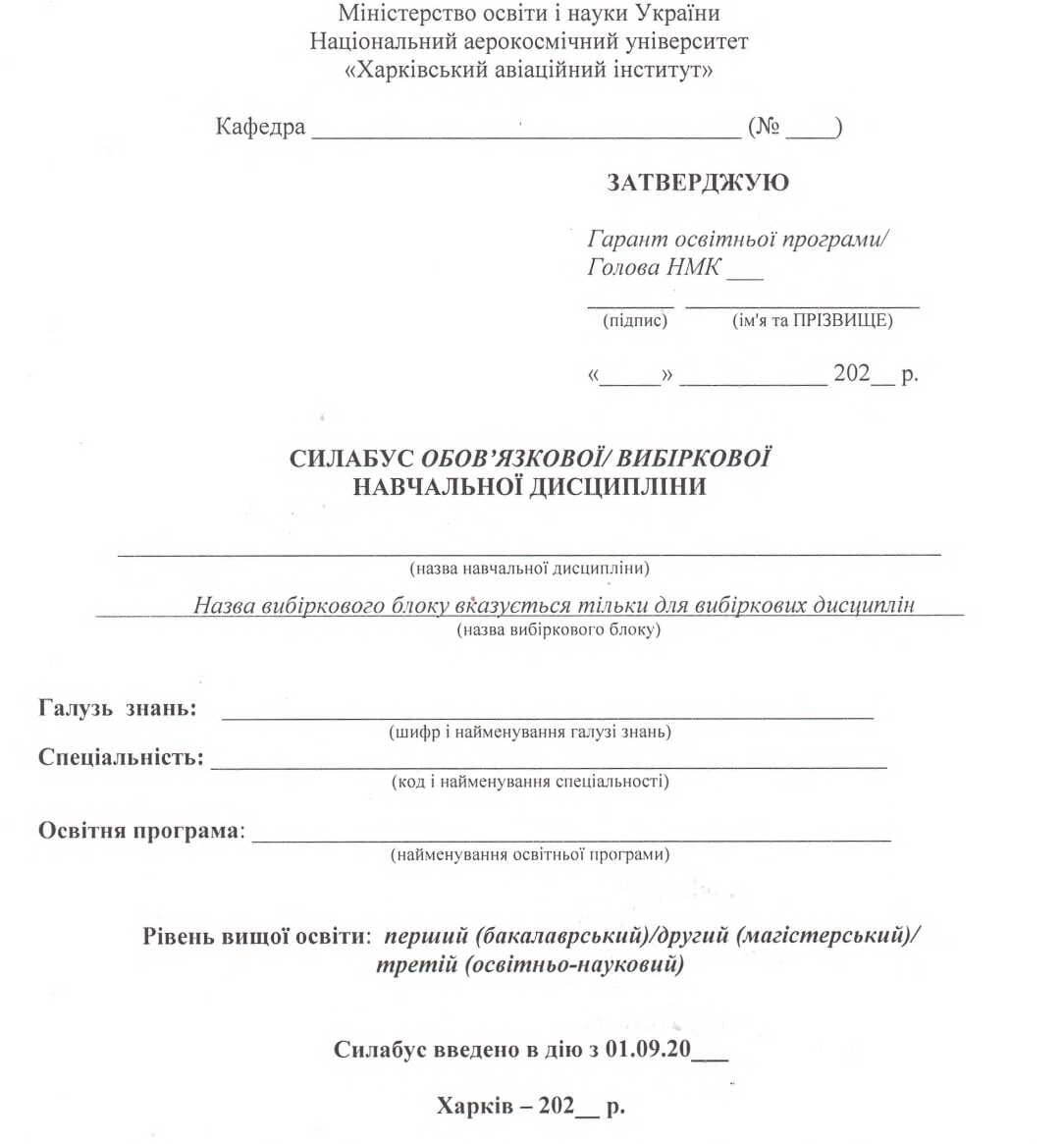
2.2.1 Title page of the syllabus of an academic discipline.
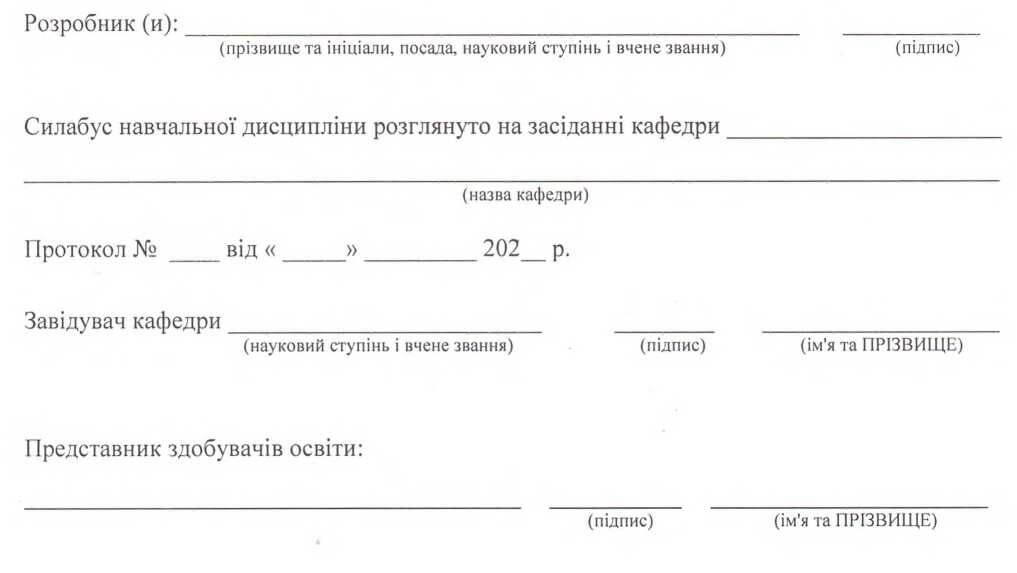
The title page of the syllabus is formatted according to the template provided in Appendix A.
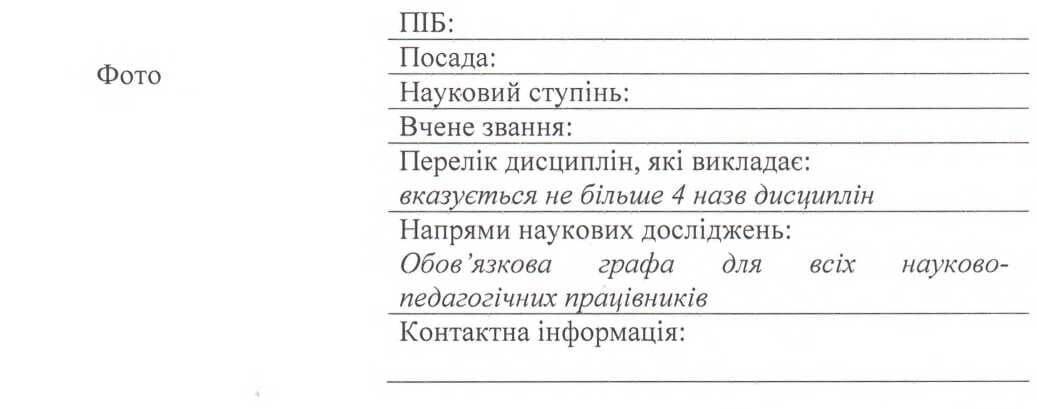
2.2.2 General information about the instructor.
Includes the surname, first name, patronymic, scientific degree, academic rank, position of the instructor, a list of disciplines they teach, areas of scientific research, contact information, etc. (see Appendix B).
2.2.3 Description of the academic discipline.
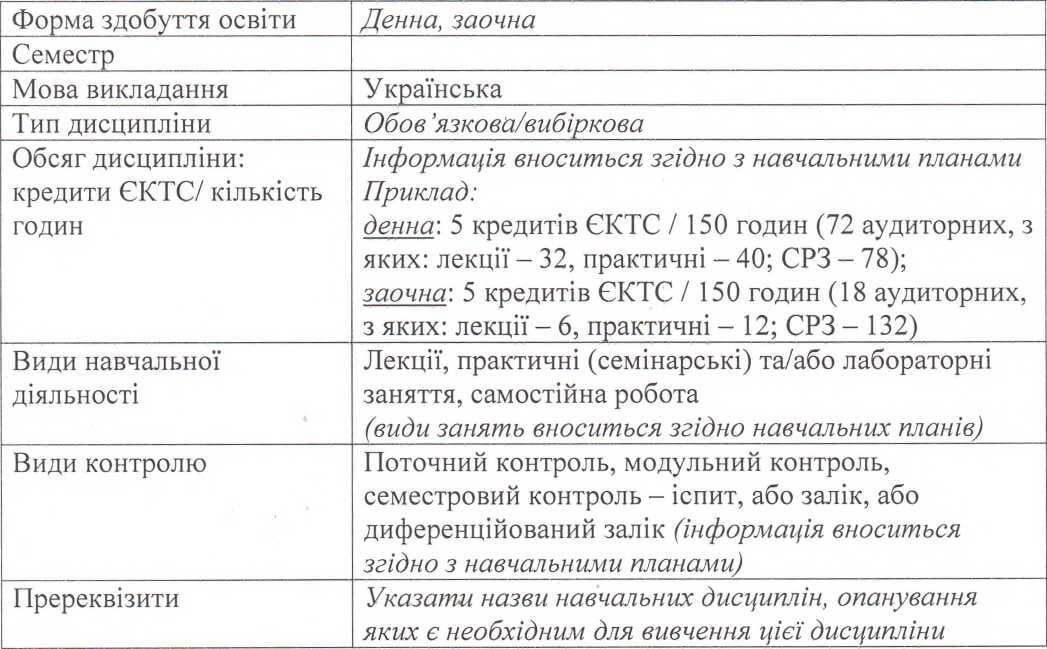
The following characteristics of the discipline must be specified (see Appendix C):
- mode of study;
- semester in which the academic discipline is taught;
- language of instruction, completion of individual assignments, and assessment activities;
- type of discipline (mandatory/elective);
- number of ECTS credits, total number of hours for studying the discipline, number of classroom hours and hours of independent work for education seekers for each mode of study;
- types of learning activities;
- types of assessment;
- prerequisites of the academic discipline.
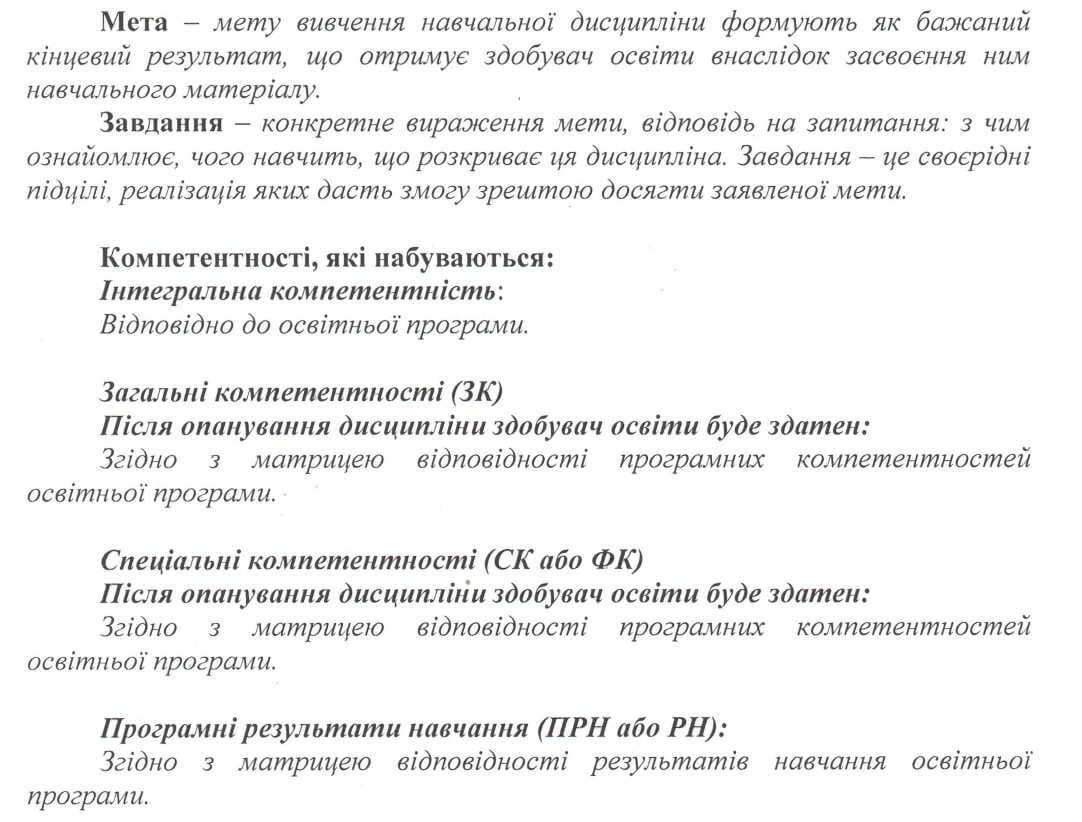
2.2.4 Goals and tasks of the academic discipline (see Appendix D).
The goal of studying the academic discipline is formulated as the desired end result that the education seeker obtains as a result of mastering the educational material.
Tasks are a concrete expression of the goal, answering the questions: what will this discipline introduce, what will it teach, what will it reveal? These are specific sub-goals whose implementation will ultimately allow the stated goal to be reached.
2.2.5 List of competencies (see Appendix D).
Specify the competencies that are formed in the education seeker during the study of the discipline and enable professional activity. These competencies are analyzed by the guarantor of the educational program, based on which a decision is made regarding which of them are program-specific for a given educational program. In other words, the guarantor determines which competencies described in the syllabus of the academic discipline correspond to the competencies of the educational program or are equivalent to program competencies.
2.2.6 List of expected learning outcomes (see Appendix D).
Specify all learning outcomes that an education seeker must achieve after mastering the discipline. It should be stated what the education seeker will know, be able to do, what skills they will acquire, what views, values, and ways of thinking will be formed, as well as additional personal qualities.
These learning outcomes are analyzed by the guarantor of the relevant educational program, based on which a decision is made regarding which of them are program-specific for a given educational program. In other words, the guarantor determines which learning outcomes described in the syllabus of the academic discipline correspond to the learning outcomes of the educational program or are equivalent to program learning outcomes.
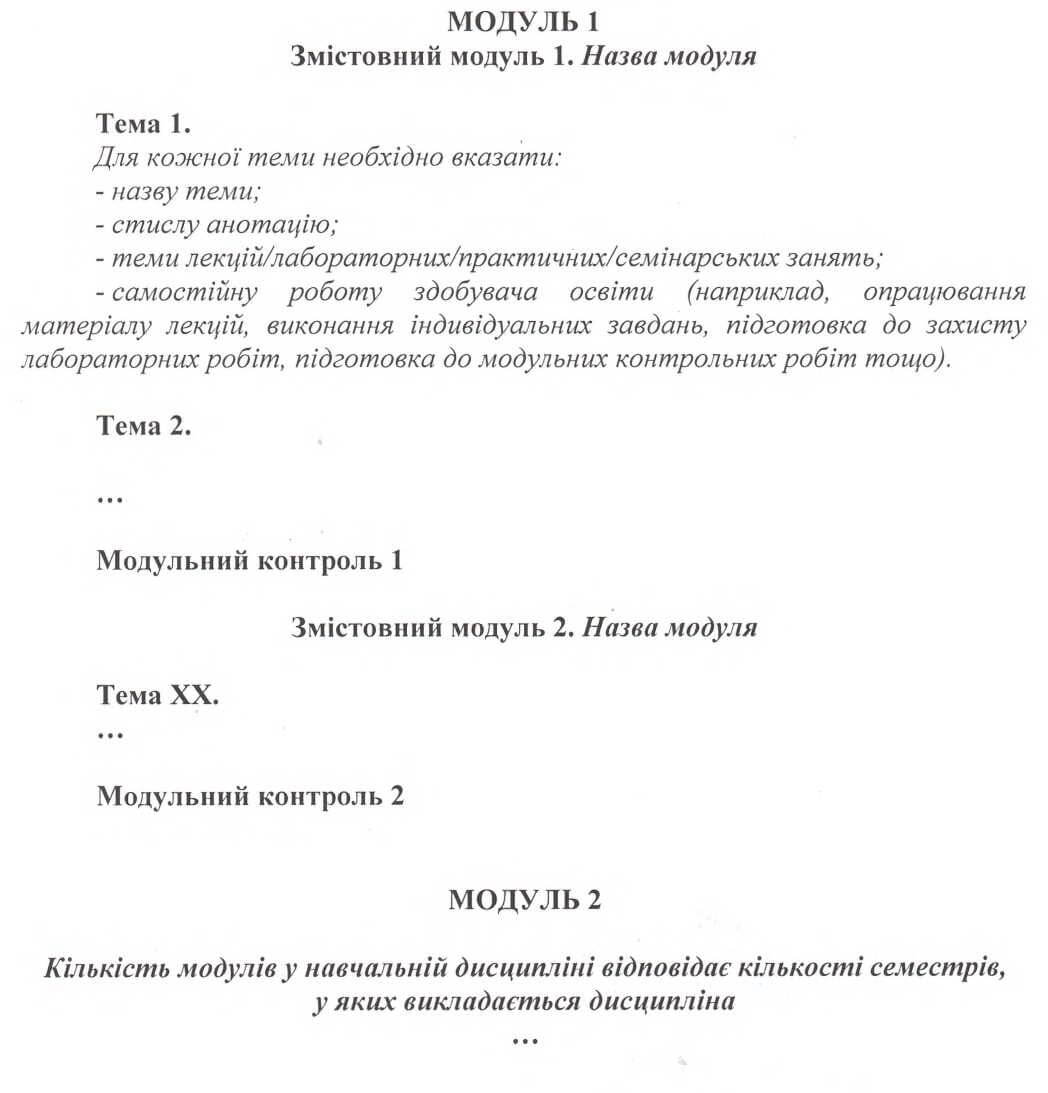
2.2.7 Content of the academic discipline (see Appendix E).
This section provides a list of content modules and the topics included within them. The content of each topic is presented concisely as a list of questions or subtopics discussed during the lesson.
Information by type of lesson is provided concisely and may reflect teaching methods aimed at implementing the learning process and achieving the set goal.
During the course of study, the instructor may adjust the volume of teaching workload for certain types of work, taking into account the results of the education seekers' assimilation of the learning material.
The content of the education seeker’s independent work (ESW) for a specific discipline may consist, in particular, of the following types of work:
- preparation for classroom sessions (lectures, practical, seminar, laboratory sessions, etc.);
- completion of practical assignments (writing essays, analyzing practical or problem situations, preparing own research results for presentation at conferences, participation in academic competitions, etc.) throughout the semester;
- independent study of individual topics of the academic discipline;
- translation of foreign language texts of established volumes;
- completion of individual assignments, including course design, etc.;
- preparation for all types of assessment, including modular control tests and final attestation;
- other types of activities initiated by the University, the faculty, and the department.
2.2.8 Individual work of education seekers.
Individual assignments include: calculation-graphic works (CGW), calculation works (CW), control works (test papers) (TCW), course papers (CP), and course projects (CPr).
Individual assignments are performed by education seekers independently and are not part of the education seeker's weekly classroom workload. The instructor monitors the completion of individual assignments during consultations, the schedule of which is developed and approved by the head of the department at the beginning of the semester.
The purpose of individual assignments is to deepen, generalize, and consolidate the knowledge that education seekers acquire during their studies, as well as to apply this knowledge in practice. The completion of individual assignments contributes to the fullest realization of the education seekers' creative potential.
A special type of individual assignment is the completion of course projects (papers) in accordance with the semester curriculum.
2.2.9 Teaching methods.
The following teaching methods are distinguished: verbal (explanation, narrative, conversation, educational discussion, etc.), visual (illustration, demonstration, independent observation), and practical (laboratory and practical work).
It is recommended to use teaching methods aimed at forming an active position of education seekers (they are not just taught, they learn themselves):
- problem-based presentation;
- research;
- presentations;
- case studies;
- trainings and business games, conversations and discussions, etc.
A student-centered approach to organizing learning is used.
2.2.10 Assessment methods.
Assessment of education seekers' progress is divided into current, final, and semester (examination session) assessments.
Current assessment is carried out during practical, laboratory, and seminar sessions, with the goal of systematically checking the understanding and assimilation of theoretical educational material, the ability to use theoretical knowledge when performing practical tasks, etc. The possibilities for current assessment are extremely broad: motivation for learning, stimulation of educational and cognitive activity, differentiated approach to learning, individualization of learning, etc.
Final assessment is conducted to evaluate learning outcomes based on the sum of modular grades (the number of points obtained by the education seeker during modular control works) and current assessment results.
Semester assessment is an assessment activity conducted in one of the following forms: exam, differentiated credit, or credit, which is determined in the curriculum and the syllabus of the academic discipline.
The form of the semester assessment may vary — written, oral, testing, written-oral (combined), etc.; it is approved at the department and reflected in the syllabus of the academic discipline.
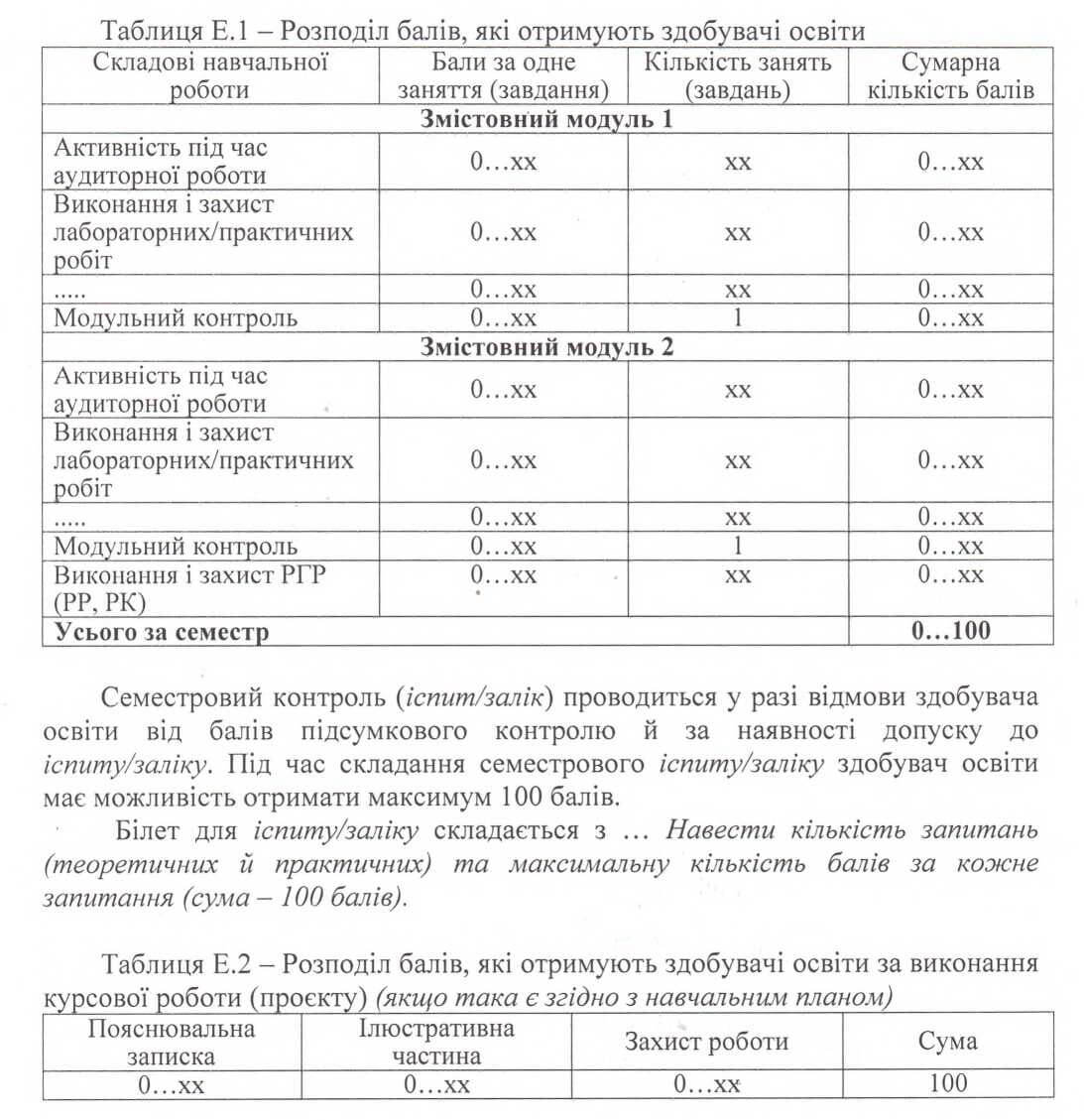
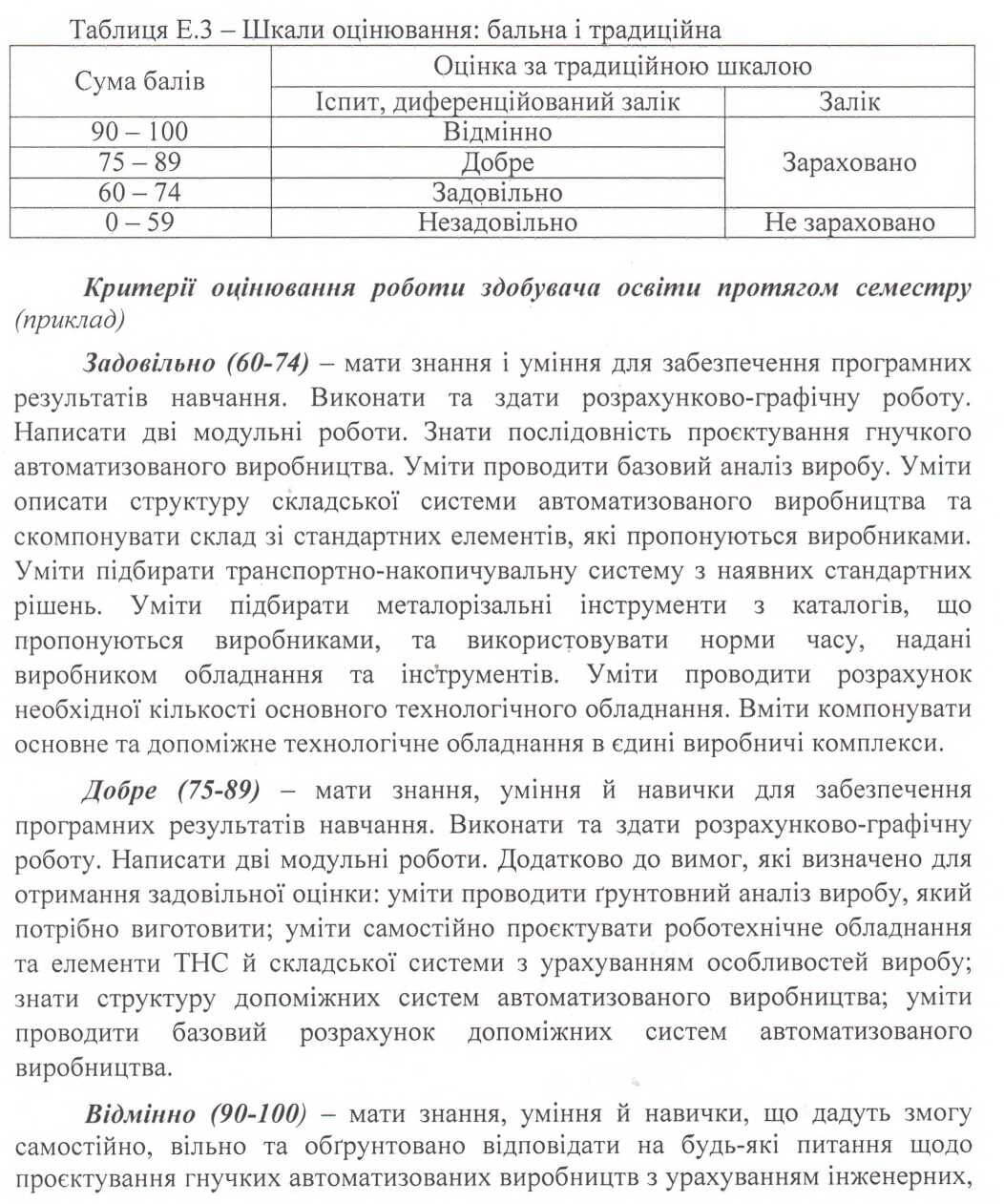
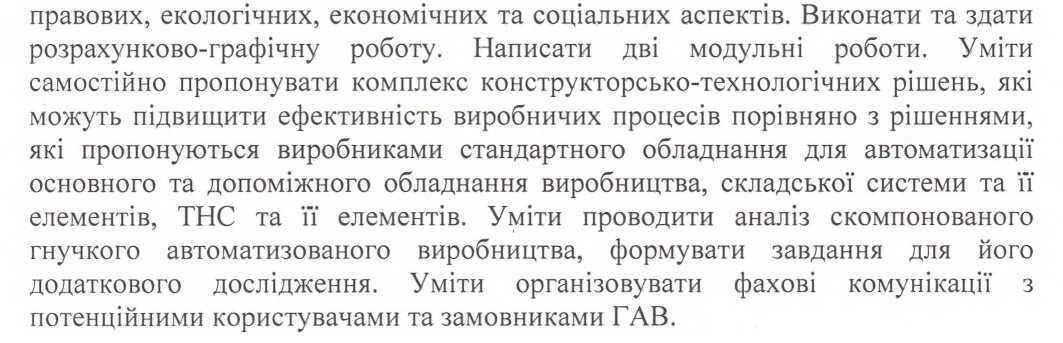
2.2.11 Criteria for assessing the learning outcomes of education seekers and the distribution of points they receive.
When assessing the assimilation of each topic for current educational activity, the education seeker is given grades based on approved evaluation criteria for the relevant discipline. All types of work provided for in the syllabus of the academic discipline are taken into account. Forms of assessment of current educational activity must be standardized and consist of checking theoretical and practical training. Grades are given on a 100-point scale.
The criteria for assessing the learning outcomes of education seekers and the distribution of points they receive are regulated by the "Regulations on Rating Assessment of Education Seekers' Achievements in Educational Components at the National Aerospace University 'Kharkiv Aviation Institute'."
An example of the distribution of points received by education seekers is provided in Appendix E.
The specifics of conducting the final assessment are reflected in the syllabus of the academic discipline and brought to the attention of education seekers during the first session.
2.2.12 Course policy.
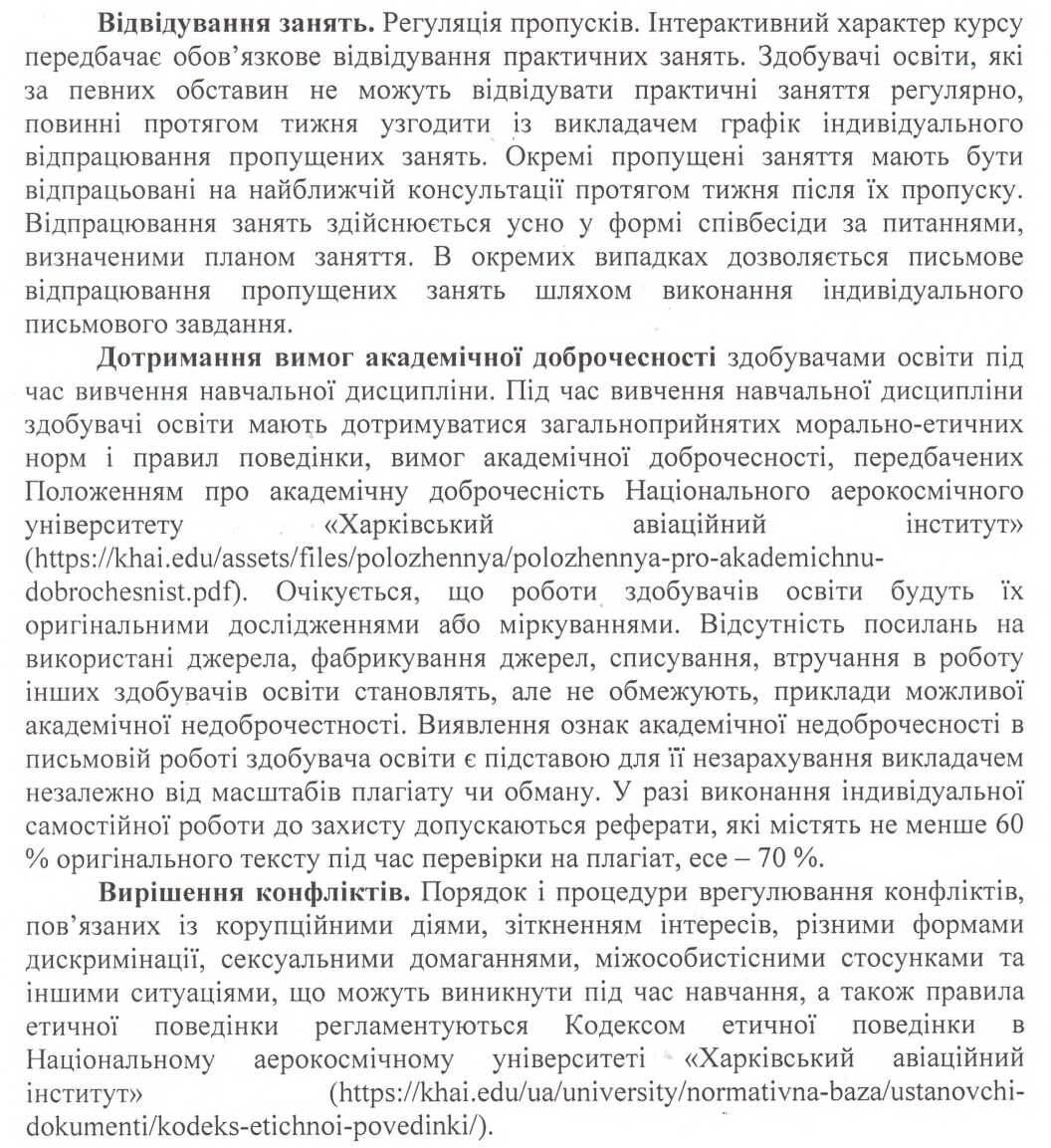
Reflect the procedure for making up missed classes (due to sick leave, academic mobility, etc.) and uncompleted assignments. Describe how plagiarism checks are carried out on assignments completed by education seekers, and how academic integrity is maintained by all participants in the educational process, etc. An example of the course policy is provided in Appendix Zh.
2.2.13 Methodological support.
Define textbooks, teaching manuals, educational-methodological manuals, lecture notes, methodological recommendations for conducting practical sessions, laboratory works, independent preparation, etc., published at the University. In addition, include a link to the educational-methodological complex of the discipline hosted in the "Mentor" system.
2.2.14 Recommended literature.
Define the literary sources proposed for studying the discipline, presented in two blocks: primary (basic) and additional (auxiliary) literature.
Primary (basic) literature usually includes current regulatory documents, basic domestic textbooks, and the best foreign textbooks and teaching manuals published within the last 5-10 years (maximum 10 sources), taking into account their availability in the University library or on relevant websites.
The list of additional (auxiliary) literature includes various modern reference books, periodicals, scientific monographs, methodological recommendations, and other significant sources that complement the content of the primary (basic) literature, etc. (maximum 7 sources, published within the last 5-10 years).
2.2.15 Information resources.
This section must contain Internet sources, links to the electronic portal of the University's scientific and technical library, etc.
3. Procedure for Developing and Approving the Syllabus of an Academic Discipline
3.1 The syllabus of an academic discipline is developed by the instructor (lecturer) or a group of instructors who provide instruction for this discipline.
3.2 The syllabus of an academic discipline is reviewed at a meeting of the department that provides instruction for the relevant discipline; the results of the meeting are recorded in the corresponding protocol.
The syllabus of an academic discipline is signed by the developer(s) and the head of the department, and agreed upon with a representative of the education seekers of the relevant educational program (a representative of student self-government).
The syllabus of an academic discipline is approved by the guarantor of the educational program. If the discipline is taught for several educational programs, the syllabus is submitted for consideration to the relevant branch scientific-methodological commission (SMC) of the University, reviewed at its meeting, and in case of a positive decision, approved by the head of the SMC.
3.3 Based on the results of the syllabus approval, the date of its entry into force is determined and indicated on the title page of the document.
3.4 Instructors are required to familiarize education seekers with the syllabi of the disciplines they teach at the beginning of the semester.
3.5 Following the annual review and approval of educational programs at the University, the syllabi of academic disciplines may be reviewed/updated and approved if necessary.
Grounds for reviewing/updating the syllabus may include:
- initiative and proposals from the guarantor of the educational program and/or instructors of the discipline;
- initiative from education seekers through an appeal to the guarantor of the educational program;
- results of assessing the knowledge of education seekers in the academic discipline;
- results of surveys of education seekers and proposals from stakeholders;
- etc.
3.6 The validity period of the syllabus of an academic discipline is 5 years, unless there are grounds for its update — such as a change in the number of ECTS credits for the discipline, a change in the number of hours for classroom and independent work, types of assessment, or the reasons specified in item 3.5 of these Regulations.
3.7 The syllabus of an academic discipline with all appendices is kept at the department, and an electronic copy is submitted to the Department of Educational Quality, Analytics, and Methodological Support and posted on the official University website.
3.8 Control over the implementation of the syllabus is carried out by the guarantor of the educational program and the head of the relevant department.
4. Final Provisions
4.1 These Regulations are approved by the Academic Council of the University and put into effect by an order of the University Rector.
4.2 Control over the implementation of these Regulations is carried out by University officials within the scope of their authority established in their job descriptions.
4.3 Amendments and additions to these Regulations are reviewed and approved by the Academic Council of the University and put into effect by an order of the University Rector.
Appendix A
Form of the title page of the academic discipline syllabus
Appendix B
General information about the instructor
Appendix C
Description of the academic discipline
Appendix D
Goal and tasks of the academic discipline, lists of competencies and expected learning outcomes
Appendix E
Content of the academic discipline
Appendix F
Evaluation criteria and distribution of points received by education seekers

Appendix G
Example of a course policy