Regulations on Scientific and Pedagogical Practice
of Higher Education Seekers for the Degree of Doctor of Philosophy (Postgraduate Students)
of the National Aerospace University
«Kharkiv Aviation Institute»
APPROVED BY
Decision of the University Academic Council
Minutes No. 6 dated January 21, 2026
ENACTED BY
Order No. 38 dated January 22, 2026
QMS HAI-VAID-P/002:2026
Date of introduction: January 22, 2026
Revision No. 1
1. General Provisions
1.1. The Regulations on Scientific and Pedagogical Practice of Higher Education Seekers for the Degree of Doctor of Philosophy (Postgraduate Students) (hereinafter referred to as the Regulations) of the National Aerospace University «Kharkiv Aviation Institute» (hereinafter referred to as the University) regulate the procedure and forms of completing scientific and pedagogical practice by Ukrainian higher education seekers and seekers from among foreign citizens and stateless persons.
1.2. Scientific and pedagogical practice in the higher education system at the third educational and scientific level is a component of professional training for scientific and pedagogical activity and a type of practical activity of higher education seekers for the degree of Doctor of Philosophy regarding the implementation of the educational and upbringing process in higher education, including teaching special disciplines, organizing educational activities, scientific and methodological work, and acquiring practical teaching skills and abilities.
1.3. These Regulations have been developed in accordance with the Procedure for Training Higher Education Seekers for the Degrees of Doctor of Philosophy and Doctor of Sciences in Higher Educational Institutions (Scientific Institutions), approved by Resolution of the Cabinet of Ministers No. 261 dated March 23, 2016, with amendments, according to which scientific and pedagogical practice is one of the components of the training program for scientific-pedagogical and scientific personnel of higher qualification.
1.4. The organizer of scientific and pedagogical practice is the department to which the higher education seeker for the degree of Doctor of Philosophy is assigned.
1.5. The purpose, tasks, content, forms, and methods of control and evaluation of the results of scientific and pedagogical practice, taking into account the specifics of the specialty and the educational and scientific program, are specified in the practice programs.
1.6. Amendments and additions to these Regulations are agreed upon with the Vice-Rector for Scientific Work and enacted by order of the University Rector.
2. Tasks of Scientific and Pedagogical Practice
2.1. In the process of completing scientific and pedagogical practice, higher education seekers for the degree of Doctor of Philosophy must master the basics of scientific-methodological and educational-methodological work: skills in structuring and psychologically competently transforming scientific knowledge into educational material, systematizing educational and upbringing tasks, exercises, tests on various topics, oral and written presentation of subject material, and various educational technologies.
2.2. In the process of practical activity and conducting classes, higher education seekers for the degree of Doctor of Philosophy must develop skills in determining educational and upbringing goals, choosing the type and form of classes, and using various forms of organizing educational activities of education seekers (diagnostics, control, and evaluation of the effectiveness of educational activities).
2.3. In the process of visiting classes of teachers of relevant disciplines, higher education seekers for the degree of Doctor of Philosophy must familiarize themselves with various methods of structuring and presenting educational material, techniques for activating educational activity, features of professional rhetoric, and methods and forms of evaluating the results of students' educational activities.
2.4. Under conditions when the possibilities of physical attendance at practice bases by seekers are limited or absent (participation of higher education seekers in international exchange programs, force majeure circumstances (active hostilities, natural disasters, quarantine restrictions, etc.)), a remote or combined (mixed) form of conducting practices is applied, which may include alternative tasks defined by the scientific and pedagogical practice program.
2.5. Higher education seekers for the degree of Doctor of Philosophy are familiarized with the program, tasks, forms, and methods of control and evaluation of the results of scientific and pedagogical practice.
3. Content of Scientific and Pedagogical Practice
3.1. Scientific and pedagogical practice of an education seeker includes the following types of activities:
- familiarization with the organization of the educational and upbringing process in higher education;
- studying the teaching experience of leading university teachers by attending classroom sessions in academic disciplines;
- developing the content of classes and methodological work in the discipline;
- independently conducting classes in the discipline (lectures, seminars, practical classes) and self-analysis;
- participating in evaluating the quality of various types of work of higher education seekers of the first and second levels;
- individual work with higher education seekers of the first and second levels, and supervision of student scientific research.
4. Practice Bases
4.1. Scientific and pedagogical practice of higher education seekers for the degree of Doctor of Philosophy of the university is carried out at practice bases that meet the requirements of the program.
4.2. Full-time higher education seekers for the degree of Doctor of Philosophy, as a rule, complete their practice at the department to which they are assigned.
4.3. Part-time higher education seekers for the degree of Doctor of Philosophy may complete scientific and pedagogical practice at other higher education institutions of Ukraine of III-IV accreditation levels in accordance with a signed agreement.
4.4. Higher education seekers for the degree of Doctor of Philosophy from among foreign citizens and stateless persons studying remotely complete their scientific and pedagogical practice at the department to which they are assigned, remotely. In this case, the department ensures the conditions for the postgraduate student to complete scientific and pedagogical practice.
5. Reporting Documentation
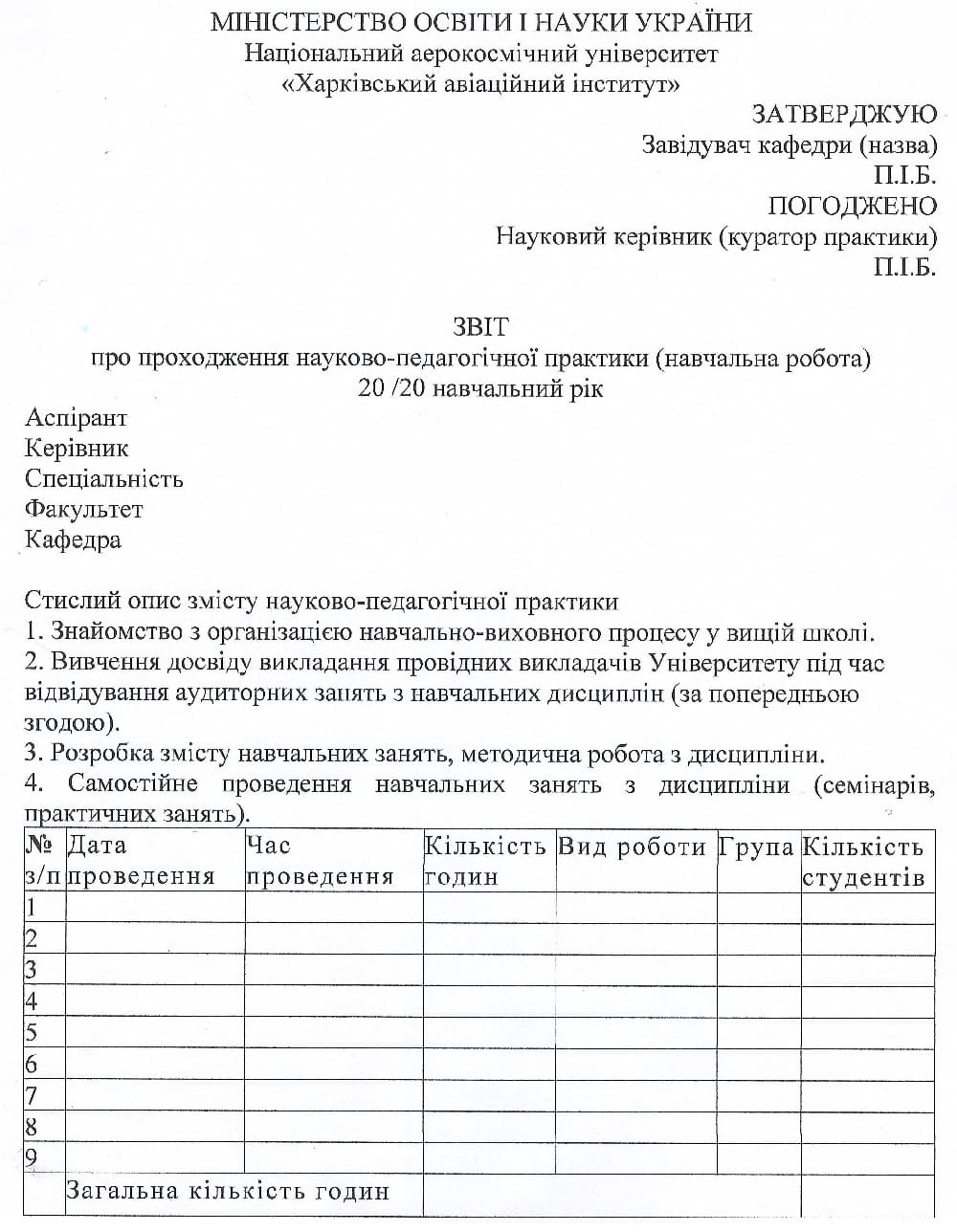
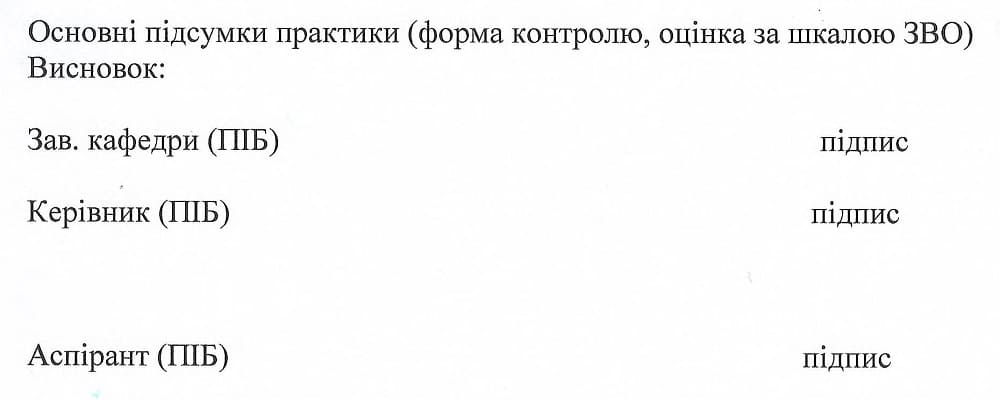
5.1. Based on the results of completing scientific and pedagogical practice, higher education seekers for the degree of Doctor of Philosophy submit to the department of postgraduate education and doctorate a report on each type of pedagogical practice work, signed by the head of the department, scientific supervisor, or lecturer of the discipline in which the practice took place, in the manner determined by the scientific and pedagogical practice program, in Ukrainian or a foreign (English) language depending on the language of study and report on the results at a meeting of the department (Appendix 1), (Appendix 2).
5.2. The grade for pedagogical practice is given by the scientific supervisor and the lecturer of the discipline in which the practice took place, and is approved by the head of the department.
5.3. Higher education seekers for the degree of Doctor of Philosophy who perform educational and educational-methodological work under an employment contract within the University submit a report on the completion of scientific and pedagogical practice to the department of postgraduate education and doctorate in accordance with the educational and educational-methodological work performed at the department (University). The reports must be signed by the scientific supervisor and the head of the department where the higher education seeker for the degree of Doctor of Philosophy performs work. The grade is given based on the results of monitoring individual classes conducted by the postgraduate student according to the plan of the head of the department.
5.4. The number of hours for all types of work performed by a postgraduate student during pedagogical practice is at least 30 hours of educational work and 30 hours of educational-methodological work, but not more than 200 hours for all types of work. The number of hours for each type of work must comply with the Regulations «Time Norms for Planning and Accounting for the Work of Scientific and Pedagogical Workers» in force at the University.
5.5. If higher education seekers for the degree of Doctor of Philosophy complete their scientific and pedagogical practice in other higher education institutions of Ukraine of III-IV accreditation levels, in addition to the reporting documentation, they also submit to the department a detailed reference from the responsible curator from the place of practice.
6. Rights and Obligations of Higher Education Seekers for the Degree of Doctor of Philosophy
6.1. A higher education seeker for the degree of Doctor of Philosophy has the right to consult the scientific supervisor and the head of the department on all issues arising during the practice and to submit proposals for improving the organization of the practice.
6.2. During the practice, by prior agreement, a higher education seeker for the degree of Doctor of Philosophy has the right to attend classes conducted by leading specialists of the university in order to study teaching methodology and familiarize themselves with advanced pedagogical experience.
6.3. A higher education seeker for the degree of Doctor of Philosophy performs all types of work provided for by the scientific and pedagogical practice program and thoroughly prepares for each class.
6.4. A higher education seeker for the degree of Doctor of Philosophy is subject to the University's internal regulations, instructions of the administration, and practice supervisors. In case of failure to meet the requirements, a higher education seeker for the degree of Doctor of Philosophy may be suspended from practice.
6.5. A higher education seeker for the degree of Doctor of Philosophy who is suspended from practice or whose work during practice is deemed unsatisfactory is considered not to have fulfilled the individual plan and, in accordance with the Procedure for Training Higher Education Seekers for the Degrees of Doctor of Philosophy and Doctor of Sciences in Higher Educational Institutions (Scientific Institutions) approved by the Resolution of the Cabinet of Ministers of March 23, 2016, is subject to expulsion.
6.6. A higher education seeker for the degree of Doctor of Philosophy must submit reporting documentation to the department and pass the test within 10 days after the end of the practice.
7. Rights and Obligations of the Supervisor (Curator of Scientific and Pedagogical Practice)
7.1. General management and control over the completion of scientific and pedagogical practice by a higher education seeker for the degree of Doctor of Philosophy are entrusted to the head of the department to which the higher education seeker for the degree of Doctor of Philosophy is assigned.
7.2. Direct management and control over the implementation of the individual plan for pedagogical practice of a higher education seeker for the degree of Doctor of Philosophy are carried out by their scientific supervisor (practice curator), who:
- ensures clear organization, planning, and accounting of the results of scientific and pedagogical practice;
- approves the individual plan for scientific and pedagogical practice;
- selects the topics of classes and study groups for conducting scientific and pedagogical practice;
- provides methodological assistance in planning and organizing educational interaction;
- controls the work of the higher education seeker for the degree of Doctor of Philosophy, class attendance, and other types of work with students, and takes measures to eliminate shortcomings in the organization of scientific and pedagogical practice;
- approves the report of the higher education seeker for the degree of Doctor of Philosophy on the completion of scientific and pedagogical practice;
- prepares a certificate of completion of practice, which serves as the basis for passing the test.
8. Final Provisions
8.1. The Regulations are approved by the University Academic Council and enacted by order of the University Rector.
8.2. Control over the implementation of the Regulations is exercised by University officials within their powers specified in job descriptions.
8.3. Amendments and additions to the Regulations are considered and approved by the University Academic Council and enacted by order of the University Rector.
Appendix 1
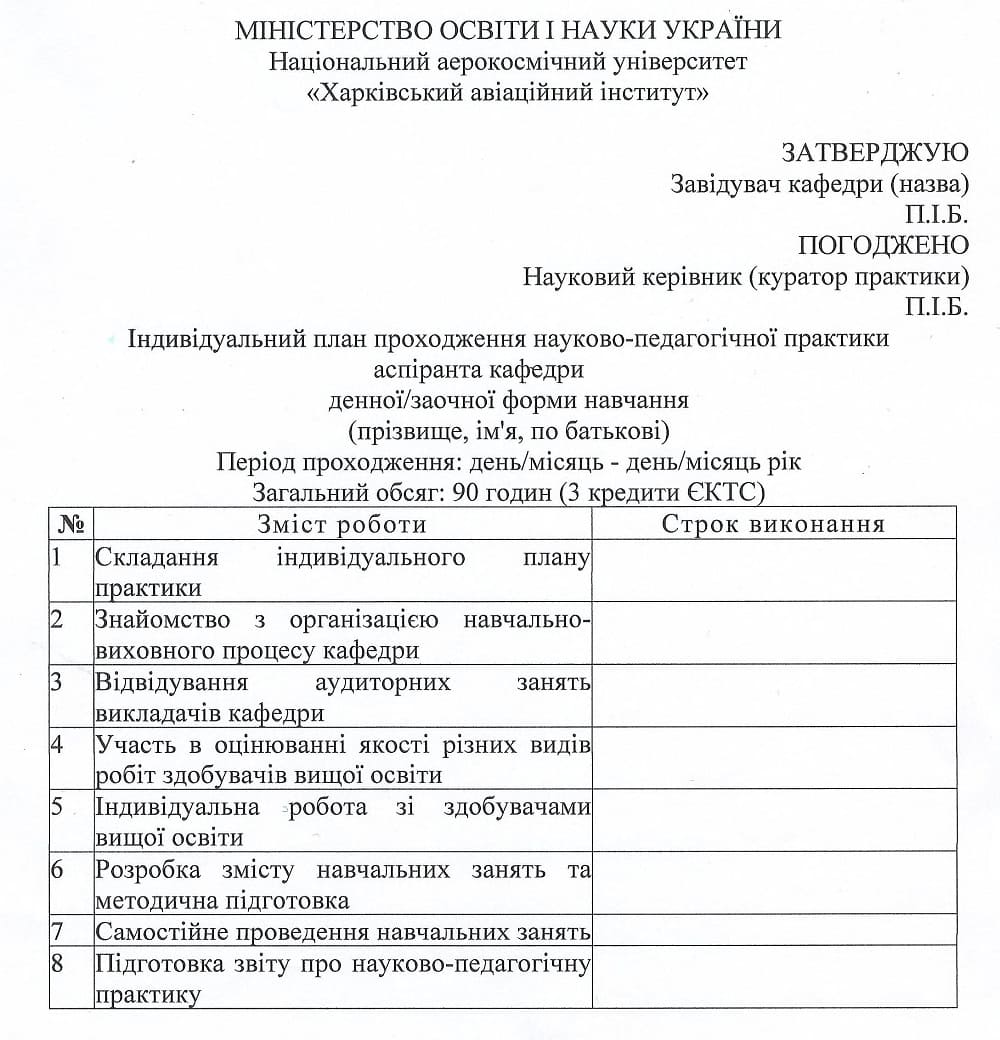
Appendix 2