
Regulations on the Quality Management System
at the National Aerospace University
«Kharkiv Aviation Institute»
QMS KhAI-NMV-P/012:2019
Date of Enactment: April 20, 2019
Revision No. 1
1. Purpose and Scope of Application
1.1 The Regulations on the Quality Management System (hereinafter referred to as the Regulations) of the National Aerospace University «Kharkiv Aviation Institute» (hereinafter referred to as the University) is the main document describing the University's quality management system, developed on the basis of ISO 9001 and DSTU ISO 9001 requirements without exclusions.
1.2 The Regulations describe the relationship and interaction of the quality management system processes, the distribution of responsibilities and powers among University officials within the QMS, resources, and process monitoring tools.
1.3 The scope of application of the quality management system (hereinafter referred to as QMS) covers the University's activities in providing higher education services for the training of specialists holding the educational degrees of Bachelor, Master (Specialist), Doctor of Philosophy, and Doctor of Science (including for international students), as well as research and methodological activities.
1.4 The requirements of these Regulations are mandatory for implementation by all departments and personnel of the University involved in the execution and provision of higher education services, research, and methodological activities.
2. Normative References
These Regulations contain references to the following regulatory documents:
1) Law of Ukraine «On Higher Education» dated 01.07.2014 No. 1556-VII (as amended);
2) Law of Ukraine «On Access to Public Information» dated 13.01.2011 No. 2939-VI (as amended);
3) Law of Ukraine «On Public Procurement» dated 25.12.2015 No. 922-VIII (as amended);
4) Strategy for Reforming Higher Education in Ukraine until 2020;
5) Resolution of the Cabinet of Ministers of Ukraine «On Approval of Licensing Conditions for Educational Activity of Educational Institutions» dated 30.12.2015 No. 1187;
6) Standards and Guidelines for Quality Assurance in the European Higher Education Area (ESG): 2015;
7) Statute of the National Aerospace University named after M.E. Zhukovsky «Kharkiv Aviation Institute»;
8) Collective Agreement;
9) Internal Regulations;
10) Admission Conditions and Rules;
11) Quality Policy;
12) Regulations «On the Department of Organization and Implementation of Research and Development»;
13) Regulations «On the Organization of Scientific and Scientific-Technical Activities»;
14) Regulations «On Student Self-Government of the National Aerospace University named after M.E. Zhukovsky 'Kharkiv Aviation Institute'»;
15) Regulations «On Academic Leaves and Re-enrollment for Studies of Students at the National Aerospace University named after M.E. Zhukovsky 'Kharkiv Aviation Institute'»;
16) Regulations «On Academic Mobility of Students and Postgraduate Students of the National Aerospace University named after M.E. Zhukovsky 'Kharkiv Aviation Institute'»;
17) Regulations «On Independent Work of Students at the National Aerospace University named after M.E. Zhukovsky 'Kharkiv Aviation Institute'»;
18) Regulations «On the Procedure for Assigning Honorary Titles»;
19) Regulations «On the Procedure for Maintaining Academic Group Attendance and Performance Tracking Journals»;
20) Regulations «On the Procedure for Awarding Bonuses to University Lecturers Who Provide Scientific Supervision of Foreign Postgraduate Students and Scientific Consulting of Foreign Doctoral Candidates»;
21) Regulations «On Ensuring Access to Public Information at the National Aerospace University named after M.E. Zhukovsky 'Kharkiv Aviation Institute'»;
22) Regulations «On the System for Prevention and Detection of Academic Plagiarism»;
23) Regulations «On the Tender Committee»;
24) Office Management Instruction;
25) Passport of Sanitary and Technical Conditions of Working Environment at the University;
26) Rules and Instructions on Occupational Health and Safety;
27) QMS KhAI-VR-P/001:2015 Regulations «On the Academic Council of the University»;
28) QMS KhAI-NR-P/001:2016 Regulations «On the Supervisory Board»;
29) QMS KhAI-OGS-P/001:2016 Regulations «On the Conference of the Labor Collective»;
30) QMS KhAI-VK-P/001:2015 Regulations «On the Procedure for Conducting a Competition for Vacant Positions, Appointment and Dismissal from Positions, Extension of the Term of Employment of Academic and Pedagogical Staff of the National Aerospace University named after M.E. Zhukovsky 'Kharkiv Aviation Institute'»;
31) QMS KhAI-NDCP-P/001:2017 Regulations «On Providing State Targeted Support to Certain Categories of Students Associated with Accommodation in Dormitories of the National Aerospace University named after M.E. Zhukovsky 'Kharkiv Aviation Institute'»;
32) QMS KhAI-NOV-P/001:2015 Regulations «Procedure for Ordering and Issuing Higher Education Documents»;
33) QMS KhAI-NMV-P/001:2015 Regulations «Rating Assessment of the Activities of Academic and Pedagogical Staff, Departments, and Faculties»;
34) QMS KhAI-NAV-P/001:2015 Regulations «Organisation of Diploma Project (Work) Execution»;
35) QMS KhAI-FPIG-P/001:2015 Regulations «Organisation of Admission and Training of Foreign Citizens Studying in the Ukrainian (Russian) Language under the Full-Time Mode of Study at the National Aerospace University named after M.E. Zhukovsky 'Kharkiv Aviation Institute'»;
36) QMS KhAI-VPO-P/001:2016 Regulations «On the Certification of Pedagogical Staff»;
37) QMS KhAI-ZDZ-P/001:2016 Regulations «On Conducting Sub-threshold Procurement of Goods, Works, and Services»;
38) QMS KhAI-VOP-P/001:2016 Regulations «On the Occupational Health and Safety Department»;
39) QMS KhAI-VK-P/001:2016 Regulations «On the Human Resources Department»;
40) QMS KhAI-VK-RI/001:2015 Instruction «Procedure for Preparing Regulations on Structural Units»;
41) QMS KhAI-NMV-RI/001:2019 Instruction «Management Review»;
42) QMS KhAI-VK-TPI-1229.4/001:2015 Standard Job Description of a Faculty Dean;
43) QMS KhAI-VK-TPI-2310.1/001:2016 Standard Job Description of a Professor;
44) QMS KhAI-NMV-P/002:2019 Regulations «Planning and Conducting Internal Audits»;
45) QMS KhAI-NOV-P/002:2015 Regulations «On the Procedure for Credit Transfer of Academic Disciplines and Determination of Academic Difference»;
46) QMS KhAI-NAV-P/002:2018 Regulations «Time Norms for Planning and Accounting of the Work of Academic and Pedagogical Staff»;
47) QMS KhAI-VK-TP/002:2015 Standard Regulations «On a Faculty»;
48) QMS KhAI-VK-TPI-1229.4/002:2015 Standard Job Description of a Head of Department;
49) QMS KhAI-VK-TPI-2310.1/002:2016 Standard Job Description of an Associate Professor;
50) QMS KhAI-NMV-RI/002:2019 Instruction «Nonconformity and Corrective Actions»;
51) QMS KhAI-NOV-P/003:2015 Regulations «On the Admission Committee»;
52) QMS KhAI-NMV-P/003:2016 Regulations «On Ensuring Students' Right to Choose Disciplines»;
53) QMS KhAI-VPO-P/003:2016 Regulations «On Professional Development and Internships for Pedagogical and Academic-Pedagogical Staff and Industry Specialists at the University»;
54) QMS KhAI-NAV-P/003:2017 Regulations «On the Module-Rating System for Assessing Student Knowledge»;
55) QMS KhAI-VK-TPI-2310.2/003:2016 Standard Job Description of a Senior Lecturer;
56) QMS KhAI-NOV-P/004:2015 Regulations «On the Procedure for Transfer, Expulsion, and Re-admission of Students»;
57) QMS KhAI-NMV-004:2017 Regulations «On the Assessment of Students' Retained Knowledge in the Form of Rector's Control Tests in Academic Disciplines»;
58) QMS KhAI-VK-TPI-2310.2/004:2016 Standard Job Description of an Assistant;
59) QMS KhAI-NOV-P/005:2016 Regulations «On the Organisation of the Educational Process»;
60) QMS KhAI-NMV-P/005:2016 Regulations «On the Formation of the Working Programme of an Academic Discipline»;
61) QMS KhAI-COP-P/005:2016 Regulations «On Distance Learning»;
62) QMS KhAI-VK-TPI-2310.2/005:2016 Standard Job Description of a Lecturer;
63) QMS KhAI-NOV-P/006:2015 Regulations «On the Procedure for Establishing and Organising the Work of the State Examination Committee at the National Aerospace University named after M.E. Zhukovsky 'Kharkiv Aviation Institute'»;
64) QMS KhAI-NMV-P/006:2016 Regulations «On the Formation of the Academic Discipline Programme»;
65) QMS KhAI-VDOT-P/006:2016 Regulations «Time Norms for Planning and Accounting of the Work of Academic and Pedagogical Staff in Organising the Educational Process Using Distance Learning Technologies»;
66) QMS KhAI-NMV-P/007:2019 Regulations «Risk Management»;
67) QMS KhAI-COP-P/008:2016 Regulations «On Distance Learning Course»;
68) QMS KhAI-NMV-P/008:2019 Regulations «Management of Documented Information»;
69) QMS KhAI-NMV-P/009:2016 Regulations «On the Procedure for Clearing Academic Debts»;
70) QMS KhAI-NMV-P/010:2016 Regulations «On the Professional Mastery Competition "ICARI KHAI"»;
71) QMS KhAI-NMV-P/011:2017 Regulations «On the System for Ensuring Quality of Educational Activities and Higher Education»;
72) DSTU ISO 9000:2015 (ISO 9000:2015, IDT) Quality management systems. Fundamentals and vocabulary;
73) DSTU ISO 9001:2015 (ISO 9001:2015, IDT) Quality management systems. Requirements.
3. Terms and Definitions of Concepts
These Regulations apply the terms and definitions given in DSTU ISO 9000, namely:
3.1 educational organization (educational organization) - organization that provides educational services;
3.2 education provider (education provider) - person that provides education to a learner;
3.3 educational process - intellectual and creative activity in the field of higher education and science, carried out in the University through a system of scientific, methodological, and pedagogical measures aimed at the transfer, acquisition, enhancement, and use of knowledge, skills, and other competencies in learners, as well as the formation of a harmoniously developed personality;
3.4 educational activity - activity conducted in order to ensure the acquisition of higher and postgraduate education and satisfaction of other educational needs of higher education applicants and other individuals.
4. Organisation Environment
4.1 Understanding the Organisation and its Environment
The National Aerospace University named after M.E. Zhukovsky «Kharkiv Aviation Institute» was established on April 17, 1930. The University is the only specialized higher education institution of the 4th level of accreditation in Ukraine that comprehensively trains personnel in the design and production of all types of aircraft, aviation and rocket engines, power engineering equipment, and systems.
The University's activities are carried out within the current national and international legislative, regulatory, and procedural framework, as well as internal constituent and normative documentation, namely:
a) external documents:
1) Constitution of Ukraine;
2) laws of Ukraine regarding educational, scientific, financial, educational, organizational, social, personnel, international, foreign economic, and other activities;
3) resolutions of the Cabinet of Ministers of Ukraine regarding educational, scientific, financial, educational, organizational, social, personnel, international, foreign economic, and other activities;
4) orders and instructions of the Ministry of Education and Science of Ukraine regarding educational, scientific, financial, educational, organizational, social, personnel, international, foreign economic, and other activities;
5) higher education standards of Ukraine and others;
6) standards and guidelines for quality assurance in the European Higher Education Area (ESG) and others;
b) internal documents:
1) Statute of the National Aerospace University named after M.E. Zhukovsky «Kharkiv Aviation Institute»;
2) licenses of educational programmes;
3) Organisational Structure of the National Aerospace University named after M.E. Zhukovsky «Kharkiv Aviation Institute»;
4) Quality Policy in the Provision of Educational Services of the National Aerospace University named after M.E. Zhukovsky «Kharkiv Aviation Institute»;
5) Internal Regulations;
6) Regulations «On the Conference of the Labor Collective»;
7) Collective Agreement;
8) Passport of Sanitary and Technical Conditions of Working Environment at the University;
9) Regulations «On the Organisation of the Educational Process»;
10) Regulations «On Student Self-Government of the National Aerospace University named after M.E. Zhukovsky 'Kharkiv Aviation Institute'»;
11) educational programmes and others.
The University constantly monitors changes in national and international legislative, regulatory, and procedural documents concerning its scope of activity, and adjusts internal documents in a timely manner in accordance with these changes.
Annually (at the beginning of the current calendar year and/or at the end of the current academic year) during the review of QMS functioning using the SWOT analysis methodology, the University management determines external and internal factors related to its scope of activity and strategic development that affect the achievement of planned results of the quality management system functioning, namely:
1) strengths;
2) weaknesses;
3) opportunities;
4) threats.
These external and internal factors are continuously monitored and analyzed at the University.
The results of monitoring and analyzing external and internal factors are evaluated by the University management during the management review of the QMS and recorded in the «SWOT Analysis».
4.2 Understanding the Needs and Expectations of Interested Parties
Due to the fact that the University's ability to provide quality educational services that satisfy the requirements of customers (students, postgraduate students, and doctoral candidates) and legislative, regulatory, and procedural documents is or can be influenced by interested parties, the University management annually in December when planning activities for the next year determines:
a) interested parties relevant to the quality management system;
b) requirements of these interested parties relevant to the quality management system.
Based on the results of determining interested parties and their requirements, the Register of Interested Parties (Appendix A) is formed.
Vice-rectors for academic and pedagogical work and the vice-rector for research are responsible for conducting continuous monitoring and analysis of information on interested parties and their requirements at the University (Regulations «On Marketing of Educational and Scientific Services and the Labor Market»).
The results of monitoring and analyzing information on interested parties and their requirements are evaluated by the University management during the management review of the QMS and recorded in the «Register of Interested Parties» appendix of the minutes of this review.
4.3 Determining the Scope of Application of the Quality Management System
The University management has established that the boundaries and applicability of the QMS extend to the University's activities in providing higher education services for the training of specialists under relevant educational-professional, educational-scientific, and scientific programmes at the following levels of higher education: first (bachelor's), second (master's), third (educational-scientific), scientific (including for international students), as well as research and methodological activities. These boundaries cover all structural units of the University.
When determining the scope of application of the QMS, the University management took into account:
a) external and internal factors;
b) requirements of relevant interested parties;
c) services provided by the University.
All requirements of ISO 9001 and DSTU ISO 9001 are taken into account in the University's quality management system.
The Chief Quality Manager of the University is responsible for ensuring the availability of information on the scope of application of the QMS and maintaining documented information on its functioning, effectiveness, and efficiency in proper condition.
4.4 Quality Assurance System of Education and its Processes
4.4.1 The University has developed and implemented a quality management system that encompasses the processes required for its functioning and their interaction in accordance with the requirements of ISO 9001 and DSTU ISO 9001, which is maintained and continually improved.
The University management has determined the processes required for the effective functioning of the QMS (Appendix B) and their application within the University, and has also:
a) determined the required inputs of these processes and the outputs expected from them (specified in relevant internal normative documents);
b) determined the sequence and interaction of these processes (Appendix C);
c) determined the criteria and methods (including monitoring, measurements, and relevant performance indicators) needed to ensure the effective functioning and control of these processes (specified in relevant internal normative documents);
d) determined the resources needed for these processes and ensured their availability;
e) assigned responsibilities and authorities for these processes (Appendix D);
f) addressed risks and opportunities;
g) ensured the evaluation of these processes during internal audits and management reviews of the QMS, and the implementation of any changes required to ensure that these processes achieve their intended results;
h) ensured the improvement of the processes and the quality management system.
4.4.2 In order to effectively manage processes at the University, the following is ensured:
a) the relevance of documented information necessary for the functioning of processes in accordance with the Regulations «Management of Documented Information». The list of University QMS documents, the processes described in them, and relevant clauses of ISO 9001 and DSTU ISO 9001 are given in Appendix C;
b) retention of documented information to ensure confidence that processes are being carried out as planned in accordance with the Regulations «Management of Documented Information».
The Chief Quality Manager of the University is responsible for the implementation, operation, and assurance of continuous improvement of the QMS and the effective management of its processes.
5. Leadership
5.1 Leadership and commitment
5.1.1 General provisions
The Rector of the University (hereinafter referred to as the Rector) continually demonstrates leadership and commitment with respect to the quality management system as follows:
a) taking responsibility for the effectiveness of the quality management system;
b) ensuring that the quality policy and quality objectives are established for the University and are compatible with the strategic direction and the future general objectives of the University;
c) ensuring the integration of the quality management system requirements into the University's business processes;
d) promoting the use of the process approach and risk-based thinking; critical analysis of the QMS and provision of educational services to evaluate its effectiveness and identify ways for their improvement;
e) ensuring that the resources needed for the quality management system are available;
f) communicating the importance of effective quality management and of conforming to the quality management system requirements, as well as the importance of meeting customer requirements and applicable statutory and regulatory requirements for the provision of educational services that satisfy the needs and expectations of the learner;
g) ensuring that the QMS achieves its intended results;
h) engaging, directing, and supporting persons to contribute to the effectiveness of the QMS;
i) promoting improvement;
j) supporting other relevant management roles to demonstrate their leadership as it applies to their areas of responsibility.
5.1.2 Customer focus
The Rector continually demonstrates leadership and commitment with respect to customer focus by ensuring that:
a) customer requirements and applicable statutory and regulatory requirements are determined in contracts and agreements, communicated to personnel, and met in the provision of educational and research services;
b) the risks and opportunities that can affect conformity of products and services and the ability to enhance customer satisfaction are determined and addressed by process and department managers, and communicated to all process participants and department staff;
c) the focus on enhancing customer and interested party satisfaction is maintained.
This commitment by top management represented by the Rector is aimed at aligning quality management with the overall management of the University’s activities.
The Rector is responsible for the effective and efficient implementation of the quality management principles «Leadership» and «Customer focus» within the University.
5.2 Quality policy
5.2.1 Establishing the quality policy
The Rector of the University establishes a quality policy that:
a) is appropriate to the purpose and context of the organization and supports its strategic direction;
b) provides a framework for setting quality objectives;
c) includes a commitment to satisfy applicable requirements (customer, statutory, and regulatory) regarding services;
d) includes a commitment to continual improvement of the quality management system.
The quality policy is approved by the Academic Council and put into effect by an order of the Rector of the University.
Annually, as part of the QMS management review, the relevance of the quality policy and its compliance with the University's strategy are evaluated. The evaluation results are recorded in the minutes of this review.
Relevant amendments to the quality policy are introduced by the Rector, approved by the Academic Council, and put into effect by an order of the Rector of the University.
5.2.2 Communicating the quality policy
The approved quality policy is disseminated and explained to employees within the University at general meetings of the labor collective, as well as by the heads of structural units at unit meetings or briefings.
Printed copies of the approved quality policy are posted on the premises of structural units and on information boards. A scanned copy of the approved quality policy is published on the official website of the University to ensure its accessibility to all interested parties.
The Rector is responsible for the formulation, implementation, and updating of the quality policy.
5.3 Organizational roles, responsibilities, and authorities
The University management ensures that responsibilities and authorities for relevant roles are assigned, communicated, and understood throughout the University as specified in job descriptions.
The organizational structure currently in place at the University is developed taking into account the processes necessary to support the development and implementation of the QMS, as well as the University's objectives, and is described in the University Statute.
The assignment of responsibilities for the University QMS processes is given in Appendix D.
The Rector of the University appoints, by order, the Chief Quality Manager of the University and QMS persons in charge within the units, granting them the appropriate authorities necessary to perform the following functions:
a) ensuring that the QMS conforms to the requirements of regulatory documents (ISO 9001 and DSTU ISO 9001);
b) reporting on the performance of the quality management system and on opportunities for improvement, in particular to top management;
c) ensuring the promotion of customer focus throughout the University;
d) ensuring that the integrity of the QMS is maintained when changes to the quality management system are planned and implemented.
The Rector is responsible for assigning and monitoring the execution of functions, responsibilities, and authorities within the University, and department heads are responsible for the same within their subordinate structural units.
6. Planning
6.1 Actions to address risks and opportunities
6.1.1 When planning, the University management considers the business environment factors, the needs and expectations of interested parties, as well as the established list of typical risks and opportunities, which are taken into account for the following purposes:
a) giving assurance that the QMS can achieve its intended result(s);
b) enhancing desirable effects;
c) preventing, or reducing, undesired effects;
d) achieving improvement.
The list of typical risks and opportunities is established by the management, reviewed, approved, and updated by the Academic Council of the University at the end of each academic year.
6.1.2 When planning actions to address these risks and opportunities, the University uses SWOT analysis and the «Risk Management» Regulation to ensure that these actions are proportional to the potential impact of risks and opportunities on the conformity of educational services.
Risk response includes: avoiding risk, taking risk in order to pursue an opportunity, eliminating the source of risk, changing the likelihood or consequences, sharing the risk, or retaining risk by informed decision of the parties in accordance with the «Risk Management» Regulation.
Opportunities can lead to the adoption of new practices, the implementation of new educational programs or services, entering new markets, acquiring new customers, building partnerships, using new educational technology, and other desirable and effective ways to respond to the needs of the University or customers/interested parties in accordance with the «Risk Management» Regulation.
The Rector is responsible for determining and implementing actions to address risks and opportunities within the University, and department heads are responsible for the same within their subordinate structural units.
6.2 Quality objectives and planning to achieve them
6.2.1 Based on the quality policy, the University management ensures that quality objectives are established annually by January 15 for relevant functions, levels, and processes needed for the quality management system. The University quality objectives are approved by the Academic Council and put into effect by an order of the Rector of the University.
The University management ensures that the quality objectives:
a) are consistent with the quality policy;
b) are measurable;
c) take into account applicable requirements;
d) are relevant to conformity of services and enhancement of customer satisfaction;
e) are monitored continually;
f) are communicated to employees;
g) are updated as appropriate.
The approved quality objectives are disseminated and explained to employees within the University at general meetings of the labor collective, as well as by the heads of structural units at unit meetings or briefings.
A scanned copy of the approved quality objectives is published on the official website of the University.
Based on the University quality objectives, department heads determine quality objectives for their subordinate units and communicate them to the staff at unit meetings or briefings.
Annually, as part of the QMS management review, the relevance of the quality objectives and their compliance with the University policy are evaluated. The evaluation results are recorded in the minutes of this review.
6.2.2 When planning how to achieve its quality objectives, the University management determines:
a) what will be done;
b) what resources will be required;
c) who will be responsible;
d) when it will be completed;
e) how the results will be evaluated.
This information is documented in the annual University development plan.
The Rector is responsible for defining, planning, and monitoring the achievement of objectives within the University, and department heads are responsible for the same within their subordinate structural units.
6.3 Planning of changes
If the University management (or process and/or department managers) determines the need for changes to the quality management system, it shall carry out the following actions:
1) develop a draft action plan;
2) initiate the submission of changes and the action plan to a meeting of the University Academic Council in order to evaluate:
a) the purpose of the changes and their potential consequences;
b) the integrity of the quality management system;
c) the availability of resources;
d) the possibility of allocating or reallocating responsibilities and authorities.
The evaluation results are recorded in the minutes of the University Academic Council meeting. The changes and the action plan are approved by the University Academic Council and put into effect by an order of the Rector of the University.
The approved changes and action plan are implemented in the sequence specified in clause 4.4.
The Rector is responsible for ensuring the planning and implementation of changes within the University, and department/process managers are responsible for the same within their subordinate structural units/processes.
7. Support
7.1 Resources
7.1.1 General provisions
The University management determines and provides the resources needed for the establishment, implementation, maintenance, and continual improvement of the QMS.
Annually in December, when planning the University's activities for the next calendar year, the University management reviews and evaluates:
a) the capabilities of, and constraints on, existing internal resources;
b) what needs to be obtained from external providers.
The results of resource provision planning are recorded in the University Budget.
7.1.2 People
The Rector ensures the determination and provision of the persons necessary for the effective implementation of the QMS and for the operation and control of its processes, in accordance with which the University staffing table is formed.
Labor relations at the University are formed on the basis of state and contractual regulation and are described in the Collective Agreement.
Information on education, qualification, experience, position, and changes thereto for each employee is recorded by human resources inspectors in their personal files, which are kept in the Human Resources Department.
The process of organizing and ensuring human resource management is described in the Regulation «On the Human Resources Department».
The Rector is responsible for staffing within the University, and department heads are responsible for the same within their subordinate structural units.
The Head of the Human Resources Department is responsible for organizing and ensuring human resource management.
7.1.3 Infrastructure
The University determines, provides, and maintains the infrastructure necessary for the operation of processes and to achieve conformity of educational services with licensing and accreditation requirements for the training of specialists and the implementation of research activities.
The University infrastructure includes academic buildings, dormitories, research laboratories, a publishing center, administrative and service buildings, structures and premises, sports facilities, catering establishments (canteens and buffets), equipment, hardware and software, vehicles, communication and information systems.
Management of infrastructure elements is carried out on the basis of an approved annual plan for premises and building repairs, requests for current repairs, and memos from department heads by relevant units, such as:
- the campus administration in accordance with legislative and regulatory documents on inspection, certification, and safe and reliable operation of industrial buildings and structures;
- the operational and technical department of buildings and structures in accordance with legislative and regulatory documents on inspection, certification, and safe and reliable operation of industrial buildings and structures;
- the operational and technical department of thermal and communication systems in accordance with legislative and regulatory documents regarding the rules of operation of engineering networks;
- the operational and technical communications department in accordance with legislative and regulatory documents in the field of telecommunications of Ukraine;
- the educational and research center of information technologies in accordance with regulatory documents regarding information security in Ukraine.
The Vice-Rector for Scientific and Pedagogical Work (administrative and financial activities) is responsible for managing the following infrastructure elements: buildings, structures, engineering networks, and communications.
The Vice-Rector for Scientific and Pedagogical Work (educational and upbringing work) is responsible for managing the information infrastructure elements of the University.
The Rector is responsible for managing the activities of the University Publishing Center.
7.1.4 Environment for the operation of processes
The University has determined and provided, in accordance with licensing and accreditation requirements for the training of specialists, the environment necessary for the operation of the University's processes and for achieving the conformity of educational and research services to their requirements. The environment for the operation of processes includes the following factors, which are maintained by the relevant units and responsible persons:
- physical (temperature, heat, humidity, lighting, air circulation, hygiene, noise) - the operational and technical department of buildings and structures, and the operational and technical department of thermal and communication systems in accordance with the passport of the sanitary and technical condition of working conditions at the University;
- social (non-discrimination, calmness, absence of conflict) - the University management and department heads in accordance with the Collective Agreement;
- psychological (reduction of stress states, prevention of emotional exhaustion, emotional comfort) - the University management and department heads in accordance with the Collective Agreement;
- safe working conditions (security, electrical and fire safety, prevention of workplace injuries) - the Security Department in accordance with the Collective Agreement and the regulations «On the Security Department» and «On the Occupational Safety Department», and occupational safety persons in charge within the units in accordance with the rules and instructions on occupational safety and life safety, by conducting relevant seminars and briefings for employees and participants in the educational process.
The Vice-Rector for Scientific and Pedagogical Work (administrative and financial activities) is responsible for ensuring and maintaining the appropriate environment for the operation of the University's processes.
7.1.5 Monitoring and measuring resources
7.1.5.1 General provisions
7.1.5.1.1 Resources for monitoring and measuring the results of educational service provision
To improve the quality of education and increase students' motivation to study, the University has introduced a modular-rating system for assessing student performance, confirmatory tests, and other means of assessing learning outcomes, which provide for intermediate assessment of participants' knowledge, including ongoing and final knowledge control. The requirements for the means of monitoring and measuring the performance of participants in the educational process are described in the regulations «On the Organization of the Educational Process», «On the Modular-Rating System for Assessing Student Knowledge», «On the Assessment of Students' Residual Knowledge (conducting Rector's control tests in academic disciplines)», and «Organization of Diploma Projects (Works) Execution».
Relevant documented information serving as evidence that the resources for monitoring and measuring the performance of participants in the educational process are suitable for their purpose is kept in the Educational and Methodological Department.
The Rector's Assistant for Quality Assurance in Education is responsible for managing the provision of necessary resources for monitoring and measuring the results of educational service provision.
7.1.5.1.2 Resources for monitoring and measuring the results of research service provision.
The University has determined the resources needed to ensure valid and reliable results of research activities and has ensured their availability in research laboratories.
Heads of research laboratories ensure that the resources provided:
a) are suitable for the specific type of monitoring and measuring activities undertaken for research results;
b) are maintained in a proper condition to ensure their continuing fitness for their purpose.
Heads of research laboratories ensure the retention of appropriate documented information as evidence that the resources for monitoring and measuring research results are suitable for their purpose.
The Vice-Rector for Research is responsible for managing the provision of necessary resources for monitoring and measuring the results of research service provision.
7.1.5.2 Measurement traceability
Traceability of measurement results from scientific research is a requirement of agreements and contracts. The management of scientific schools, projects, and topics considers it an essential element in guaranteeing confidence in the validity of measurement results. To guarantee measurement traceability, heads of research laboratories ensure that the following actions are performed regarding measuring equipment:
a) calibrated and/or verified at specified intervals, or prior to use, against measurement standards traceable to international or national measurement standards; where no such standards exist, the basis used for calibration or verification is retained as documented information in accordance with the Regulation «Control of Documented Information»;
b) identified in order to determine their calibration status;
c) safeguarded from adjustments, damage, or deterioration that would invalidate the calibration status and subsequent measurement results.
If unauthorized adjustment, damage, or deterioration of measuring equipment is detected, the heads of research projects or topics shall determine whether this has affected the validity of previously obtained measurement results and, if necessary, take appropriate actions:
1) invalidate the results of previous measurements and organize the execution of new ones;
2) order additional measurements;
3) determine the results of previous measurements as being in conformity.
Heads of research laboratories are responsible for maintaining measuring equipment in proper working order, preventing unauthorized adjustment and use, and organizing timely calibration and/or verification.
7.1.6 Organizational knowledge
In accordance with higher education standards and educational programs, the University has determined the list of knowledge necessary for the operation of processes and for achieving conformity of educational services to their requirements, as specified in the course syllabi.
To ensure knowledge sharing among participants in the educational process and their updating, the University organizes the publication of scientific and educational-methodical literature and its distribution through the Scientific and Technical Library, as well as the holding of conferences, thematic seminars, open lectures, meetings with representatives of enterprises, etc.
To ensure knowledge sharing among employees and their updating, the University has introduced a mentoring system, classroom visit peer reviews, and conducts scientific-methodical seminars, trainings, and roundtables with representatives of enterprises, scientific communities, and other higher education institutions.
Department heads are responsible for determining, providing, and maintaining the necessary knowledge.
7.2 Competence
The competence of a person(s), requirements for education, professional training, or experience necessary to perform job duties are specified in job descriptions.
The University has introduced employee competence assessment systems described in the regulations «On the Certification of Pedagogical Staff», «Rating Assessment of the Activity of Scientific and Pedagogical Staff, Departments, and Faculties», and «On the Procedure for Conducting a Competition to Fill Vacant Positions, Appointment and Dismissal from Positions, and Extension of the Term of Employment of Scientific and Pedagogical Staff of the National Aerospace University named after M.E. Zhukovsky "Kharkiv Aviation Institute"».
The University has implemented and maintains a process for professional development by employees, which is described in the regulations «On the Organization of the Educational Process» and «On Advanced Training and Internship of Pedagogical and Scientific-Pedagogical Staff and Industry Specialists at the University».
The University operates a system of incentives and motivation for employees described in the Collective Agreement and the regulations «On the Procedure for Bonus Payments to KhAI Lecturers Conducting Scientific Supervision of Foreign Postgraduates and Scientific Advising of Foreign Doctoral Candidates», «On the Professional Excellence Contest "IKARI KHAI"», and «On the Procedure for Conferring Honorary Titles».
Appropriate documented information as evidence of employees' competence is recorded in personal files and kept in the Human Resources Department.
The Rector is responsible for organizing and ensuring the professional development process at the University.
7.3 Awareness
The Rector at general meetings of the University staff, and department heads at meetings and/or briefings, communicate the following information to employees:
a) the quality policy;
b) relevant quality objectives;
c) the importance of individual contribution to the effectiveness of the quality management system, including the benefits of improved performance;
d) the implications of non-conformance with quality management system requirements.
7.4 Communication
The University has established an internal communication process described in the Instruction «Internal Communication with Personnel».
External communication at the University is carried out in accordance with the requirements of the Law of Ukraine «On Access to Public Information».
The process of external communication is described in the Regulation «On Ensuring Access to Public Information at the National Aerospace University named after M.E. Zhukovsky "Kharkiv Aviation Institute"».
7.5 Documented information
The documented information of the University's QMS is given in Appendix C and covers:
a) documented information required by ISO 9001 and DSTU ISO 9001;
b) documented information determined by the University as being necessary for the effectiveness of the QMS.
The University has developed, implemented, and maintains a document control process that covers the creation, updating, and control of documented information. The process is described in the Regulation «Control of Documented Information».
The procedure for document management at the University is described in the University Records Management Instruction.
Responsible persons for document management in the units have been appointed by an order of the University Rector.
The Rector's Assistant for Quality Assurance in Education is responsible for organizing and ensuring the process of controlling documented information of the University's QMS.
The Rector's Assistant for Regime and Personnel is responsible for organizing and ensuring document management at the University.
8. Operation
8.1 Operational planning and control
The University plans, implements, and controls the processes needed to meet the requirements for the provision of educational and research services (Appendix B), and to implement the actions determined in clause 6:
a) determining requirements for educational services and research activities;
b) establishing criteria for the processes and services;
c) determining resources needed to achieve conformity to the service requirements;
d) implementing control of the processes in accordance with the criteria;
e) determining, maintaining, and retaining documented information to the extent necessary:
1) to have confidence that the processes have been carried out as planned;
2) to demonstrate the conformity of services to their requirements.
The operational planning and control processes are described in the following regulations:
1) «On the Organization of the Educational Process»;
2) «On Ensuring the Quality of Higher Education»;
3) «On the Formation of the Course Syllabus»;
4) «On Ensuring Students' Right to Choose Disciplines»;
5) «On the Organization of Scientific and Scientific-Technical Activities»;
6) «On Curricula»;
7) «On the Formation of the Course Syllabus»;
8) «On the Formation of the Working Course Syllabus»;
9) «On the Procedure for Students Studying on an Individual Schedule»;
10) «On the Establishment and Organization of the Work of the Examination (Attestation) Commission»;
11) «On the Assessment of Students' Residual Knowledge (conducting Rector's control tests in academic disciplines)»;
12) «On the Modular-Rating System for Assessing Student Knowledge»;
13) «On Student Self-Directed Learning at the National Aerospace University named after M.E. Zhukovsky "Kharkiv Aviation Institute"»;
14) «On the Procedure for Transfer, Expulsion, and Reinstatement of Students».
The University controls planned changes and reviews the consequences of unintended changes in accordance with the Regulation «Risk Management» and, when necessary, takes action to mitigate any adverse effects.
The University controls processes provided by external providers.
The Rector is responsible for planning, implementing, and controlling processes within the University, and process/department managers are responsible for the same within their subordinate processes/units.
8.2 Requirements for products and services
8.2.1 Customer communication
The University implements, ensures, and maintains communication with customers, which covers:
a) providing information regarding services by posting admission terms and rules, descriptions of educational programs and research activities on the official website of the University, conducting career guidance events among prospective applicants, «Open Doors Days», and other promotional events, as well as meetings with employers in accordance with the regulations «On Ensuring Access to Public Information at the National Aerospace University named after M.E. Zhukovsky "Kharkiv Aviation Institute"», «On the Organization of the Educational Process», «On Ensuring the Quality of Higher Education», and «On the Pre-University Education Department»;
b) handling applicant applications, inquiries, contracts, or orders for the provision of additional educational services and research work (projects), including changes thereto in accordance with the Terms and Rules of Admission to the University, the Statute, and the regulations «On the Organization of Scientific and Scientific-Technical Activities» and «On the Organization of the Educational Process»;
c) obtaining feedback information from applicants, participants in the educational process, employers, and customers of research work (projects) regarding services, including complaints through surveys, questionnaires, and correspondence in accordance with the Statute and the Regulation «On the Appeals Commission»;
d) handling documents provided by participants in tow, their personal data in accordance with the requirements of the Law of Ukraine «On Personal Data Protection», and the property of customers of research work (projects) or controlling it in accordance with the terms of contracts and agreements;
e) establishing specific requirements in contracts and agreements regarding actions in emergency situations (force majeure situations).
The Rector is responsible for organizing and ensuring the customer communication process.
8.2.2 Determination of requirements for products and services
At the University, requirements for services are determined based on higher education standards, normative and regulatory documents of the Ministry of Education and Science of Ukraine regarding higher education, scientific and research activities, the results of labor market analysis, and the requirements of grant programs in accordance with the Regulation «On Marketing of Educational and Scientific Services and the Labor Market».
The Rector's Assistant for Quality Assurance in Education is responsible for organizing and ensuring the process of determining requirements for educational services.
8.2.3 Review of requirements for products and services
Annually at the end of June, during preparations for the new academic year and/or organization of training under a new educational program, scientific-methodical commissions by fields of knowledge analyze the requirements of educational programs and evaluate their educational-methodical and logistical support to ensure the capability of providing educational services that meet the specified requirements. The results of the review and evaluation are recorded in the minutes of meetings of the scientific-methodical commissions by fields of knowledge.
The University has established a procedure for resolving discrepancies between contract or order requirements and previously defined requirements in accordance with the current legislation of Ukraine.
The Rector's Assistant for Quality Assurance in Education is responsible for organizing and ensuring the process of reviewing requirements for educational services.
8.2.4 Changes to requirements for products and services
If the requirements for the organization and provision of the educational process and/or educational programs are changed, the managers of the relevant processes/units, deans, and department heads ensure that changes are made to the relevant documents and that the changed requirements are brought to the attention of the personnel.
The Rector's Assistant for Quality Assurance in Education is responsible for organizing and ensuring the process of timely introducing changes to the requirements for educational services.
8.3 Design and development of educational and research services
The process of designing and developing educational programs at the University is implemented in accordance with the Law of Ukraine «On Higher Education», the Licensing Conditions for conducting educational activities of educational institutions, and «Methodological Recommendations on Describing the Educational Program in the Context of New Higher Education Standards». This process is described in the Regulation «On Ensuring the Quality of Education (Quality of Educational Activities and Higher Education)».
The processes of designing and developing research work (projects) are implemented in accordance with the requirements of grant programs, contracts, and agreements.
The Rector's Assistant for Quality Assurance in Education is responsible for organizing and ensuring the process of designing and developing educational programs.
The Vice-Rector for Research is responsible for organizing and ensuring the process of designing and developing research work (projects).
8.4 Control of externally provided processes, products, and services
The University is a recipient of budgetary funds; therefore, the procurement process and control of externally provided processes, products, and services are implemented in accordance with the requirements of the Law of Ukraine «On Public Procurement» through the electronic procurement system and in accordance with the Regulation «On Threshold Procurement».
The Head of the Tender Committee is responsible for organizing and ensuring procurement and control of externally provided processes, products, and services.
8.5 Provision of educational and research services
8.5.1 Control of the provision of educational and research services
Educational and research services at the University are provided in accordance with the Laws of Ukraine «On Higher Education» and «On Scientific and Scientific-Technical Activity» under controlled conditions, which cover:
a) the availability of documented information that defines:
1) the characteristics of services specified in higher education standards, educational programs, curricula, course syllabi, working course syllabi, plans, and programs of research work (projects);
2) the results to be achieved, specified in higher education standards, educational programs, curricula, course syllabi, working course syllabi, plans, and programs of research work (projects);
b) the availability and use of appropriate monitoring and measuring resources specified in higher education standards, educational programs, working course syllabi, contracts, and agreements regarding research work (projects);
c) the implementation of monitoring and measurement activities at appropriate stages to verify that criteria for the control of processes or outputs, as well as criteria for evaluating the results of service provision, have been met;
d) the use of suitable infrastructure and environment for the operation of processes;
e) the assignment of competent personnel, including any required qualifications;
f) the validation and periodic re-validation of the ability to achieve planned results of the service provision processes in cases where the resulting output cannot be verified by subsequent monitoring or measurement;
g) the implementation of actions to prevent human-error-induced mistakes.
The process of controlling the provision of educational services is described in the Regulation «On the Organization of the Educational Process».
The Rector is responsible for organizing and ensuring the control of the provision of educational and research services.
8.5.2 Identification and traceability
Ensuring identification and traceability in the educational process at the University is carried out in accordance with the regulations «On the Organization of the Educational Process», «On the Modular-Rating System for Assessing Student Knowledge», and «On the Procedure for Maintaining Attendance and Academic Performance Logbooks of Academic Groups»; and in research activities, in accordance with contracts and agreements.
The following information is subject to identification and traceability:
a) data on educational programs, academic courses, and groups (their codes);
b) data on persons studying;
c) class and exam schedules;
d) credit and examination grade sheets;
e) study contracts;
f) laboratory equipment;
g) contracts and agreements for research work (projects).
The Rector's Assistant for Quality Assurance in Education is responsible for ensuring identification and traceability in the educational process.
The Vice-Rector for Research is responsible for ensuring identification and traceability regarding research activities.
8.5.3 Property of customers or external providers
The University ensures careful handling of documents provided by persons studying upon admission for registration or registration renewal, and during the provision of educational services throughout their entire study period at the University. The list of such documents is specified in the «Terms and Rules of Admission to the University».
Managers of processes/units using the property of customers of research services or external providers ensure careful handling of it as long as such property is under the control of the University.
The University has implemented a system for identifying, verifying, protecting, and safeguarding the property of customers or external providers provided for use during the provision of services.
If any property of a person studying and/or the property of a customer or external provider is lost, damaged, or otherwise found to be unsuitable for use, the person studying, customer, or external provider shall be notified with the execution of appropriate protocols, acts, or official memos.
The Head of the Human Resources Department is responsible for the careful handling and appropriate storage of documents provided by persons studying.
The Vice-Rector for Research is responsible for the careful handling, appropriate application, and storage of property belonging to customers of research services.
8.5.4 Preservation
The University ensures the preservation of outputs during the provision of services to the extent necessary to ensure conformity to requirements, namely:
a) for educational services:
1) curricula, course syllabi, working course syllabi stored in the educational-methodical department and at departments;
2) educational-methodical, didactic, and informational printed or electronic materials (educational-methodical literature, lecture notes, educational videos, computer programs, etc.) stored at departments;
3) results of monitoring the academic performance of participants in the educational process (modular assignments, calculation and graphic works, course works (projects), answers to exam papers, etc.) stored at departments;
4) diploma works (projects) stored in the Scientific and Technical Library;
b) for research services: contracts, agreements, reports, and acceptance certificates of performed work stored in the research department.
The specified units ensure appropriate storage conditions for these documents to prevent their damage, spoilage, or improper use.
Preservation may also apply to supplies used in the educational process and research activities, such as chemical reagents for laboratories, raw or processed materials for research installations, etc.
For students residing in the dormitory, provisions may also be made for the provision of facilities or services related to healthcare, counseling, personal safety, accommodation, catering, etc.
Managers of processes/units are responsible for organizing and ensuring the preservation process.
8.5.5 Post-delivery activities
The Student and Graduate Employment Promotion Department implements post-delivery activities for educational services in accordance with the requirements of legislative and regulatory acts, as well as contracts regarding the promotion and provision of graduate employment in accordance with the Regulation «On the Student and Graduate Employment Promotion Department».
The results of assigning graduates to workplaces are recorded in a corresponding logbook and brought to the attention of the University management.
The process of providing postgraduate education and professional development services is organized and implemented at the University, as described in the Regulation «On the Organization of the Educational Process».
The Rector is responsible for organizing and ensuring activities to promote graduate employment.
8.5.6 Control of changes
The University has developed and implemented a process for analyzing and controlling changes in the provision of educational services to the extent necessary to ensure continuing conformity to requirements, which is described in the Regulation «On Ensuring the Quality of Education (Quality of Educational Activities and Higher Education)».
The University ensures the retention of documented information describing the results of the review of changes, the person(s) authorizing the change, and any necessary actions arising from the review.
The Rector's Assistant for Quality Assurance in Education is responsible for organizing and ensuring the control of changes in the provision of educational services.
8.6 Release of products and services
At the University, in accordance with the educational process schedule and the regulations «On the Organization of the Educational Process», «On the Establishment and Organization of the Work of the Examination (Attestation) Commission», «On the Assessment of Students' Residual Knowledge (conducting Rector's control tests in academic disciplines)», and «On the Modular-Rating System for Assessing Student Knowledge», planned arrangements are implemented at appropriate stages to verify that the requirements for educational services have been met.
When performing research work (projects), planned arrangements in the schedule plan are implemented at appropriate stages to verify the fulfillment of contract and agreement requirements.
The University ensures the retention of documented information on the release of services, which includes:
a) evidence of conformity with the acceptance criteria;
b) traceability to the person(s) authorizing the release of services.
The Rector's Assistant for Quality Assurance in Education is responsible for organizing and ensuring the provision of educational services.
The Vice-Rector for Research is responsible for organizing and ensuring research activities.
8.7 Control of nonconforming outputs
8.7.1 The University ensures that outputs that do not conform to their requirements are identified and controlled.
Nonconforming outputs of the educational process are students who have academic arrears, disciplinary, and/or administrative violations.
A description of the actions applied to such students is given in the regulations «On the Organization of the Educational Process» and «On the Procedure for Transfer, Expulsion, and Reinstatement of Students».
At the University, decisions on applying appropriate actions to such students are made taking into account the nature of the nonconformity (violation) and its impact on the possibility of continuing further studies and ensuring the formation of relevant competencies.
After nonconforming outputs have been corrected, verification of conformity to the requirements is conducted.
8.7.2 Information regarding nonconformities (violations) is registered in students' personal files, stored in the Human Resources Department, and contains the following:
a) description of the nonconformity (violation);
b) description of the actions taken;
c) description of any concessions obtained;
d) identification of the authorized person deciding the action in respect of the nonconformity.
The Rector is responsible for organizing and ensuring the control of nonconforming outputs within the University, and deans of faculties within their subordinate faculties.
9. Evaluation of Performance
9.1 Monitoring, measurement, analysis, and evaluation
9.1.1 General provisions
The University shall conduct regular monitoring, measurement, analysis for improvement, and evaluation of operational processes according to established schedules, in order to:
a) ensure conformity of educational services to the requirements established for them, specified objectives, as well as the needs of students and society, and demonstrate this to all interested parties;
b) ensure conformity of the QMS to the requirements of ISO 9001 and DSTU ISO 9001;
c) continually improve the performance of the QMS and enhance educational programs and research activities.
Any changes planned or implemented as a result of this process shall be communicated to all interested parties.
To achieve improvement in QMS indicators, the following have been determined:
a) objects of monitoring and measurement;
b) methods of monitoring, measurement, analysis, and evaluation required to ensure valid results, including statistical methods, as well as their scope of application;
c) schedules and timelines for monitoring and measurement;
d) timelines for analyzing and evaluating the results of monitoring and measurement.
When conducting the monitoring process for educational programs established at the University, the evaluation of the following parameters is foreseen:
- program content in light of the latest research in the relevant field to ensure program relevance;
- changing needs of society;
- workload, academic achievements, and student success;
- effectiveness of student assessment procedures;
- expectations, needs, and satisfaction of students regarding the program;
- learning environment and student support services and their alignment with program objectives.
Information obtained from monitoring, measurement, analysis, and evaluation shall be recorded, used to evaluate the effectiveness and performance of the quality management system, and retained in accordance with the Regulation "Control of Documented Information".
The Quality Manager is responsible for organizing and ensuring the implementation of monitoring, measurement, analysis, and evaluation of the quality management system.
9.1.2 Customer (Learner) Satisfaction
The University shall monitor customers' perceptions of the degree to which their needs and expectations regarding the quality of educational services are fulfilled. To enable analysis, research is continually conducted across all types of services and customer categories. Measurement of customer satisfaction levels is based on a data collection system obtained through questionnaires, surveys, or other methods.
To improve service quality, the University has introduced a system for determining the satisfaction of needs and expectations of those commissioning educational services through the documentary collection and analysis of information regarding the fulfillment of their requirements. The results of customer satisfaction and expectation surveys are used by top management of the University to determine current and future customer needs and expectations in order to improve and enhance competitive services.
The main sources of information regarding customer satisfaction are the results of their questionnaires or surveys, the outcomes of reviewing customer appeals, complaints, and proposals, their feedback regarding provided services, meetings with customers, etc.
Collection of information on customer satisfaction shall be conducted after each stage of service provision, and the results must be reviewed by authorized persons in structural units of the University to identify potential problems and, if necessary, implement corrective actions (cl. 10.2) or determine risks and opportunities (cl. 6.1). This information shall be taken into account during the QMS management review by the University leadership.
The Quality Manager is responsible for organizing and ensuring the assessment of customer satisfaction.
9.1.3 Analysis and evaluation
The University has established and implemented methods for collecting, analyzing, and using the necessary information for the effective management of implemented educational programs and other activities. Students and staff actively participate in providing and analyzing information, as well as planning future activities.
The reliable data obtained is used to make informed decisions and understand what is working properly and what requires attention.
Based on reports regarding the functioning of the QMS, the Quality Manager organizes an analysis to demonstrate the suitability and effectiveness of the QMS, as well as to evaluate where there are opportunities to continually improve its performance. Report data covers the results of monitoring and measurement, as well as internal audits.
The results of the analysis are used to evaluate:
a) conformity of provided services;
b) degree of customer satisfaction;
c) efficiency and effectiveness of the QMS;
d) effectiveness of planning;
e) effectiveness of actions taken regarding risks and opportunities;
f) effectiveness of external providers;
g) need for QMS improvement.
The Quality Manager analyzes each aspect of the QMS using statistical methods to identify changes in characteristics such as success rates, drop-out percentages, achievement records, learner satisfaction, and trends in the provision of educational services.
The analysis data and corresponding management decisions are documented in a protocol (minutes) and used to compare the effectiveness of the QMS, educational processes, and research activities in promoting continual improvement through improvement plans, as well as carrying out corrective actions (cl. 10.2) or determining risks and opportunities (cl. 6.1).
The Quality Manager is responsible for organizing and ensuring the analysis and evaluation of the QMS.
9.2 Internal audit
At the University, in accordance with the annual internal audit program and the Regulation "Planning and Conducting Internal Audits", internal audits are conducted to determine:
a) conformity of the QMS to:
1) requirements established for it by the University;
2) requirements of ISO 9001 and DSTU ISO 9001;
b) effectiveness of implementation and maintenance.
To evaluate the effectiveness of the QMS and educational processes, internal audits are performed in accordance with the audit program, taking into account the status and importance of the processes and areas to be audited, as well as the results of previous audits.
9.3 Management review
9.3.1 General provisions
To ensure the continual suitability, adequacy, and effectiveness of the quality management system and its alignment with the strategic direction of the University, the University leadership annually conducts a review of the operating QMS at a meeting of the Academic Council in accordance with an established schedule. Management review is carried out in accordance with the instruction "Management Review of the Quality Management System" based on information and reporting data provided by process/department heads, and is aimed at evaluating the effectiveness of the quality management system in achieving goals, satisfying requirements, and determining ways for its improvement, as well as the need for changes, in particular regarding quality policy and objectives.
The results of the management review are documented in a protocol (minutes) and used when planning QMS improvement processes.
9.3.2 Management review inputs
At the University, management review is planned and implemented taking into account:
a) the status of actions from previous management reviews;
b) changes in external and internal issues that are relevant to the University's QMS;
c) information on the performance and effectiveness of the QMS, including trends concerning:
1) customer satisfaction levels, as well as feedback, complaints, and requests from relevant interested parties;
2) the degree to which indicators stated in the University's quality policy and objectives have been achieved;
3) performance indicators of the functioning of QMS processes and the conformity of educational services provided at the University;
4) the status of nonconformities and corrective actions;
5) monitoring and measurement results;
6) internal and external QMS audit results;
7) performance of external providers;
d) adequacy of resource provision;
e) effectiveness of actions taken to address risks and opportunities (cl. 6.1);
f) opportunities and staff recommendations for improvement.
9.3.3 Management review outputs
Based on the results of the QMS review, the top management of the University makes decisions and takes actions regarding:
a) improving the effectiveness of the QMS and its processes;
b) any need for changes to the QMS;
c) improving educational services in accordance with customer requirements and expectations;
d) providing processes with necessary resources.
The Quality Manager is responsible for organizing, preparing, and ensuring the conduct of the QMS management review.
10. Improvement
10.1 General provisions
The University shall determine and select opportunities for improvement and implement any necessary actions to meet customer requirements and enhance customer satisfaction.
These actions shall include:
a) improving educational services to meet requirements as well as to address future needs and expectations;
b) correcting, preventing, or reducing undesired effects;
c) improving the performance and effectiveness of the QMS.
The Rector is responsible for determining and implementing any necessary actions for improvement within the University, and department heads are responsible for the same within their subordinate structural units.
10.2 Nonconformity and corrective action
10.2.1 The instruction "Nonconformity and Corrective Action" establishes requirements for performing corrective actions determined based on the results of analyzing the causes of nonconformities, in particular those related to complaints and opportunities for improvement. Corrective actions are developed to eliminate the causes of nonconformities identified during the functioning of the QMS and the provision of educational services during their analysis or audit.
In accordance with the instruction "Nonconformity and Corrective Action", the responsible person:
a) reacts to the nonconformity and, as applicable:
1) takes action to control and correct it;
2) deals with the consequences;
b) evaluates the need for action to eliminate the cause(s) of the nonconformity, in order that it does not recur or occur elsewhere, by:
1) reviewing the nonconformity (specifically customer complaints);
2) determining the causes of the nonconformity;
3) determining if similar nonconformities exist, or could potentially occur;
c) determines corrective measures, timelines, and responsible persons for eliminating the cause of the nonconformity and implementing necessary actions to ensure confidence that nonconformities will not recur;
d) reviews the effectiveness of any corrective action taken;
e) updates, if necessary, the list of risks and opportunities determined during planning;
f) makes changes to the QMS, if necessary.
10.2.2 The University shall retain documented information resulting from implemented corrective actions as evidence of:
a) the nature of the nonconformities and any subsequent actions taken;
b) the results of any corrective action.
Process/department heads are responsible for making decisions regarding nonconformities and implementing appropriate corrective actions.
10.3 Continual improvement
The University shall ensure continual improvement of the suitability, adequacy, and effectiveness of the QMS.
The University shall ensure that the results of analysis and evaluation, as well as management review outputs, are considered to determine whether there are needs or opportunities that must be addressed as part of continual improvement.
The University shall ensure the improvement of the effectiveness of the quality management system and educational processes, encouraging personnel to develop and implement improvement plans within their scope of activity based on quality policy and objectives, using audit results, data analysis, executing corrective and preventive actions, as well as critical review by the Rector of the University.
Appropriate methods shall be used to determine potential improvement opportunities, based on quality analysis and statistical methods, and shall include reviewing complaints, suggestions, and feedback from learners and interested parties.
The Rector is responsible for the continual improvement of the QMS within the University, and process/department heads are responsible for the same within their respective processes/subordinate structural units.
11. Final Provisions
11.1 This Regulation is approved by the Academic Council of the University and enacted by order of the Rector of the University.
11.2 Control over the implementation of this Regulation shall be exercised by University officials within their powers established in job descriptions.
11.3 Amendments and additions to this Regulation shall be considered and approved by the Academic Council of the University and enacted by order of the Rector of the University in the established manner.
11.4 Review and updating of this Regulation shall be carried out in the following cases:
a) changes in the requirements of DSTU ISO 9001;
b) changes in the strategy, policy, and objectives of the University;
c) changes in the organizational management structure of the University;
d) cancellation or replacement of documented procedures;
e) provision of new types of services;
f) detection of nonconformities during internal and external audits.
Appendix A
Register of Interested Parties of National Aerospace University "Kharkiv Aviation Institute", Their Needs (Requirements) and Expectations
Table A.1
| Interested parties | Needs (requirements) and expectations |
| Students and their parents | Quality and affordable educational services; proper, comfortable, and safe conditions for study, accommodation, research, sports, and creative activities; promotion of successful employment after graduation |
| University employees | Proper, comfortable, and safe working conditions; opportunities for professional, social, and personal development |
| Employers and manufacturers | Competent graduates (employees) who possess the necessary professional skills, are able to work in a team, and can implement and use modern innovations in their activities |
| Authorities | Competent specialists, innovative scientific developments, contribution to the development of the economic, social, and scientific potential of the country (region) |
| Society as a whole | Upbringing of cultured and educated citizens |
| Grant-giving foundations | Innovative, knowledge-intensive, technological, and social research or development programs (real startups) |
| Other educational institutions | Productive and effective interaction and cooperation in the development of educational and scientific processes. Fair competition |
Appendix B
Structure of the Quality Management System of the National Aerospace University "Kharkiv Aviation Institute"
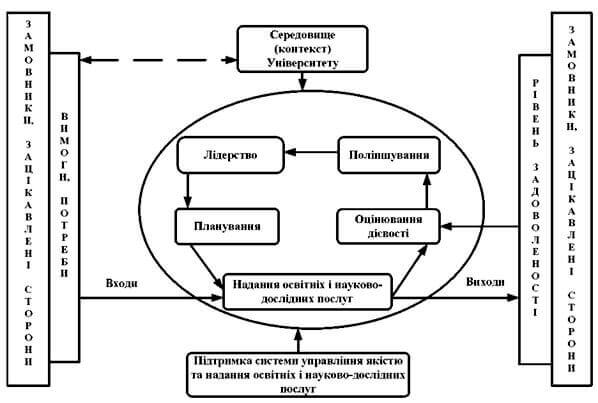
Figure B.1 - Structure of the University's Quality Management System
Appendix C
Classification of the University's Quality Management System Processes, Documents Describing Their Execution, and Cross-References with ISO 9001:2015, DSTU ISO 9001:2015
Table C.1
Regulation "On the Implementation of Sub-Threshold Procurement of Goods, Works, and Services", Regulation "On the Tender Committee"
7.1, 8.4
| Types of processes | Higher-level processes | First-level processes | Documents describing process execution | Clauses of ISO 9001:2015, DSTU ISO 9001:2015 | |
| Management processes | Organization of the quality management system | Determination of the University's context (environment) | University Statute, Regulation "On the Conference of the Labor Collective", Regulation "On the Quality Management System", Instruction "Management Review" | 4.1 | |
| Determination of the needs and expectations of interested parties | University Statute, Regulation "On the Quality Management System", Instruction "Management Review" | 4.2 | |||
| Determination of the scope and processes of the quality management system | Regulation "On the Quality Management System" | 4.3-4.4 | |||
| Leadership and its commitment | University Statute, Regulation "On the Supervisory Board", Regulation "On the Academic Council of the University", Regulation "On the Quality Management System", Regulation "On Quality Assurance (Quality of Educational Activity and Higher Education)", Instruction "Management Review" | 5.1 | |||
| Formulation, implementation, and updating of the quality policy | Regulation "On the Quality Management System", Regulation "On Quality Assurance (Quality of Educational Activity and Higher Education)", Instruction "Management Review" | 5.2 | |||
| Distribution of functions, responsibilities, and authorities within the University | University Statute, University Structure, Regulation "On the Quality Management System", Regulation "On Structural Units", Job Descriptions | 5.3 | |||
| Planning | Management of risks and opportunities | Regulation "Risk Management", Regulation "On the Quality Management System" | 6.1 | ||
| Establishing quality objectives and ensuring their achievement | Regulation "On the Quality Management System", Instruction "Management Review" | 6.2 | |||
| Planning of changes | Regulation "On the Quality Management System", Instruction "Management Review" | 6.3 | |||
| Evaluation of performance and improvement | Monitoring, measurement, analysis, and evaluation | Regulation "On the Quality Management System", Regulation "On Quality Assurance (Quality of Educational Activity and Higher Education)" | 9.1 | ||
| Internal audit | Regulation "On the Quality Management System", Regulation "Planning and Conducting Internal Audits", Regulation "On Quality Assurance (Quality of Educational Activity and Higher Education)" | 9.2 | |||
| Review of the quality management system by the University leadership | Regulation "On the Quality Management System", Instruction "Management Review" | 9.3 | |||
| Control of nonconformities and corrective actions | Regulation "On the Quality Management System", Instruction "Nonconformity and Corrective Actions" | 10.2 | |||
| Continual improvement | Regulation "On the Quality Management System", Regulation "On Quality Assurance (Quality of Educational Activity and Higher Education)" | 10.1, 10.3 | |||
| Core processes (provision of educational and research services) | Organization of the educational process | Planning of the educational process | Regulation "On the Organization of the Educational Process", Regulation "On Quality Assurance (Quality of Educational Activity and Higher Education)", Regulation "Time Norms for Planning and Accounting of the Work of Scientific and Pedagogical Personnel", Regulation "Time Norms for Planning and Accounting of the Work of Scientific and Pedagogical Personnel in the Organization of the Educational Process Using Distance Learning Technologies", Regulation "On the Formation of the Training Course Program", Regulation "On the Procedure for Creating and Organizing the Work of the State Examination Commission at the National Aerospace University 'Kharkiv Aviation Institute'", Regulation "On the Formation of the Work Program of a Training Course" | 8.1 | |
| Educational and organizational activity | Regulation "On the Organization of the Educational Process", Regulation "On the Educational and Organizational Department", Regulation "Procedure for Ordering and Issuing Higher Education Documents" | 7.5, 8.1, 8.2, 8.5, 8.6, 8.7 | |||
| Educational and methodological activity | Regulation "On the Organization of the Educational Process", Regulation "On the Educational and Methodological Department", Regulation "On the System for Preventing and Detecting Academic Plagiarism" | 7.1.5, 7.5, 8.1, 8.3, 8.5, 8.6, 8.7 | |||
| Educational and analytical activity | Regulation "On the Organization of the Educational Process", Regulation "On the Educational and Analytical Department", Regulation "On the Procedure for Maintaining Attendance and Academic Performance Record Journals of Academic Groups" | 7.1.5, 7.5, 8.1, 8.2, 8.3, 8.5, 8.6, 8.7 | |||
| Formation of the student body | Pre-university education | Regulation "On Quality Assurance (Quality of Educational Activity and Higher Education)", Regulation "On the Pre-University Education Department" | 8.1, 8.2 | ||
| Career guidance work | Regulation "On the Organization of the Educational Process", Regulation "On the Marketing of Educational and Scientific Services and the Labor Market" | 8.1, 8.2 | |||
| Work of the Admissions Committee | Regulation "On the Admissions Committee", Terms and Rules of Admission, Regulation "On the Organization of the Educational Process" | 8.1, 8.2 | |||
| Design and development of educational programs |
| Regulation "On the Organization of the Educational Process", Regulation "On Quality Assurance (Quality of Educational Activity and Higher Education)" | 8.3 | ||
| Provision of educational services | Full-time education | Regulation "On the Organization of the Educational Process", Regulation "On Quality Assurance (Quality of Educational Activity and Higher Education)", Regulation "On Ensuring Students' Right to Choose Disciplines", Regulation "On the Procedure for Transferring Academic Disciplines and Determining Academic Difference", Regulation "Organization of Diploma Projects (Works) Execution", Regulation "On Independent Work of Students at the National Aerospace University 'Kharkiv Aviation Institute'", Regulation "On Student Self-Government of the National Aerospace University 'Kharkiv Aviation Institute'" | 8.5, 8.6 | ||
| Part-time (distance) education | Regulation "On the Organization of the Educational Process", Regulation "On Distance Learning", Regulation "On Quality Assurance (Quality of Educational Activity and Higher Education)", Regulation "On Ensuring Students' Right to Choose Disciplines", Regulation "On the Distance Learning Course", Regulation "On the Procedure for Transferring Academic Disciplines and Determining Academic Difference", Regulation "Organization of Diploma Projects (Works) Execution", Regulation "On Independent Work of Students at the National Aerospace University 'Kharkiv Aviation Institute'" | 8.5, 8.6 | |||
| Education of foreign citizens | Regulation "On the Organization of the Educational Process", Regulation "On Quality Assurance (Quality of Educational Activity and Higher Education)", Regulation "On the Organization of Admission and Education of Foreign Citizens Studying in Ukrainian (Russian) Language in Full-Time Form of Study at the National Aerospace University 'Kharkiv Aviation Institute'" | 8.5, 8.6 | |||
| Provision of paid educational services for professional development | University Statute, Regulation "On the Organization of the Educational Process", Regulation "Training Courses for Category 'B' Vehicle Drivers", Regulation "On Professional Development and Internship of Pedagogical and Scientific-Pedagogical Personnel and Industry Specialists at the University" | 8.5, 8.6 | |||
| Provision of research and development services |
| Regulation "On the Department for the Organization and Implementation of Scientific Research", Regulation "On the Organization of Scientific and Scientific-Technical Activities" | 8.5, 8.6 | ||
| Educational and extracurricular activities | Educational activities | Regulation "On Quality Assurance (Quality of Educational Activity and Higher Education)", Regulation "On the Organization of the Educational Process" | 8.5, 8.6, 8.7 | ||
| Ensuring scientific and creative development of students | Regulation "On Quality Assurance (Quality of Educational Activity and Higher Education)", Regulation "On the Organization of the Educational Process" | 8.5, 9.1.2 | |||
| Control of nonconforming outputs | Transfer, expulsion, and reinstatement | Regulation "On Quality Assurance (Quality of Educational Activity and Higher Education)", Regulation "On the Procedure for Clearing Academic Deficiencies", Regulation "On the Procedure for Transfer, Expulsion, and Reinstatement of Students" | 8.7 | ||
| Organization of internships and employment of graduates | Interaction with enterprises | Regulation "On the Department for Promoting Student and Graduate Employment of the National Aerospace University 'Kharkiv Aviation Institute'" | 4.2, 8.2, 8.5, 9.1.2 | ||
| Promotion of graduate employment | Regulation "On the Department for Promoting Student and Graduate Employment of the National Aerospace University 'Kharkiv Aviation Institute'" | 4.2, 8.2, 8.5, 9.1.2 | |||
| International activities |
| Regulation "On Academic Mobility of Students and Postgraduate Students of the National Aerospace University 'Kharkiv Aviation Institute'", Regulation "On the Organization of Admission and Education of Foreign Citizens Studying in Ukrainian (Russian) Language in Full-Time Form of Study at the National Aerospace University 'Kharkiv Aviation Institute'" | 4.2, 8.1, 8.2, 8.3, 8.5, 8.6, 8.7, 9.1.3 | ||
| System support processes | Human resource (personnel) management | Staffing | Collective Agreement, Regulation "On the Procedure for Conducting a Competition for Vacant Positions, Appointment and Dismissal from Positions, Extension of the Work Term of Scientific and Pedagogical Personnel of the National Aerospace University 'Kharkiv Aviation Institute'" | 7.1.1, 7.1.2 | |
| Knowledge management (mentorship) | Regulation "On the Human Resources Department", Regulation "On the Quality Management System" | 7.1.1, 7.1.6 | |||
| Personnel evaluation | Regulation "On Certification of Pedagogical Personnel", Regulation "Rating Evaluation of the Activity of Scientific and Pedagogical Personnel, Departments, and Faculties" | 7.1.1, 7.1.6, 7.2 | |||
|
| Professional development | Regulation "On Professional Development and Internship of Pedagogical and Scientific-Pedagogical Personnel and Industry Specialists at the University" | 7.1.1, 7.1.6, 7.2 | ||
| Informing personnel | Regulation "On the Quality Management System" | 7.3, 7.4 | |||
| Stimulation and motivation of personnel | Collective Agreement, Regulation "On the Bonus System for KhAI Lecturers Conducting Scientific Supervision of Foreign Postgraduate Students and Scientific Consulting of Foreign Doctoral Students", Regulation "On the Procedure for Conferring Honorary Titles", Regulation "On the Professional Mastery Competition 'IKARY KhAI'" | 7.1.2 | |||
| Management of infrastructure and environment for process operation | Telecommunication and technical support | Regulation "On the Quality Management System", Regulation "On the Educational and Scientific Center of Information Technologies", Regulation on KhAI Computer Networks, Procedure for Working on the Internet, Regulation on Technical Information Security | 7.1.1, 7.1.3, 7.1.4 | ||
| Administrative and economic activity | Passport of the sanitary and technical condition of working conditions at KhAI, Regulation "On the Quality Management System" | 7.1.1, 7.1.3, 7.1.4 | |||
| Ensuring safe working conditions (occupational safety and sanitary-hygienic conditions) | Regulation "On the Quality Management System", Regulation "On the Occupational Health and Safety Department", Passport of the sanitary and technical condition of working conditions at KhAI, Rules and instructions on occupational safety and life safety | 7.1.1, 7.1.3, 7.1.4 | |||
| Ensuring living conditions | University Statute, Collective Agreement, Regulation "On the Quality Management System" | 7.1.1, 7.1.3, 7.1.4 | |||
| Organization of leisure | University Statute, Collective Agreement | 7.1.1, 7.1.3, 7.1.4 | |||
| Security | Regulation "On the Security Department" | 7.1.1, 7.1.3, 7.1.4 | |||
| Management of resources for monitoring and measuring | Management of means for monitoring the quality of educational activity | Regulation "On the Quality Management System", Regulation "On the Modular-Rating System for Assessing Students' Knowledge", Regulation "On the Assessment of Residual Knowledge of Students (Conducting Rector's Control Tests in Academic Disciplines)" | 7.1.1, 7.1.5 | ||
| Management of measuring equipment | Regulation "On the Quality Management System" | 7.1.1, 7.1.5 | |||
| Information, library, and publishing activities | Activity of the scientific and technical library | Regulation "On the Scientific and Technical Library", Rules of the Scientific and Technical Library | Public procurement | 7.1.3, 7.1.4, 8.4 | |
| Publishing activity | Regulation "On the Publishing Center" | 7.1.1, 7.1.3, 7.1.4 | |||
| Information and advertising activities | Informing | Instruction "Internal Informing of Personnel" | 7.4 | ||
| Public information | Regulation "On the Quality Management System", Regulation "On Ensuring Access to Public Information at the National Aerospace University 'Kharkiv Aviation Institute'" | ||||
| Advertising activity | Regulation "On the Educational and Scientific Center of Information Technologies" | 7.4, 8.2 | |||
| Management of documented information | Management of QMS documented information | Regulation "On the Quality Management System", Regulation "Management of Documented Information", Instruction "Procedure for Preparing Regulations on Structural Units" | 7.5 | ||
| Office work | Instruction on Office Work | 7.5 | |||
| Control of customer's property | Preservation of student documents | Regulation "On the Archive", Regulation "On the Human Resources Department" | 8.5.3 | ||
| Financial and economic activity | Public procurement | Regulation "On Public Procurement", Regulation "On the Quality Management System" | 7.1.3, 7.1.4, 8.4 | ||
|
| Financial activity | Regulation "On the Provision of State Targeted Support to Certain Categories of Students Related to Living in Dormitories of the National Aerospace University 'Kharkiv Aviation Institute'" | 7.1 | ||
Appendix G
Distribution of Responsibility for the Processes of the University's Quality Management System
Table G.1
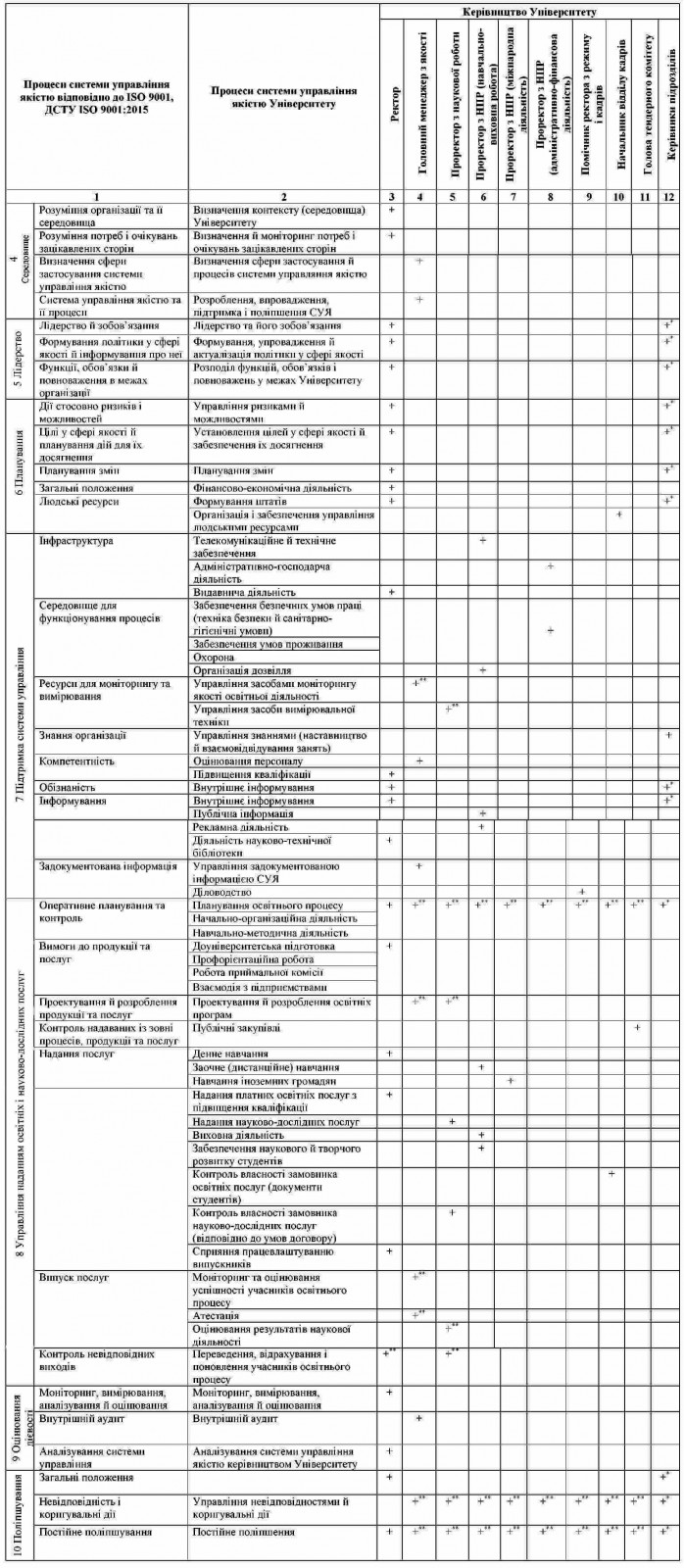
Note:
* responsible within the subordinate unit;
** responsible in the sphere of the University's subordinate activity.