Regulations on the Occupational Safety and Health Management System
of the National Aerospace University
«Kharkiv Aviation Institute»
Enacted by Order No. 268 of June 05, 2020
Date of introduction: June 05, 2020
Fourth Edition, revised and supplemented
1. General Provisions
1.1. Regulations on the Occupational Safety and Health Management System (hereinafter – Regulations on the OSHMS) of the National Aerospace University “Kharkiv Aviation Institute” (hereinafter – the University) define the procedure for interaction between structural units on occupational safety issues, the responsibility of their heads, as well as the principles, methods, tasks, functions, and components of the occupational safety and health management system.
1.2. Occupational Safety and Health Management System is part of the overall management system of the University, which contributes to the prevention of occupational accidents and diseases, as well as hazards to third parties arising in the process of management, and contains a set of interrelated measures aimed at fulfilling the requirements of legislative and regulatory acts on occupational safety.
1.3. The main goal of the OSHMS at the University is the formation of safe and harmless working and learning conditions.
1.4. Management of the OSHMS is ensured:
- in the University as a whole — by the Rector of the University through Assistants to the Rector and Vice-Rectors for the respective areas;
- in divisions (faculty, department, division) — by heads of divisions.
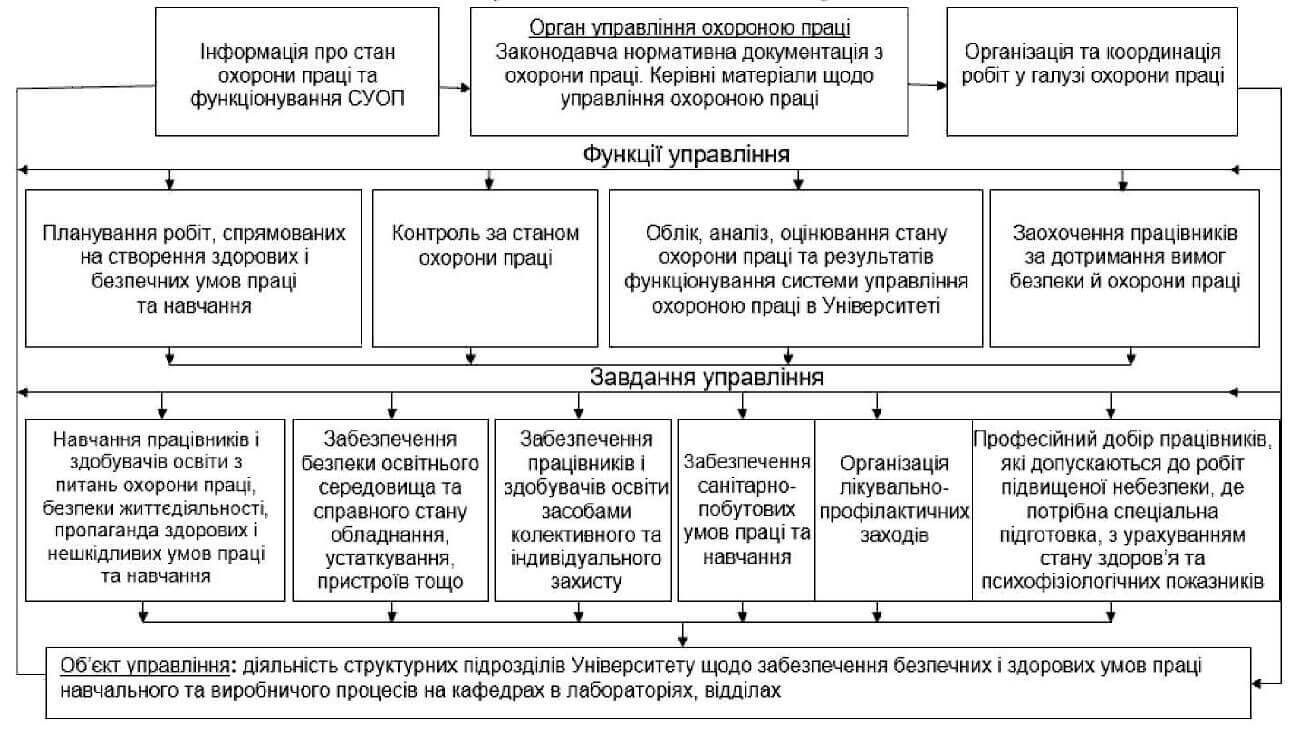
1.5. The functioning of the OSHMS at the University is carried out in accordance with the Implementation Scheme of OSHMS Tasks (Appendix 1 to the Regulations on the OSHMS of the University).
2. Basic Principles of the Occupational Safety and Health Management System
2.1. Principle of comprehensiveness – implementation of socio-economic, organizational-technical, and sanitary-hygienic measures to resolve occupational safety issues.
2.2. Principle of systematicity – interconnected methods and means used to perform the above measures regarding the working environment.
2.3. Principle of continuity – systematic, regular, and uninterrupted use of all management functions to ensure safe and harmless working and learning conditions.
2.4. Principle of dynamism – improvement of methods and forms of occupational safety management taking into account advanced domestic and world experience.
2.5. Principle of scientific grounding – use of a scientific approach to hazard and risk analysis, development of recommendations, and decision-making regarding working and learning conditions.
2.6. Principle of optimization – selection of the most optimal decision when performing occupational safety tasks.
2.7. Principle of standardization – ordering of requirements for ensuring safe and harmless working conditions in the form of state regulatory acts on occupational safety.
2.8. Principle of responsibility – responsibility of each employee for compliance with occupational safety requirements set forth in job descriptions, safety instructions for specific types of work or certain professions.
2.9. Principle of efficiency – analysis of the efficiency of decisions made in the process of occupational safety management.
3. Methods of Occupational Safety Management
3.1. Organizational and administrative:
3.1.1. Organizational measures (establishment of a commission on occupational safety issues, on accident investigation, development of the section «Working Conditions and Occupational Safety» of the collective agreement, regulatory acts on occupational safety, normative documents on life safety issues, performance by employees of their job duties on occupational safety, compliance of higher education students with life safety requirements, etc.).
3.1.2. Instructional and methodological measures (issuance and execution of orders, instructions, directives, decisions on occupational safety and life safety issues).
3.2. Socio-psychological:
3.2.1. Educational and instructional work with employees and higher education students on occupational safety and life safety issues.
3.2.2. Promotion of safe and harmless working and learning conditions, holding days, weeks, and awareness months on occupational safety and life safety issues.
3.2.3. Establishment of control and mutual control, strengthening work and learning discipline.
3.2.4. Moral encouragement.
3.3. Economic:
3.3.1. Material and moral incentives for high-level occupational safety performance and the creation of safe and harmless working and learning conditions.
4. Functions of the Occupational Safety and Health Management System
The occupational safety management system performs the following functions:
4.1. Planning of work aimed at creating healthy and safe working and learning conditions.
Planning of work on occupational safety and life safety at the University consists of developing plans, comprehensive measures, and lists for a year, quarter, or month in order to ensure safe and harmless working and learning conditions for participants in the educational process.
4.2. Monitoring the state of occupational safety.
Monitoring the state of occupational safety and life safety is one of the main functions of the occupational safety management system. Systematic control (continuous, periodic operational, selective), timely identification, and elimination of problematic situations are carried out for further improvement and health-improving of working and learning conditions at the University.
Continuous monitoring is carried out by employees and higher education students; requirements are established by occupational safety instructions. The goal is to monitor compliance of working conditions with occupational safety requirements before and during work.
Periodic operational control is carried out by supervisors of work and structural units, and teachers.
Selective control is carried out by the occupational safety service according to schedules.
4.3. Record-keeping, analysis, and evaluation of the state of occupational safety and the performance results of the occupational safety management system at the University.
With the help of record-keeping and analysis of working conditions, compliance of occupational safety management activities with established requirements is evaluated.
Record-keeping consists of registering and systematizing issues characterizing safety levels and working/learning conditions. Analysis determines the state of occupational safety and allows evaluating the functioning efficiency of the OSHMS.
Tasks of the OSHMS are fulfilled through the implementation of necessary management decisions.
4.4. Incentivizing employees for compliance with safety and occupational health requirements.
Incentivizing employees for compliance with safety and occupational health requirements is carried out through bonuses, additional pay, awards for participation in competitions for the best team, best expert in occupational safety and life safety issues, etc.
5. Tasks of the Occupational Safety and Health Management System
5.1. The main task of the occupational safety and health management system is to create conditions for the highly efficient functioning of the University.
5.2. Tasks of the occupational safety and health management system are fulfilled through:
- training employees and students on occupational safety, life safety issues, and promoting healthy and harmless working and learning conditions;
- ensuring the safety of the educational environment and the proper operational state of equipment, machinery, devices, etc.;
- providing employees and students with collective and personal protective equipment;
- providing sanitary and hygienic conditions for work and study;
- organizing medical and preventive measures;
- professional selection of employees admitted to high-risk work requiring special training, taking into account health status and psychophysiological indicators.
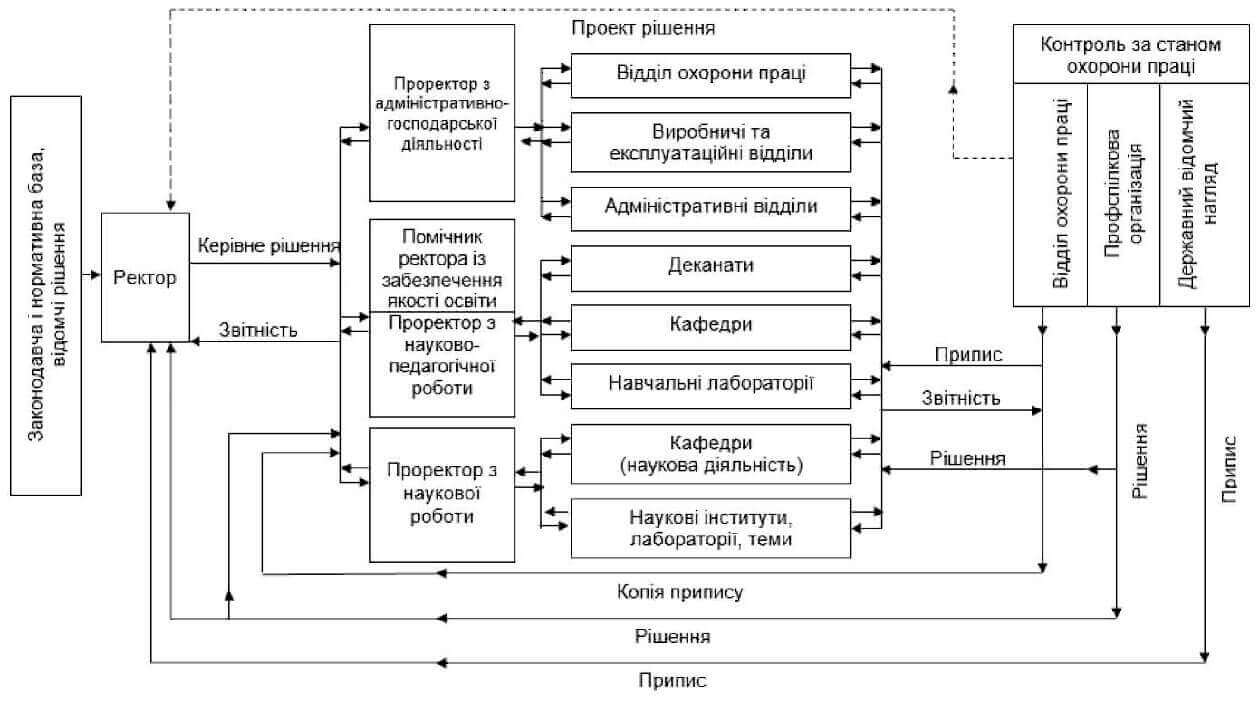
5.3. The resolution of OSHMS tasks is ensured by the interaction of all units of the University and is carried out according to the Scheme of Functional Interactions in Resolving OSHMS Tasks at the National Aerospace University “Kharkiv Aviation Institute” (Appendix 2 to the Regulations on the OSHMS of the University).
6. Components of the Occupational Safety and Health Management System
6.1. Regulatory documents on occupational safety and life safety issues.
Regulatory legal acts on occupational safety are rules, norms, regulations, provisions, standards, instructions, and other documents that are mandatory for execution.
6.1.1. Legislation on occupational safety consists of the Law “On Occupational Safety”, the Labor Code of Ukraine, the Law of Ukraine “On Mandatory State Social Insurance Against Industrial Accidents and Occupational Diseases Which Caused Disability”, and regulatory legal acts adopted in accordance with them.
6.1.2. Regulations on the Organization of Work on Occupational Safety and Life Safety of Educational Process Participants in Educational Institutions and Establishments, approved by Order No. 1669 of the Ministry of Education and Science of Ukraine dated December 26, 2017, an excerpt from which is attached (Appendix 3 to the Regulations on the OSHMS of the University), defines the duties of officials regarding the provision of safe and harmless learning and working conditions at the University.
6.1.3. Regulations on the Occupational Safety Department of the University, approved by the Rector's Order dated October 04, 2016, an excerpt from which is attached (Appendix 4 to the Regulations on the OSHMS of the University), was developed on the basis of the Model Regulations on the Occupational Safety Service, approved by Order No. 255 of the State Committee of Ukraine for Occupational Safety and Health Supervision dated November 15, 2004, and defines the main tasks, functions, rights, and duties of employees of the occupational safety department.
6.1.4. University regulations and instructions on occupational safety are internal regulatory legal acts of the University.
6.1.5. Occupational safety instructions are developed in accordance with the requirements of the Regulations on the Development of Occupational Safety Instructions, approved by Order No. 9 of the Occupational Safety Supervision Committee of the Ministry of Labor and Social Policy of Ukraine on January 29, 1998 (as amended by Order No. 526 of the Ministry of Social Policy of Ukraine dated March 30, 2017) (Appendix 5 to the Regulations on the OSHMS of the University).
6.2. Collective Agreement.
The collective agreement contains a section on occupational safety, as well as comprehensive measures to ensure safe and harmless working conditions, which are developed jointly with trade union representatives.
6.3. Maintenance of buildings, structures, premises, equipment.
Issues regarding the maintenance of buildings, structures, and premises are governed by the Regulations on the Service for Ensuring the Safe Operation of Buildings and Structures.
Issues regarding the readiness of premises for the academic year are specified in the certificate of acceptance of the University's readiness for the new academic year, drawn up by the relevant commission.
The safety of operating production and laboratory equipment is ensured by bringing it into compliance with the requirements of the Occupational Safety Rules during Operation, Technical Regulations, and labor safety standards through timely planned preventive maintenance, mandatory testing, and improvement of protective devices.
6.4. Occupational safety training.
Conducting training on occupational safety and life safety at the University is carried out in accordance with the Regulations on the Procedure for Conducting Training and Knowledge Testing on Occupational Safety and Life Safety at the National Aerospace University “Kharkiv Aviation Institute”, approved by Rector's Order No. 611 dated December 26, 2018 (Appendix 6 to the Regulations on the OSHMS of the University).
The list of professions and positions of employees exempted from repeated occupational safety briefings was approved by University Order No. 611 dated December 26, 2018 (Appendix 7 to the Regulations on the OSHMS of the University).
The list of high-risk works requiring special training and an annual knowledge check on occupational safety was approved by University Order No. 611 dated December 26, 2018 (Appendix 8 to the Regulations on the OSHMS of the University).
The list of positions and professions of employees of the National Aerospace University “Kharkiv Aviation Institute” who must undergo internship (shadowing) was approved by University Order No. 63 dated February 04, 2018 (Appendix 9 to the Regulations on the OSHMS of the University).
The procedure for organizing work performed under a work permit or order was approved by University Order No. 64 dated February 04, 2018.
The list of works performed under a work permit at the National Aerospace University “Kharkiv Aviation Institute” was approved by University Order No. 64 dated February 04, 2018 (Appendix 10 to the Regulations on the OSHMS of the University).
The list of works performed under verbal/written orders at the National Aerospace University “Kharkiv Aviation Institute” was approved by University Order No. 64 dated February 04, 2018 (Appendix 11 to the Regulations on the OSHMS of the University).
6.5. Personal and collective protective equipment.
Provision with personal protective equipment is carried out in accordance with the Minimum Health and Safety Requirements for the Use of Personal Protective Equipment by Workers at the Workplace, approved by Order No. 1804 of the Ministry of Social Policy of Ukraine dated November 29, 2018, and the Regulations on Health and Safety Requirements for the Use of Personal Protective Equipment by Workers at the Workplace at the National Aerospace University “Kharkiv Aviation Institute”, approved by Rector's Order No. 220 dated April 23, 2019 (Appendix 12 to the Regulations on the OSHMS of the University).
6.6. Occupational safety audit.
Conclusions regarding the occupational safety audit, research into working conditions, workplace attestation for compliance with regulatory legal acts on occupational safety, and monitoring employee compliance with rules for handling equipment and performing work according to occupational safety requirements are made by the occupational safety commission upon the order of the head during planned inspections of the University.
6.7. Investigation of accidents.
Accidents occurring to employees while performing their duties, and to students undergoing practical training at an enterprise, are investigated in accordance with the Procedure for the Investigation and Accounting of Accidents, Occupational Diseases, and Industrial Incidents, approved by Resolution No. 337 of the Cabinet of Ministers of Ukraine dated April 17, 2019.
Accidents occurring to students during the educational process are investigated in accordance with the Regulations on the Procedure for Investigating Accidents Occurring to Students During the Educational Process, approved by Order No. 659 of the Ministry of Education of Ukraine dated May 16, 2019.
Accidents occurring off-duty (non-occupational) are investigated in accordance with the Procedure for the Investigation and Accounting of Non-Occupational Accidents, approved by Resolution No. 270 of the Cabinet of Ministers of Ukraine dated March 22, 2001.
6.8. Prevention of accidents.
Based on the analysis of accidents occurring to participants in the educational process, employees of the occupational safety service carry out work on accident prevention, elimination of causes that led to accidents and occupational diseases, and provision of assistance to victims.
Appendix 1 to clause 1.5
Scheme
of Implementation of OSHMS Tasks
at National Aerospace University
"Kharkiv Aviation Institute"
Appendix 2 to clause 5.3
Scheme
of Functional Interactions in Resolving OSHMS Tasks
at National Aerospace University
"Kharkiv Aviation Institute"
Appendix 3 to clause 6.1.2
Excerpt from the Regulations on the Organization of Work on Occupational Safety
and Life Safety of Educational Process Participants in Educational Institutions and Establishments
4. Duties of Officials and Organization of Occupational Safety and Life Safety Work in Educational Institutions
1. Head of the educational institution (rector, director, head):
1) is responsible for creating safe conditions for the educational process in accordance with occupational safety legislation and these Regulations; does not allow the educational process to take place in the presence of harmful or dangerous conditions;
2) in accordance with the Model Regulations on the Occupational Safety Service, establishes an occupational safety and life safety service in the educational institution, which reports directly to them; appoints persons responsible for organizing work on occupational safety and life safety in the educational institution and defines their functional duties; ensures the operation of the occupational safety management system;
3) appoints by order persons responsible for the state of occupational safety in structural units, classrooms, laboratories, workshops, sports halls, shooting ranges, etc.;
4) approves job descriptions of heads of structural units and employees with a mandatory section covering occupational safety and life safety issues;
5) before the start of the academic year, as well as periodically during the academic year, evaluates the technical condition of equipment and machinery in the educational premises of the educational institutions;
6) takes measures to bring engineering and technical utilities, equipment, and machinery into compliance with current standards, rules, and norms on occupational safety;
7) enters into a collective agreement (agreement) containing a section on occupational safety and life safety, and ensures its execution;
8) ensures compliance with the requirements of regulatory legal acts on occupational safety, occupational safety and life safety measures provided for by the collective agreement (agreement), orders of state occupational safety supervision authorities, and proposals of the elected body of the primary trade union organization (trade union representative);
9) at meetings of the pedagogical council of the educational institution, meetings of heads of structural units, and persons responsible for the state of occupational safety and life safety, organizes reporting on injury prevention, implementation of measures under the occupational safety and life safety section of the collective agreement (agreement), and issues orders and directives on these matters;
10) organizes preventive work to prevent injuries and reduce morbidity among students and staff of educational institutions;
11) organizes work on the development of the introductory safety briefing program and ensures the delivery of all types of briefings:
- on occupational safety - in accordance with the Model Regulations;
- on life safety - in accordance with these Regulations;
12) organizes work on the development and periodic review (once every 5 years) of:
- occupational safety instructions for employees in accordance with the Regulations on the Development of Occupational Safety Instructions, approved by Order No. 9 of the Occupational Safety Supervision Committee of the Ministry of Labor and Social Policy of Ukraine dated January 29, 1998, and registered with the Ministry of Justice of Ukraine on April 07, 1998 under No. 226/2666 (as amended by Order No. 526 of the Ministry of Social Policy of Ukraine dated March 30, 2017) (hereinafter – Regulations on the Development of Instructions);
- safety instructions during training for students in accordance with these Regulations;
13) promotes public oversight of compliance with the requirements of regulatory legal acts on occupational safety;
14) monitors the provision of students and staff of educational institutions with workwear, safety footwear, and other personal protective equipment in accordance with the Regulations on the Procedure for Providing Employees with Special Clothing, Special Footwear;
15) exercises control over the preparation of student work teams and student associations regarding the creation of safe and healthy conditions for work and rest at their locations;
16) facilitates dosimetric control in accordance with regulatory legal acts with mandatory registration in a special logbook;
17) ensures training on occupational safety and life safety for students and staff of educational institutions in accordance with legislation and these Regulations;
18) promotes the implementation of organizational and technical measures to introduce occupational safety standards, as well as workplace attestation regarding working conditions;
19) organizes mandatory preliminary and periodic medical examinations for staff of educational institutions in accordance with the Procedure for Conducting Medical Examinations of Workers of Certain Categories, approved by Order No. 246 of the Ministry of Health of Ukraine dated May 21, 2007, registered with the Ministry of Justice of Ukraine on July 23, 2007 under No. 846/14113 (as amended), and Order No. 280 of the Ministry of Health of Ukraine dated July 23, 2002 "On the Organization of Mandatory Preventive Medical Examinations of Workers of Certain Professions, Industries, and Organizations Whose Activities Are Related to Population Service and May Lead to the Spread of Infectious Diseases", registered with the Ministry of Justice of Ukraine on August 08, 2002 under No. 639/6927 (as amended);
20) prohibits the execution of work that adversely affects students, staff of educational institutions, and the environment;
21) maintains continuous contact with executive authorities and public associations regarding the prevention of injuries among students and staff of educational institutions;
22) in the event of an accident during the educational process, takes the measures provided for by the Regulations on the Procedure for Investigating Accidents.
2. Deputy Head (vice-rector, deputy director, head):
1) organizes and controls the implementation by heads of structural units (faculties, departments, study rooms, laboratories, etc.) of measures to create safe and harmless conditions for the educational process;
2) ensures the implementation of relevant requirements of regulatory legal acts on occupational safety and life safety into the educational process;
3) controls the arrangement and equipment of study rooms, workshops, laboratories, sports halls, etc.;
4) exercises control over the safe use of educational equipment, devices, chemical reagents, etc., used during the educational process, in accordance with the model lists approved by the order of the Ministry of Education and Science of Ukraine;
5) participates in the preparation of student work teams and student associations regarding the creation of safe and harmless conditions for work and rest at their locations;
6) once every three years, organizes training and knowledge testing of educational institution employees on occupational safety and life safety, and participates as a member of the knowledge testing commission;
7) controls the delivery of occupational safety and life safety briefings to students and employees in structural units;
8) ensures work on the development and periodic review (once every 5 years) of occupational safety instructions for educational institution employees and safety instructions during training for students when performing practical and laboratory work in study rooms, laboratories, workshops, etc.;
9) ensures the development of occupational safety instructions for professions or types of work with increased danger, which are reviewed once every 3 years in accordance with the Regulations on the Development of Instructions;
10) participates in the development of the occupational safety and life safety section of the collective agreement (agreement);
11) approves daily storage and consumption limits for poisonous substances, flammable liquids, and other fire- and explosion-hazardous materials agreed upon with the occupational safety and life safety service;
12) controls compliance by educational institution employees with job descriptions regarding the provision of occupational safety and life safety;
13) promotes public oversight of compliance with the requirements of regulatory legal acts on occupational safety.
3. Dean of Faculty:
1) ensures the creation of safe and harmless conditions for the educational process;
2) ensures the conduct of classes, practical training of students, scientific research, and other work at academic departments, in student scientific clubs, and scientific societies in accordance with the requirements of regulatory legal acts on occupational safety;
3) manages the development and periodic review of occupational safety instructions and safety instructions during training, agrees them with the occupational safety and life safety service, and submits them to the head of the educational institution for approval;
4) organizes the delivery of life safety briefings for students at the faculty;
5) ensures training and knowledge testing of faculty staff on occupational safety and life safety issues;
6) organizes assistance in the preparation of student work teams, verifies the presence of safe and harmless conditions for work and rest at their locations;
7) promotes public oversight of compliance with the requirements of regulatory legal acts on occupational safety;
8) monitors the inclusion of occupational safety and life safety issues in textbooks, learning guides, and methodological guidelines for disciplines taught at the departments of the faculty;
9) ensures, jointly with the trade union representative, systematic review of working and learning conditions in units at faculty meetings, organizes the study, generalization, and dissemination of best practices in occupational safety and life safety;
10) participates in interdepartmental meetings and conferences on occupational safety and life safety issues;
11) participates in the development of a separate section on occupational safety and life safety of the collective agreement (agreement).
4. Head of Department:
1) is responsible for creating safe and harmless conditions for the educational process at the department;
2) includes occupational safety and life safety issues in educational programs, methodological recommendations for laboratory work, course works, diploma papers, and projects;
3) organizes the development and periodic review (once every 5 years) of occupational safety instructions and safety instructions during training, agrees them with the occupational safety service of the educational institution, and submits them to the head for approval;
4) conducts occupational safety briefings with each employee of the department, recording them in the logbook in accordance with the Model Regulations;
5) organizes the delivery of occupational safety and life safety briefings to students;
6) ensures training and knowledge testing on occupational safety issues for students and employees working in high-risk conditions;
7) prepares and submits requisitions for workwear, safety footwear, and other personal protective equipment in accordance with the Regulations on the Procedure for Providing Employees with Special Clothing, Special Footwear;
8) ensures the timely attendance of employees for periodic medical examinations in accordance with Order No. 280 of the Ministry of Health of Ukraine dated July 23, 2002 "On the Organization of Mandatory Preventive Medical Examinations of Workers of Certain Professions, Industries, and Organizations Whose Activities Are Related to Population Service and May Lead to the Spread of Infectious Diseases", registered with the Ministry of Justice of Ukraine on August 08, 2002 under No. 639/6927 (as amended);
9) carries out control over the state of occupational safety and life safety jointly with the trade union representative;
10) participates in the development of a separate section on occupational safety and life safety of the collective agreement (agreement);
11) in the event of an accident during the educational process, takes the measures provided for by the Regulations on the Procedure for Investigating Accidents.
5. Head of Study Room, Laboratory, Workshop, Educational and Production Workshop (Senior Instructor, Practical Training Instructor):
1) is responsible for the safe condition of workplaces, equipment, devices, tools, inventory, etc.;
2) does not admit students and staff of the educational institution to classes or work without the provided workwear, safety footwear, and other personal protective equipment;
3) demands, in accordance with the established procedure, the provision of workwear, safety footwear, and other personal protective equipment for students and staff of the educational institution in accordance with the Regulations on the Procedure for Providing Employees with Special Clothing, Special Footwear;
4) in accordance with these Regulations, develops and reviews (once every 5 years) safety instructions during training in study rooms, laboratories, educational and production workshops, educational farms, sports halls, etc.;
5) allows the use of equipment installed in laboratories, study rooms, educational farms, workshops, sections, and proving grounds that is provided for by the model lists approved by the Ministry of Education and Science of Ukraine;
6) monitors compliance with safe and harmless conditions for conducting practical training of students at enterprises, institutions, and organizations, and does not allow performance of work not provided for by the terms of the agreement;
7) delivers occupational safety briefings during the educational and production process;
8) delivers life safety briefings or monitors their delivery by the teacher or instructor;
9) participates in the development of a separate section on occupational safety and life safety of the collective agreement (agreement);
10) in the event of an accident during the educational process, takes the measures provided for by the Regulations on the Procedure for Investigating Accidents.
6. Teacher (instructor, primary school teacher, group curator, class teacher, educator):
1) is responsible for preserving the life and health of students during the educational process;
2) ensures the conduct of the educational process as regulated by legislative and regulatory legal acts on occupational safety and life safety;
3) organizes the study of occupational safety and life safety rules and standards by students;
4) delivers briefings to students:
- on occupational safety - during practical training and work practice in accordance with the Model Regulations;
- on life safety - during classes, extracurricular, and out-of-school events;
- introductory at the beginning of the academic year - with registration of the introductory life safety briefing of students in the Class Register (Appendix 1) on the page of the class teacher or group curator;
- primary, unscheduled, and targeted - with registration in the Logbook for Registration of Primary, Unscheduled, and Targeted Life Safety Briefings for Students (Appendix 2);
- primary before the start of a lesson (new topic, laboratory work, practical work, etc.) - with registration in the registers of classes and practical training on the subject page in the line for lesson content, lecture, practical work, etc.;
5) monitors compliance by students with safety rules (instructions);
6) carries out preventive work to prevent injuries among students during the educational process;
7) carries out preventive work among students regarding personal safety requirements off-duty (actions in emergency situations, road traffic, participation in public events, presence in public places, retail facilities, etc.);
8) in the event of an accident during the educational process, takes the measures provided for by the Regulations on the Procedure for Investigating Accidents.
5. Organization of Occupational Safety and Life Safety Work During Research Activities in Educational Institutions
1. Deputy Head (Vice-Rector) for Research:
1) organizes work and exercises control over the implementation of measures to create safe and harmless conditions during research, experimental development, and expeditionary work, as well as in student scientific societies and design bureaus in accordance with occupational safety legislation and these Regulations;
2) organizes training and knowledge testing on occupational safety and life safety for scientific and research-pedagogical staff of structural units;
3) organizes work on the development and periodic review of occupational safety instructions during research work;
4) approves occupational safety instructions effective in research and experimental development (including student) units in accordance with the established procedure, and controls their execution;
5) organizes the provision of educational expeditions, parties, and units with equipment, gear, personal protective equipment, and occupational safety instructions, as well as approves readiness acts for the departure of educational expeditions, parties, and units for research and expeditionary work;
6) participates in the development of a separate section on occupational safety and life safety of the collective agreement (agreement);
7) promotes public oversight of compliance with the requirements of regulatory legal acts on occupational safety;
8) in the event of an accident during the educational process, takes the measures provided for by the Regulations on the Procedure for Investigating Accidents.
2. Head of Research Sector (Deputy Head of Research Department):
1) exercises direct management and is responsible for organizing and maintaining safe and harmless conditions for research, experimental development, and expeditionary work in accordance with occupational safety legislation and these Regulations;
2) organizes research work only in the presence of premises, devices, equipment, and installations that comply with the requirements of occupational safety standards, rules, and norms, and have been accepted into operation;
3) reviews and submits contracts for research and experimental development work to the vice-rector for research for approval after agreement with the occupational safety and life safety service;
4) participates in the development of a separate section on occupational safety and life safety of the collective agreement (agreement);
5) promotes public oversight of compliance with the requirements of regulatory legal acts on occupational safety;
6) in the event of an accident during the educational process, takes the measures provided for by the Regulations on the Procedure for Investigating Accidents.
3. Head of Research Project (Topic):
1) exercises direct management and is responsible for organizing and providing safe and harmless conditions for research and experimental development work in accordance with occupational safety legislation and these Regulations;
2) organizes research work only in the presence of premises, devices, installations, equipment, and machinery that comply with occupational safety standards, rules, and norms;
3) is responsible for the safe operation of devices, installations, equipment, as well as protective, signaling, and fire safety devices, measuring instruments, pressure vessels, and the safe use, provision, and transportation of explosive, poisonous, radioactive, flammable, and other substances harmful to life and health;
4) conducts primary (at the workplace), repeated, and unscheduled occupational safety briefings for participants in the educational process in accordance with the Model Regulations, admitting them to independent work;
5) develops safety instructions for the safe use of new materials, equipment, and the performance of relevant processes;
6) promotes public oversight of compliance with the requirements of regulatory legal acts on occupational safety;
7) participates in the development of the occupational safety and life safety section of the collective agreement (agreement);
8) in the event of an accident during the educational process, takes the measures provided for by the Regulations on the Procedure for Investigating Accidents.
6. Organization of Occupational Safety and Life Safety Work During Extracurricular and Out-of-School Activities
1. Deputy Head of the Educational Institution for Educational Work:
1) takes necessary measures to create safe and harmless conditions, comply with sanitary and hygienic norms and occupational safety, life safety requirements during extracurricular and out-of-school events;
2) controls and provides methodological assistance to leaders of clubs, interest groups, sports sections, hikes, excursions, labor associations, public works, etc., on creating safe and harmless working and resting conditions for students and preventing injuries;
3) conducts occupational safety and life safety briefings for primary teachers, class teachers, instructors, and other persons involved in organizing extracurricular and out-of-school work;
4) organizes preventive work among students on occupational safety and life safety during the educational process;
5) in the event of an accident during the educational process, takes the measures provided for by the Regulations on the Procedure for Investigating Accidents.
2. Head of Club, Interest Group, Section (Coach):
1) ensures the safe condition of workplaces, safe operation of equipment, devices, tools, sports gear (inventory), etc.;
2) conducts occupational safety briefings with employees and life safety briefings with students;
3) does not allow pupils, students, or cadets to work without appropriate workwear, safety footwear, and other personal protective equipment in accordance with the Regulations on the Procedure for Providing Employees with Special Clothing, Special Footwear;
4) in the event of an accident during the educational process, takes the measures provided for by the Regulations on the Procedure for Investigating Accidents;
5) conducts preventive occupational safety and life safety work among students.
7. Organization of Occupational Safety Work During Administrative and Maintenance Activities in Educational Institutions
1. Deputy Head for Administrative and Maintenance Work (Facilities Manager, Head of Maintenance Department):
1) operates and maintains buildings, structures, and territories in accordance with occupational safety legislation;
2) ensures compliance with occupational safety rules during the operation of production, power, ventilation equipment, machinery, mechanisms, steam and hot water boilers, and pressure vessels;
3) monitors compliance with cargo movement standards and the sanitary and hygienic condition of utility, auxiliary premises, and territories in accordance with occupational safety legislation;
4) provides classrooms, laboratories, study rooms, maintenance, and socio-cultural units of the educational institution with equipment and inventory in accordance with occupational safety legislation;
5) provides students and staff of the educational institution with workwear, safety footwear, and other personal protective equipment in accordance with the Regulations on the Procedure for Providing Employees with Special Clothing, Special Footwear, organizes periodic testing of dielectric protective equipment, as well as accounting, storage, issuance, laundering, drying, disinfection, and repair of workwear;
6) organizes measurement of insulation resistance of electrical installations and wiring, grounding devices, periodic testing and inspections of lifting machinery and mechanisms, steam and hot water boilers, pressure vessels, air analysis for dust, gas, and harmful vapor content, measurement of lighting, noise, and vibration, as well as radiation monitoring in the premises of the educational institution in accordance with regulatory legal acts;
7) organizes training with specialized organizations for personnel servicing boilers and water heaters, liquefied gas cylinders, compressors and vessels, electrical installations, and other high-risk units and mechanisms;
8) organizes warehouse storage of fuel, poisonous materials, flammable and combustible liquids, liquefied gas cylinders, equipment, raw materials, supplies, etc., in accordance with occupational safety rules and norms and the Fire Safety Rules for Educational Institutions and Educational System Organizations of Ukraine, approved by Order No. 974 of the Ministry of Education and Science of Ukraine dated August 15, 2016, and registered with the Ministry of Justice of Ukraine on September 08, 2016, under No. 1229/29359;
9) in accordance with the Regulations on the Development of Instructions, develops and periodically reviews occupational safety instructions when performing specific maintenance work, agreeing them with the occupational safety service;
10) conducts occupational safety briefings, ensures training on occupational safety and life safety issues in administrative and maintenance units;
11) promotes public oversight of compliance with the requirements of regulatory legal acts on occupational safety;
12) participates in the development of a separate section on occupational safety and life safety of the collective agreement (agreement);
13) organizes work to create safe and harmless working conditions at the motor transport enterprise, fleet, garage of the educational institution, etc., in accordance with the requirements of regulatory legal acts on occupational safety;
14) in the event of an accident during the educational process, takes the measures provided for by the Regulations on the Procedure for Investigating Accidents.
2. Chief Engineer (Chief Power Engineer, Chief Mechanic) of Educational Institution:
1) exercises direct management and is responsible for organizing and performing work in subordinate engineering and technical services in accordance with occupational safety legislation and these Regulations;
2) ensures the operation and maintenance of buildings, structures, production premises, equipment, machinery, mechanisms, electrical installations, electric power, electric lighting, heating, gas, and sewage networks, and ventilation systems in accordance with occupational safety rules and norms;
3) identifies the causes of accidents involving machinery, mechanisms, electrical installations, and equipment, keeps records and analysis of accidents, and develops and takes measures to prevent accidents;
4) organizes, in accordance with regulatory legal acts on occupational safety:
- scheduled preventive repairs;
- preventive testing of equipment, machinery, mechanisms, pressure vessels, and apparatus;
- measurement of insulation resistance of electrical installations, electrical wiring, and grounding devices;
5) develops and implements measures for the mechanization and automation of manual labor, heavy, and labor-intensive processes;
6) ensures safe and harmless working conditions during assembly, disassembly, and repair work at controlled facilities, equips workplaces with necessary auxiliary gear and fencing, safety signs, and issues work permits to employees for high-risk work;
7) registers facilities of the educational institution subject to state supervision and prepares relevant documents;
8) develops occupational safety instructions during the operation of machinery, mechanisms, devices, and the performance of specific work;
9) conducts occupational safety briefings with each subordinate employee, registering them in the logbook in accordance with the Model Regulations;
10) participates in the development of a separate section on occupational safety and life safety of the collective agreement (agreement) within their competence;
11) promotes public oversight of compliance with the requirements of regulatory legal acts on occupational safety;
12) in the event of an accident during the educational process, takes the measures provided for by the Regulations on the Procedure for Investigating Accidents.
3. Head of Production Section (Workshop) (Work Supervisor) in Educational Institution:
1) implements necessary occupational safety measures, as well as systematic monitoring of the condition and operation of workplaces;
2) supervises the correct and safe use of equipment, machinery, mechanisms, power installations, and vehicles operating under their supervision;
3) develops occupational safety instructions during the operation of machinery, mechanisms, devices, and the performance of specific work;
4) monitors the timely issuance of appropriate workwear, safety footwear, and personal protective equipment to employees;
5) conducts occupational safety briefings and ensures timely training of employees in safe work skills in accordance with the Model Regulations;
6) issues work authorization permits to employees for work in workshop subdivisions (sections) and documents for stopping the operation of machinery, mechanisms, etc.;
7) organizes the use of visual occupational safety promotion materials – instructions, memos, posters, etc.;
8) in the event of an accident during the educational process, takes the measures provided for by the Regulations on the Procedure for Investigating Accidents.
4. Master of Production Section (Workshop):
1) organizes the safe conduct of work;
2) conducts systematic monitoring of the condition of production and ventilation equipment, scaffolding, protective devices, shoring for foundation pits, trenches, etc.;
3) regularly inspects cleanliness and order at workplaces, passages, and access tracks, ensures sufficient lighting of workplaces, and proper maintenance and operation of crane tracks;
4) conducts workplace occupational safety briefings with employees during work performance in accordance with the Model Regulations;
5) monitors the correct use of workwear, safety footwear, and other personal protective equipment, compliance with load carrying standards, and the provision of workplaces with cautionary signs and posters;
6) in the event of an accident during the educational process, takes the measures provided for by the Regulations on the Procedure for Investigating Accidents.
5. Chief Accountant (Accountant):
1) monitors expenditure of funds allocated for implementing measures under the occupational safety and life safety section of the collective agreement (agreement), and ensures the implementation of measures provided for by regulatory legal acts on occupational safety and life safety;
2) keeps track of funds spent on implementing occupational safety measures, and prepares a certificate for the head of the educational institution regarding actual expenditures for performing these works;
3) organizes subscriptions to periodicals on occupational safety and life safety.
6. Head of Human Resources Department (HR Inspector):
1) processes employment for persons who have passed the introductory briefing and workplace occupational safety briefing, as well as transfers to another job based on a medical certificate of passing a preliminary (periodic) medical examination of an employee in the form specified in Appendix 8 of the Procedure for Conducting Medical Examinations of Workers of Certain Categories, approved by Order No. 246 of the Ministry of Health of Ukraine dated May 21, 2007, and registered with the Ministry of Justice of Ukraine on July 02, 2007, under No. 846/14113 (hereinafter - medical certificate);
2) processes employment for persons following a preliminary medical examination in healthcare institutions, and refers persons involved in high-risk work for periodic medical examinations, retaining their medical certificates;
3) issues referrals for employees of the educational institution involved in high-risk work for special training and knowledge testing on occupational safety;
4) processes employment for women and persons under eighteen years of age taking into account legislative and regulatory legal acts on the employment of minors and women;
5) monitors the presence of job descriptions containing a block of issues on occupational safety and life safety.
Appendix 4 to clause 6.1.3
Extract from the Regulations on the Occupational Safety Department
2. Main Tasks
The main tasks of the occupational safety department are:
2.1. Ensuring the functioning of the occupational safety management system of the University, as well as professional support for the decisions of the University Rector on occupational safety, fire safety, and environmental protection.
2.2. Organization of preventive measures aimed at eliminating harmful and hazardous occupational factors, preventing occupational accidents, occupational diseases, and other cases of threat to the life or health of University employees.
2.3. Studying and promoting the implementation of scientific and technical achievements, progressive and safe technologies, and modern collective and personal protective equipment for University employees and students into operational and educational processes.
2.4. Monitoring compliance by employees with the requirements of laws and other regulatory legal acts on occupational safety, fire safety, environmental protection, provisions of the "Occupational Safety" section of the collective agreement, and occupational safety acts effective within the University.
2.5. Informing and providing clarifications to University employees on issues of occupational safety, fire safety, and environmental protection.
3. Functions
3.1. The main line of activity of the occupational safety department is ensuring a high-quality educational process, as well as the effective functioning of the Quality Management System (QMS) of the University.
3.2. To accomplish its tasks, the occupational safety department performs the following functions by areas of activity:
- developing, jointly with other units of the University, comprehensive measures to achieve established standards and raise the existing level of occupational safety, fire safety, environmental protection, as well as plans and programs for improving working conditions and preventing occupational injuries and occupational diseases, providing organizational and methodological assistance in implementing planned measures;
- preparing draft orders on issues of occupational safety, fire safety, environmental protection, and submitting them for consideration by the University Rector after approval with the relevant vice-rectors;
- conducting, jointly with representatives of other structural units and with the participation of representatives of the University trade union, inspections of compliance by employees with the requirements of regulatory legal acts on occupational safety, fire safety, and environmental protection;
- compiling reports on occupational safety, fire safety, and environmental protection according to established forms;
- conducting introductory briefings on occupational safety and fire safety with employees;
- keeping records and analyzing the causes of occupational injuries and injuries in the educational process, occupational diseases, outbreaks of fires, accidents, and the damage caused by them;
- ensuring proper execution and storage of documentation on occupational safety, fire safety, and environmental protection, as well as its timely transfer to the archive for long-term storage in accordance with the established procedure;
- compiling, with the participation of heads of structural units of the University, lists of professions, positions, and types of work for which occupational (work) safety instructions effective within the University must be developed, as well as providing methodological assistance during their development;
- informing employees about the main requirements of laws, other regulatory legal acts, and acts on occupational safety, fire safety, and environmental protection effective within the University.
3.3. The occupational safety department considers:
- the issue of confirming the presence of a hazardous occupational situation that caused an employee's refusal to perform the assigned work, in accordance with legislation (if necessary);
- letters, applications, and complaints from University employees and citizens regarding compliance with legislation on occupational safety, fire safety, and environmental protection.
3.4. The occupational safety department organizes:
- providing units with regulatory legal acts and acts on occupational safety, fire safety, environmental protection effective within the University, manuals, and educational materials on these issues;
- operation of the occupational safety room, preparation of information boards, occupational safety corners, etc.;
- meetings, seminars, competitions, etc., on issues of occupational safety, fire safety, environmental protection;
- promotion on occupational safety, fire safety, and environmental protection issues using information resources.
3.5. The occupational safety department participates:
- in investigating accidents, occupational diseases, and industrial incidents in accordance with the Procedure for Conducting Investigations and Keeping Records of Accidents, Occupational Diseases, and Industrial Incidents;
- in investigating accidents that occurred to students, postgraduates, and trainees during the educational process in accordance with the Regulations on the Procedure for Investigating Accidents That Occurred During the Educational Process in Educational Institutions;
- in compiling the sanitary and hygienic characteristics of workplaces of employees undergoing examination for the presence of occupational diseases;
- in conducting internal occupational safety audits and workplace certifications for compliance with regulatory legal acts on occupational safety;
- in the work of commissions accepting newly constructed, reconstructed, or technically re-equipped facilities for industrial, social, and cultural purposes, or repaired/modernized equipment, into operation regarding compliance with occupational (work) safety, fire safety, and environmental protection requirements;
- in developing regulations, instructions, acts on occupational (work) safety, fire safety, environmental protection effective within the University, and the "Occupational Safety" section of the collective agreement;
- in compiling lists of professions and positions according to which employees must undergo mandatory preliminary and periodic medical examinations;
- in organizing training on issues of occupational safety, fire safety, and environmental protection;
- in organizing the work of the commission for checking knowledge on occupational safety and life safety issues.
3.6. The occupational safety department ensures control over:
- implementation of measures provided for by programs and plans for improving safety, occupational hygiene, and the working environment, the collective agreement, and measures aimed at eliminating the causes of accidents and occupational diseases;
- implementation of identification and declaration of safety of high-risk facilities;
- availability of fire safety instructions in units, as well as occupational safety instructions according to the list of professions, positions, and types of work, and timely introduction of changes into them;
- for the timely conducting of necessary tests and technical inspections of equipment;
- for the timely conducting of training on occupational safety, life safety, and all types of briefings on occupational safety and fire safety;
- for providing employees, in accordance with legislation, with workwear, safety footwear, and other personal and collective protective equipment, as well as washing and neutralizing agents;
- for providing the University units with fire-extinguishing equipment;
- for organizing storage, washing, chemical cleaning, drying, de-dusting, and repair of special clothing, special footwear, and other personal protective equipment;
- for sanitary-hygienic and sanitary-amenity conditions of employees in accordance with regulatory legal acts;
- for the timely and correct provision of benefits and compensations to employees for heavy and harmful working conditions, providing them with milk or equivalent food products, granting paid breaks for health-restorative purposes, etc., in accordance with the requirements of legislation and the collective agreement;
- for organizing workplaces in accordance with regulatory legal acts on occupational safety and fire safety;
- for the utilization of targeted funds allocated for the implementation of comprehensive measures to achieve established standards and raise the existing level of occupational safety;
- for the employment of women, persons with disabilities, and individuals under 18 years of age in accordance with legislation;
- for the implementation of prescriptions issued by officials of state supervision bodies for occupational safety, fire safety, environmental protection, and representations of an insurance expert on occupational safety;
- for conducting preliminary (upon employment) and periodic (during employment) medical examinations of workers engaged in heavy work, work with harmful or dangerous working conditions, or work requiring professional selection, as well as annual mandatory medical examinations of persons under 21 years of age.
3.8. Employees of the occupational safety department cannot be involved in performing functions not provided for by the Law of Ukraine "On Occupational Safety" and these Regulations.
3.9. Employees of the occupational safety department participate in the following processes of the Quality Management System (QMS) of the University:
- design and development of the QMS;
- educational and organizational activities of the QMS;
- management processes of the QMS.
Employees of the occupational safety department also participate in mandatory QMS processes:
- management of documented information;
- corrective actions;
- preventive actions;
- nonconformity management.
4. Rights and Responsibilities
4.1. The rights and responsibilities of the employees of the occupational safety department are realized through the rights and responsibilities of its head – the Head of the Occupational Safety Department.
4.2. The Head of the Occupational Safety Department has the right and is obliged to:
- submit proposals to the management of the University regarding the improvement of the department's work;
- organize the exchange of experience and promote professional development of the department's employees;
- request materials (official memos, certificates, etc.) necessary to perform work falling within the competence of the occupational safety department from the University units;
- endorse all documents related to occupational safety, fire safety, and environmental protection at the University (plans, reports, orders, instructions, etc.);
- represent the University on occupational safety, fire safety, and environmental protection matters in other organizations;
- involve employees from other units to participate in performing certain tasks;
- issue mandatory prescriptions to heads of structural units of the University to eliminate existing deficiencies, and obtain necessary information, documentation, and explanations on occupational safety, fire safety, and environmental protection from them.
A prescription of the occupational safety department can be canceled only by the Rector of the University. The prescription is prepared in two copies, one of which is issued to the head of works/facility, while the second remains and is registered with the occupational safety service and stored for five years. If the head of a structural unit of the University refuses to sign for receipt of the prescription, a corresponding submission is sent addressed to the person to whom this structural unit is administratively subordinate, or to the Rector of the University;
- suspend the operation of production facilities, sections, machinery, mechanisms, and equipment in case of violations that create a threat to the life or health of employees and students;
- demand the suspension from work of individuals who have not undergone the medical examination, training, briefing, or knowledge check required by law and do not have authorization for relevant work or do not comply with the requirements of regulatory legal acts on occupational safety, fire safety, and environmental protection;
- submit proposals to the Rector or Vice-Rector on bringing officials and employees who violate occupational safety, fire safety, and environmental protection requirements to account;
- submit proposals for rewarding employees for improving occupational safety conditions in the unit, as well as for active work.
4.3. All rights and responsibilities of the occupational safety department comply with current legislation regulating the internal activities of the University.
4.4. Employees of the occupational safety department are obliged to fulfill all orders and instructions of the Head of the Occupational Safety Department and the management of the University.
Appendix 5 to clause 6.1.5
Regulations on the Development of Occupational Safety Instructions
Approved
by Order of the Ministry of Education and Science of Ukraine
No. 9 dated January 29, 1998
Registered with the Ministry of Justice of Ukraine
on April 07, 1998, under No. 226/2666
Revised version by Order of the Ministry of Social Policy of Ukraine No. 526 dated March 30, 2017
1. General Provisions
1. These Regulations establish the requirements for the content, structure, and wording of occupational safety instructions in force within an enterprise, institution, or organization (hereinafter - instruction).
2. The requirements of these Regulations apply to all legal entities and natural persons who, in accordance with legislation, employ hired labor.
3. An instruction is a local occupational safety act of an enterprise, institution, or organization, regardless of ownership forms and types of activity (hereinafter - enterprise), which contains occupational safety requirements mandatory for compliance by employees when performing work of a certain type or in a certain profession at all workplaces, in production premises, on the territory of the enterprise, construction sites, or in other places where, on behalf of the employer or an authorized body (hereinafter - employer), these works, employment, or official duties are performed.
4. Instructions are developed on the basis of regulatory legal acts on occupational safety, technological documentation of the enterprise, taking into account specific production conditions and safety requirements set forth in operational and repair documentation of equipment manufacturers used at this enterprise.
Instructions are approved by the employer and are mandatory for compliance by employees of relevant professions or performers of relevant work at this enterprise.
5. Instructions must comply with occupational safety legislation.
6. Instructions should contain only those occupational safety requirements compliance with which by the employees themselves is mandatory. A violation of these requirements by an employee is considered by the employer as a violation of regulatory legal acts on occupational safety and local occupational safety acts in force within the enterprise.
7. The organization of the study of instructions by employees is provided by the employer in accordance with the Model Regulations on the Procedure for Training and Testing Knowledge on Occupational Safety Issues, approved by Order of the State Committee of Ukraine for Occupational Safety Supervision dated January 26, 2005, No. 15, registered with the Ministry of Justice of Ukraine on February 15, 2005, under No. 231/10511.
8. The employer exercises continuous control over the compliance of employees with instruction requirements.
9. Public control over the compliance of employees with instruction requirements is carried out by persons authorized by hired employees on occupational safety issues, trade unions, and their associations represented by elected bodies and representatives.
2. Content and structure of the instruction
1. Each instruction is assigned a title and an abbreviated designation (code, sequential number).
The title of the instruction briefly indicates the profession or type of work for which it is intended (for example: "Occupational Safety Instruction for an Electric Welder", "Occupational Safety Instruction During Forage Harvesting", "Occupational Safety Instruction During the Preparation of Disinfectant Solutions").
2. Instructions specify general occupational safety provisions, organizational and technical safety requirements, which are determined on the basis of:
- legislation of Ukraine on labor and occupational safety, standards, rules, and other regulatory and organizational-methodological documents on occupational safety;
- existing and probable hazards that could potentially lead to injury, deterioration of health, or death of a person during work activity, cause damage to property or the environment;
- analysis of occupational safety documents regarding the relevant production, profession (type of work);
- characteristics of work performed by a worker of a specific profession in accordance with its qualification characteristics;
- safety requirements for the technological process, production equipment, tools, and devices used during the execution of relevant work, as well as safety requirements contained in operational and repair documentation and in technological regulations;
- identification of hazardous and harmful production factors characteristic of a specific profession (specific type of work) both during the normal course of the technological process and during deviations from the optimal mode, determination of measures and means of protection against them, study of structural and operational features and the effectiveness of using these means;
- analysis of circumstances and causes of the most probable emergency situations, occupational accidents, and occupational diseases characteristic of a specific profession (specific type of work);
- study of successful experience in organizing safe labor and performing relevant work, determination of the safest methods and techniques for their execution.
3. Instruction requirements are set forth in accordance with the sequence of the technological process, taking into account the conditions under which a specific type of work is performed.
4. Instructions should consist of the following sections:
a) section "General Provisions", containing:
- information on the scope of application of the instruction;
- general information about the subject of development (definition of the workplace of an employee of a specific profession (specific type of work) depending on the duration of their stay at this workplace during a work shift (permanent or non-permanent));
- a brief characteristic of the technological process and equipment used at this workplace, this production area, or in this workshop;
- conditions and procedure for admitting workers to independent work by profession or to perform a certain type of work (requirements regarding age, work experience, gender, state of health, passing medical examinations, professional education, and special training on occupational safety issues, briefings, knowledge checks on occupational safety issues, etc.);
- internal work regulations concerning occupational safety issues for a specific type of work or a specific profession, as well as information on specific features of work organization and technological processes and job duties of employees of this profession (performers of this type of work);
- a list and characteristic of main hazardous and harmful production factors for this profession (this type of work), specific features of their impact on the worker;
- a list of types of special clothing, special footwear, and other personal protective equipment to be issued to employees of a specific profession (performers of a specific type of work) in accordance with applicable norms, indicating the requirements for their use in accordance with legislation;
- sanitary standards and personal hygiene rules that the worker must observe when performing work;
b) section "Safety Requirements Before Starting Work", containing:
- the procedure for shift handover in case of continuous operation, including in cases of disruption of the operating mode of production equipment or the technological process;
- the procedure for preparing the workplace and personal protective equipment;
- the procedure for checking the presence and serviceability of equipment, tools, protective devices for dangerous zones of machinery and mechanisms, starting, safety, braking, and cleaning devices, interlocking and signaling systems, ventilation and lighting, safety signs, primary fire-extinguishing equipment, detection of visible damage to protective grounding, etc.;
- the procedure for checking the presence and condition of initial materials (raw materials, blanks, semi-finished products);
- the procedure for notifying the employer of identified malfunctions of equipment, devices, appliances, tools, protective equipment, etc.;
c) section "Safety Requirements During Work", containing:
- information on safe organization of work, on techniques and methods of safe performance of work, rules for using technological equipment, devices, and tools, as well as warnings about possible dangerous, incorrect methods and techniques of work that are prohibited from being used;
- rules for safe handling of initial materials (raw materials, blanks, semi-finished products), finished products, auxiliary materials, and production waste that pose a hazard to workers;
- rules for safe operation of transport and load-lifting equipment, mechanisms, and containers;
- safety requirements during loading and unloading operations and cargo transportation;
- requirements regarding the procedure for maintaining the workplace in a safe condition;
- possible dangerous deviations from normal operating mode of equipment and technological regulations and methods for their elimination;
- requirements for the use of personal and collective protective equipment against harmful and hazardous production factors;
- conditions and factors under which work must be suspended (technical, meteorological, sanitary-hygienic, etc.);
- requirements for ensuring fire and explosion safety;
- the procedure for notifying the employer of accidents or sudden illnesses, facts of violation of the technological process, identified malfunctions of equipment, devices, tools, protective equipment, and other hazardous and harmful production factors threatening the life and health of workers;
d) section "Safety Requirements Upon Completion of Work", containing:
- the procedure for safe shutdown, stopping, dismantling, cleaning, and lubrication of equipment, devices, machinery, mechanisms, and apparatus, and in case of a continuous process - the procedure for handing them over to the next shift;
- the procedure for handing over the workplace;
- the procedure for cleaning up production waste;
- sanitary norms and personal hygiene rules that the employee must observe upon completion of work;
- the procedure for notifying the employer of all deficiencies identified during work;
e) section "Safety Requirements in Emergency Situations", containing:
- information on signs of possible emergency situations, characteristic causes of accidents (explosions, fires, etc.);
- information on means and actions aimed at preventing possible accidents;
- procedure of actions, personal duties, and rules of conduct for the employee in the event of an accident according to the accident response plan, including if it occurs during shift handover in continuous operation;
- the procedure for notifying the employer of accidents and situations that may lead to them;
- information on the procedure for applying emergency protection equipment and alarms;
- procedure of actions for providing pre-medical first aid to victims in an accident.
5. If necessary, instructions may contain other sections.
To accommodate materials that supplement the content of instructions, illustrate or specify individual requirements, an "Appendices" section may be provided, which may also contain a list of regulatory legal acts and internal enterprise acts on occupational safety based on which the instruction was developed.
3. Drafting the Text of the Instruction
When drafting the text of the instruction, the following rules must be followed:
- the text should be concise, clear, and specific (without possibility for varying interpretation);
- the text must not contain references to regulatory legal acts whose requirements are taken into account when developing the instruction (if necessary, such requirements are reproduced verbatim);
- the use of words, phrases, and expressions characteristic of colloquial speech not typical for regulatory acts, arbitrary word abbreviations, the use of different terms to denote one concept, as well as foreign words or terms in the presence of equivalent words or terms in the Ukrainian language is not permitted; the use of only generally accepted abbreviations and acronyms is permitted, as well as replacing phrases used in the instruction with an abbreviation or acronym, provided that this phrase is fully reproduced at its first mention in the text with the corresponding abbreviation or acronym indicated in parentheses;
- stating requirements in the form of a prohibition should be avoided, and if necessary, an explanation should be given as to what caused the prohibition; words such as "categorically", "especially", "obligatory", "strictly", etc. should not be used, since all requirements of the instruction are equally binding;
- for clarity, individual requirements may be illustrated with drawings, diagrams, blueprints, etc.;
- if work safety is determined by specific standards (values of distances, voltage, etc.), they must be specified in the instruction.
4. Development, Approval, and Enactment of Instructions
1. Instructions are developed, coordinated, and approved in accordance with the Procedure for the Processing and Approval by the Employer of Regulatory Acts on Occupational Safety Effective at the Enterprise, approved by Order of the State Committee of Ukraine for Occupational Safety Supervision dated December 21, 1993, No. 132, registered with the Ministry of Justice of Ukraine on February 07, 1994, under No. 20/229, and taking into account the requirements of these Regulations.
2. Instructions are developed in accordance with the list of instructions compiled by the occupational safety service of the enterprise with the participation of heads of units, services of chief specialists (chief technologist, chief mechanical engineer, chief power engineer, chief metallurgist, and other specialists), and the labor organization and wages service.
Such list, as well as amendments or additions to it in case of a change in the title of a profession, implementation of new types of work or professions, are approved by the employer and sent to all structural units (services) of the enterprise.
3. Overall management of the development (revision) of instructions is assigned to the employer.
4. Necessary instructions are developed (revised) by direct supervisors of work (heads of production, workshop, section, department, laboratory, and other units of the enterprise) who are responsible for their timely implementation.
5. The execution of systematic control over the timely development of new instructions and compliance of existing ones with legislative requirements, their periodic revision, and timely introduction of amendments and additions to them, provision of appropriate methodological assistance to developers, and organization of providing them with texts of regulatory legal acts on occupational safety, standards, and other regulatory-technical and organizational-methodological documents on occupational safety are assigned by the employer to the occupational safety service of the enterprise.
6. For new facilities brought into operation for the first time, the development of temporary instructions that must meet the requirements of these Regulations is allowed. The requirements of a temporary instruction must ensure the safe execution of technological processes (works) and safe operation of equipment. Temporary instructions can be developed both by professions and by types of work, and are enacted for a term until the said facilities are accepted into operation.
7. An instruction enters into force from the day of its approval, unless otherwise provided by the employer's order.
An instruction is enacted prior to the introduction of a new technological process (start of work execution), equipment, or prior to the commencement of operation of a new facility.
8. Samples of the title, first, and last pages of an occupational safety instruction are given in Appendices 1, 2, and 3 to these Regulations.
5. Registration, Accounting, and Issuance of Instructions at the Enterprise
1. Instructions enacted (revised) at the enterprise are registered by the occupational safety service in the Logbook of Registration of Occupational Safety Instructions at the Enterprise, the form of which is given in Appendix 4 to these Regulations, in the order established by the employer.
2. Enacted instructions are issued (reproduced) in the form of booklets (for direct issuance to heads of structural units (services) and employees) or single-sided sheets or posters (for placement at workplaces or in production areas) (hereinafter - copies of instructions).
3. The issuance of copies of instructions to heads of structural units (services) of the enterprise is carried out by the occupational safety service with registration in the Logbook of Accounting for the Issuance of Occupational Safety Instructions at the Enterprise, the form of which is given in Appendix 5 to these Regulations.
4. Copies of instructions are issued to employees by direct supervisors of work during the initial briefing in the order established by the employer, or placed at their workplaces.
5. Each head of a structural unit (service) of the enterprise must have on hand a set of copies of instructions necessary for employees of all professions and for all types of work of the unit (service), as well as a list of these instructions approved by the employer.
A complete set of instructions is stored in paper form or on electronic media in a location accessible to employees, determined by the employer taking into account the provision of ease and convenience of familiarization with them.
6. The employer provides employees and heads of structural units (services) with copies of instructions free of charge.
6. Revision of Instructions
1. Revision of instructions is carried out within the time limits provided for by regulatory legal acts on occupational safety based on which they were developed, but no less than once every 5 years, and for high-risk work or where there is a need for professional selection - no less than once every 3 years.
2. Instructions are revised prior to the expiration of the terms specified in paragraph 1 of this section in case of:
- changes in Ukrainian legislation on labor and occupational safety;
- entry into force of new or revised regulatory legal acts on occupational safety;
- an emergency situation or an accident that caused the need for revision (amendment) of the instruction.
In case of a change in the technological process or working conditions, introduction of new technologies, new types of equipment, machinery, mechanisms, materials, apparatus, devices, tools, and types of energy, etc., the instruction is revised prior to the implementation of the specified changes.
Appendix 1 to the Regulations on the Development of Occupational Safety Instructions (clause 8 of Section IV)
Sample Title Page of an Occupational Safety Instruction
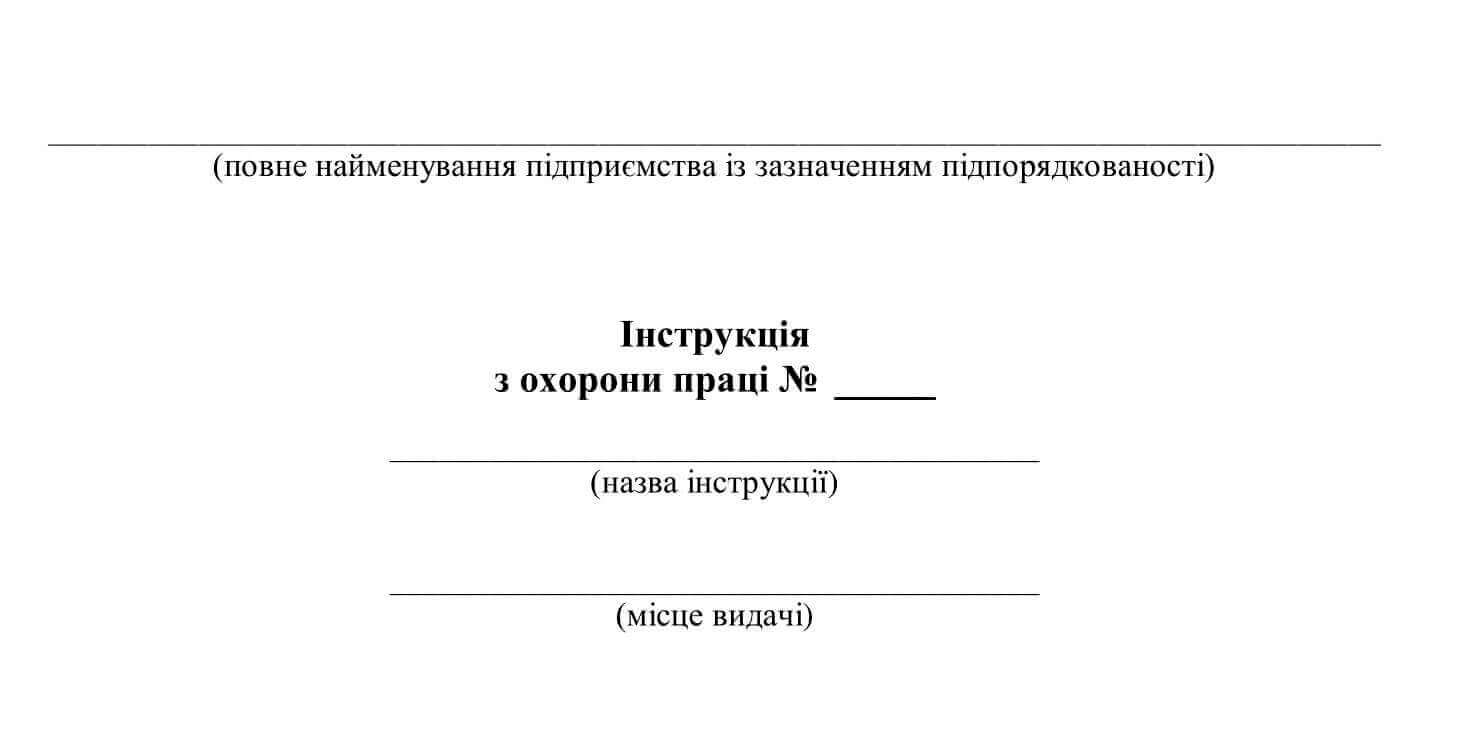

Appendix 2 to the Regulations on the Development of Occupational Safety Instructions (clause 8 of Section IV)
Sample First Page of an Occupational Safety Instruction
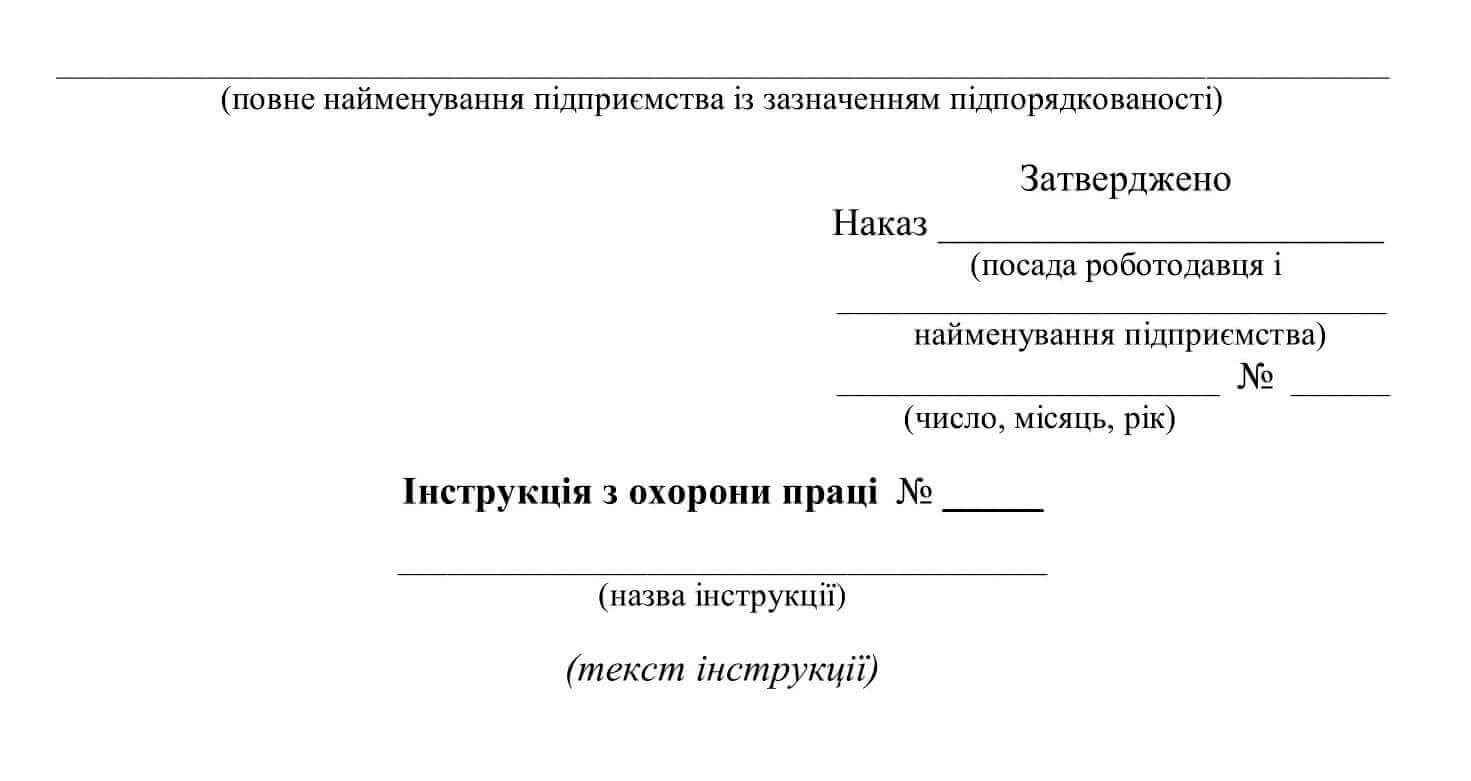

Appendix 3 to the Regulations on the Development of Occupational Safety Instructions (clause 8 of Section IV)
Sample Last Page of an Occupational Safety Instruction
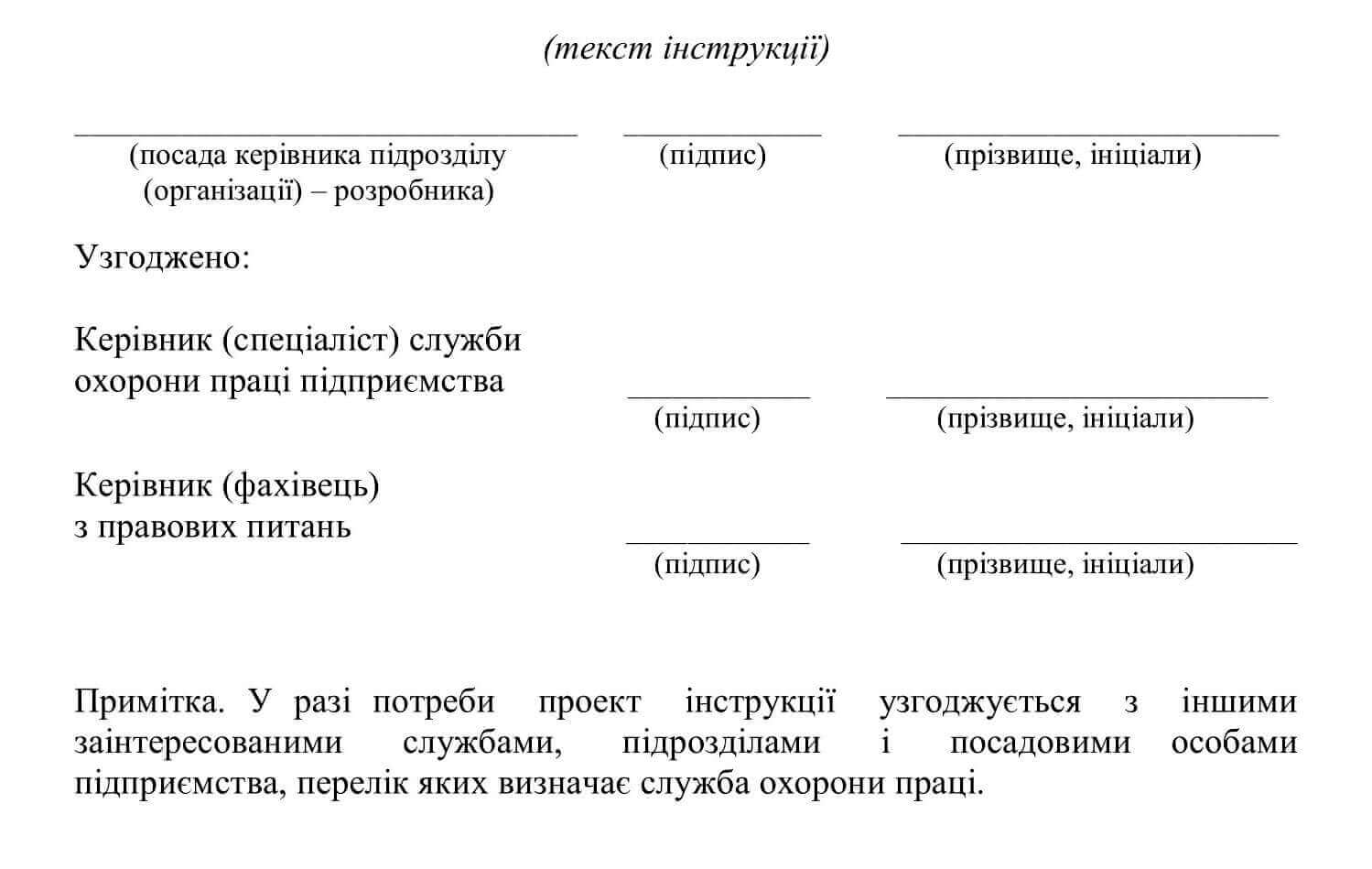

Appendix 4 to the Regulations on the Development of Occupational Safety Instructions (clause 1 of Section V)
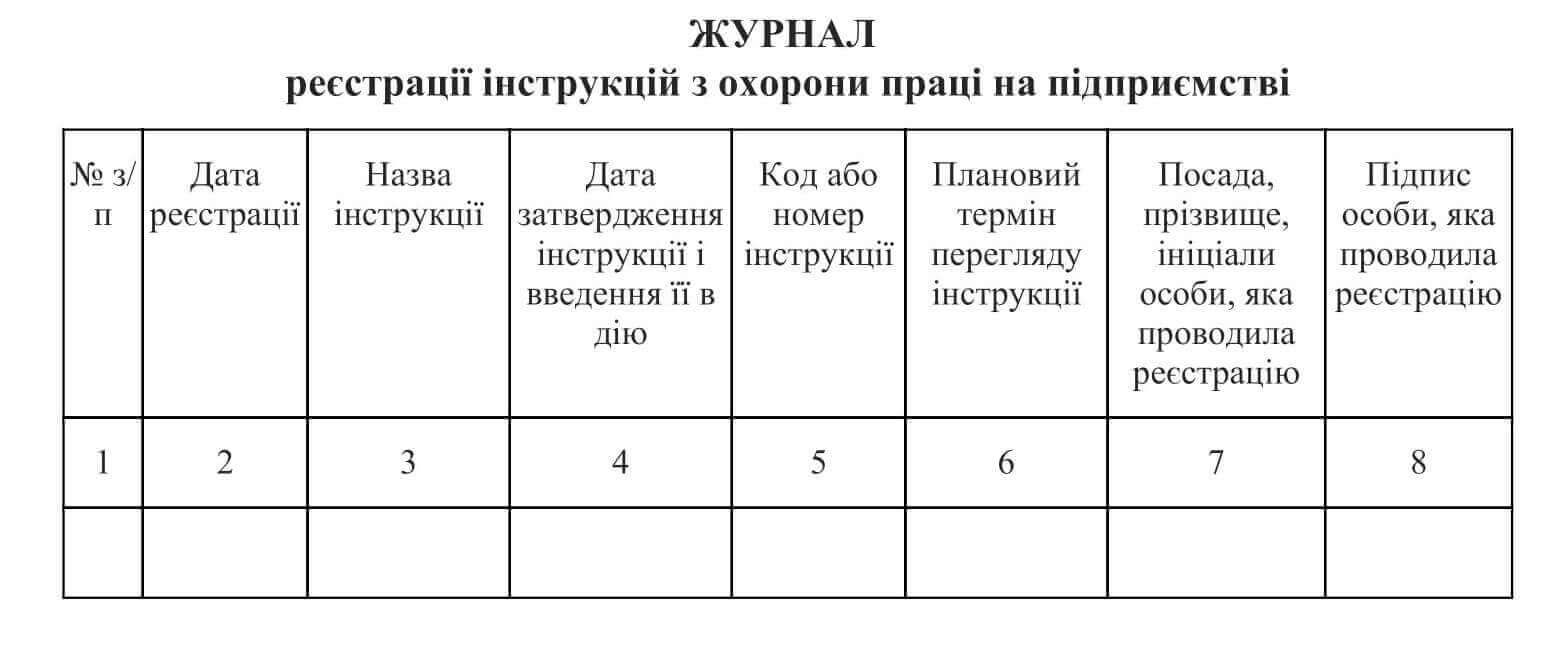

Appendix 5 to the Regulations on the Development of Occupational Safety Instructions (clause 3 of Section V)
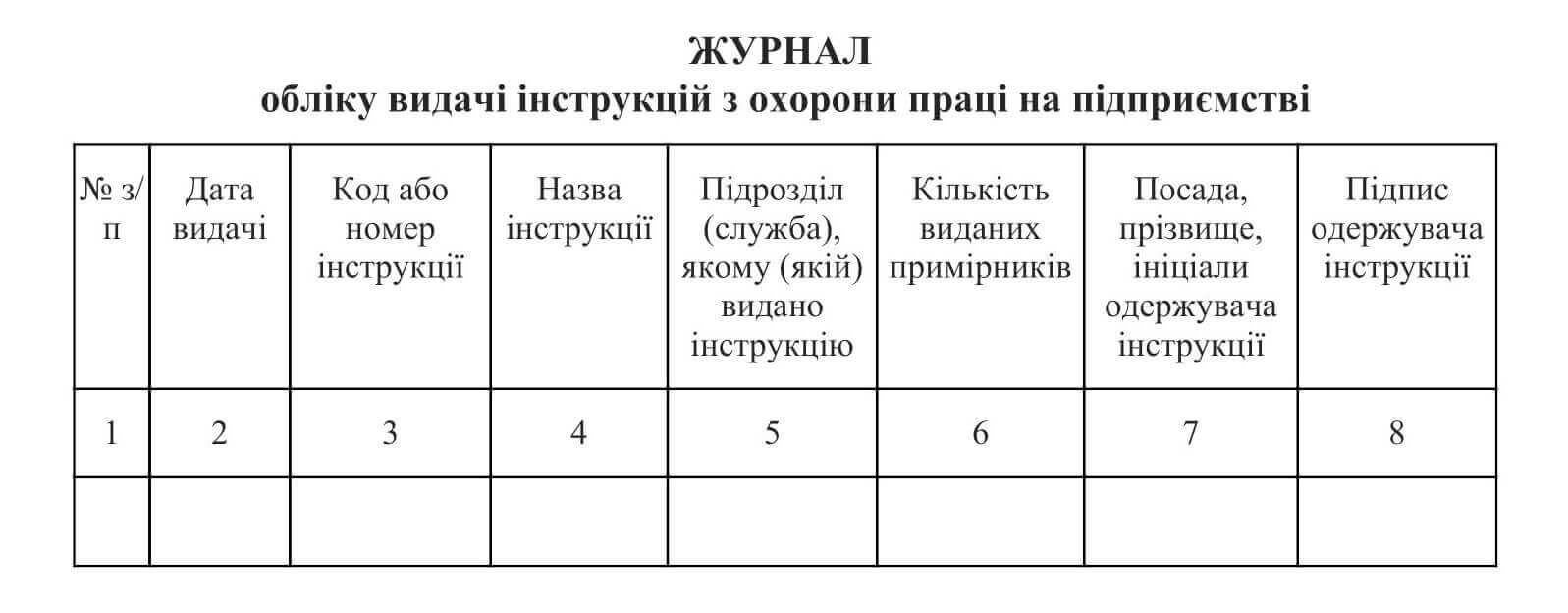

Appendix 6 to clause 6.4
Regulations
on the Procedure for Conducting Training and Knowledge Testing
on Occupational Safety and Life Safety
at National Aerospace University
"Kharkiv Aviation Institute"
Enacted by Order No. 611 dated December 26, 2018
1. General Provisions
1.1. The Regulations on the procedure for conducting training and knowledge testing on occupational safety and life safety at National Aerospace University "Kharkiv Aviation Institute" (hereinafter - Regulations) were developed based on the requirements of the Model Regulations on the Procedure for Conducting Training and Knowledge Testing on Occupational Safety Issues, approved by Order of the State Committee of Ukraine for Occupational Safety Supervision dated January 26, 2005, No. 15 (as amended), and the Regulations on the Procedure for Conducting Training and Knowledge Testing on Occupational Safety Issues in Institutions and Organizations Subordinate to the Ministry of Education and Science of Ukraine, approved by Order of the Ministry of Education and Science of Ukraine dated April 18, 2006, No. 304 (as amended).
1.2. The Regulations establish the procedure for training and testing knowledge on occupational safety and life safety of University employees, as well as training on occupational safety and life safety (health protection, fire, radiation safety, road safety, civil protection, prevention of non-occupational injuries, etc.) of students, postgraduate students, and trainees (hereinafter - learners).
1.3. The requirements of these Regulations are mandatory for execution by participants of the educational process and other University employees, and are aimed at implementing a system of continuous training on occupational safety and life safety of learners and employees to ensure proper, safe, and healthy conditions for study and work, and to prevent accidents and occupational diseases.
1.4. Control over compliance with the requirements of these Regulations is carried out by educational management bodies according to subordination, state supervision bodies for occupational safety, and representatives of the sectoral trade union.
1.5. Definition of concepts and terms.
In these Regulations, the terms below are used in the following meaning:
- high-risk work - work performed under conditions of exposure to harmful and hazardous production factors or work where there is a need for professional selection, or associated with the maintenance, operation, application of technical means of labor, or technological processes characterized by an increased degree of risk of accidents, fires, threat to life, injury to health, damage to property, or the environment;
- special training - annual study by employees who are involved in performing high-risk work or where there is a need for professional selection, of the requirements of relevant regulatory legal acts on occupational safety;
- internship - acquisition by a person of practical experience in performing production tasks and duties at the enterprise's workplace after theoretical training prior to starting independent work under the direct supervision of an experienced specialist;
- shadowing (doubling) - independent execution by an employee (shadow/double) of professional duties at the workplace under the supervision of an experienced employee with mandatory completion of emergency response and fire safety drills.
2. Occupational Safety Training for Learners at the University
2.1. Training of learners on occupational safety and life safety at the University is conducted in accordance with the requirements of legislation in the field of occupational safety, civil protection, and education.
2.2. Training of learners at the University on occupational safety and life safety is conducted both by traditional methods and with the use of modern forms of training organization - modular, distance, external, etc., as well as with the use of technical teaching aids - audiovisual, computer-based.
2.3. During labor and vocational training at enterprises, institutions, and organizations, legislation on occupational safety applies to learners.
3. Organization of Briefings on Occupational Safety and Life Safety with Learners at the University
3.1. Occupational safety briefings with learners are conducted:
- prior to the start of educational, introductory, first production, second production, or pre-graduation internships, which may be conducted at the University, at enterprises, in institutions, or organizations;
- in case of organizing an excursion to an enterprise.
3.1.1. Introductory occupational safety briefing with learners is organized by the Dean's offices of the University and conducted by Vice Deans, curators, and internship supervisors according to the Instruction for Conducting Introductory Occupational Safety Briefing, approved by an order for the University.
3.1.2. Introductory occupational safety briefing is registered in the Class Logbook of Student Groups on dedicated pages for registration of introductory occupational safety briefing according to the form provided in Appendix 1.
3.1.3. Initial, repeat, unscheduled, and targeted occupational safety briefings with learners are conducted:
- in University departments - by the head of the department (head of the structural unit), head of the laboratory, internship supervisor;
- at enterprises, institutions, organizations - by the direct supervisor of work (head of structural unit, foreman) or an individual employing hired labor.
3.1.4. Initial, repeat, unscheduled, and targeted occupational safety briefings with learners are conducted according to instructions in force at the University, enterprises, institutions, and organizations.
3.1.5. Initial, repeat, unscheduled, and targeted occupational safety briefings end with a knowledge check in the form of an oral quiz or with the help of technical means, as well as a check of acquired safe work skills by the person who conducted the briefing.
In case of unsatisfactory results of testing knowledge, skills, and abilities regarding safe execution of work after initial, repeat, or unscheduled briefing, additional briefing and re-testing of knowledge are conducted within 10 days.
3.1.6. Regarding the performance of initial, repeat, unscheduled, and targeted occupational safety briefings for employees, learners at production sites, and their admittance to work, the person who conducted the briefing makes an entry in the Logbook of Registration of Occupational Safety Briefings at the Workplace according to the form provided in Appendix 2.
3.2. Life safety briefing with learners is conducted:
- before the start of classes in each classroom, laboratory, workshop, gym;
- before the start of winter and summer vacations;
- in case of organizing extracurricular events: mass events, Olympiads, tournaments, excursions, hiking trips, sports competitions, etc.;
- during the performance of community or extracurricular work (cleaning territories, premises, research work).
Life safety briefings cover issues of occupational safety, health protection, fire, radiation safety, road safety, prevention of non-occupational injuries, actions in emergency situations, etc.
3.2.1. Introductory life safety briefing with learners of all academic years is organized by the Dean's offices of the University and conducted by Vice Deans or curators once a year, before the start of the academic year.
Introductory life safety briefing with postgraduate students is organized and conducted by the head of postgraduate studies.
3.2.2. Introductory life safety briefing with learners is conducted according to the instruction approved by an order for the University and registered on a dedicated page for registration of life safety briefing for learners in the Class Logbook (Appendix 3).
3.2.3. Initial life safety briefing with learners is conducted:
- before the start of classes in each classroom, laboratory, workshop, gym, club (circle);
- before the start of winter and summer vacations;
- before the start of events outside the University.
3.2.4. Initial life safety briefing with learners before the start of classes in each classroom, laboratory, workshop, gym, club (circle) is organized by academic departments and units of the University where the educational process takes place. This briefing is conducted by teachers, trainers, club (circle) leaders according to instructions approved by an order for the University, with mandatory registration in the Logbook of Registration of Initial, Unscheduled, and Targeted Life Safety Briefings for Learners (Appendix 4), which is kept in each classroom, laboratory, workshop, shop floor, gym, etc.
Initial life safety briefing is also conducted before the performance of each practical session (practical work, laboratory work, etc.) and is registered in the Class Logbook of Learners on the page recording the topic of the lesson or class.
3.2.5. Initial life safety briefing with learners before the start of summer and winter vacations is organized by the Dean's offices and conducted by Vice Deans or group curators, with mandatory registration in the Logbook of Registration of Initial, Unscheduled, and Targeted Life Safety Briefings for Learners (Appendix 4).
3.2.6. Unscheduled life safety briefing with learners is conducted in case of their violation of regulatory legal acts on occupational safety, which may lead or has led to injuries, emergency situations, etc., changes in the conditions for performing educational tasks (laboratory work, practical training, professional training, etc.), as well as in case of accidents during the educational process outside the University.
3.2.7. Targeted life safety briefing with learners is conducted:
- in case of organizing extracurricular events: mass events, Olympiads, tournaments, excursions, hiking trips, sports competitions, etc.;
- during the organization of community extracurricular work: cleaning territories, premises, research work on the educational and experimental plot, etc.
3.2.8. Unscheduled and targeted life safety briefings are conducted by supervisors of the activity line - teachers, trainers, excursion and hiking leaders, group curators, supervisors of extracurricular work, etc. - according to instructions approved by an order for the University.
3.2.9. Unscheduled and targeted life safety briefings are registered in the Logbook of Registration of Initial, Unscheduled, and Targeted Life Safety Briefings for Learners (Appendix 4), with the mark "unscheduled" or "targeted".
4. Organization of Training and Knowledge Testing on Occupational Safety for University Employees
4.1. Upon hiring and in the course of work, officials and other employees of the University undergo briefing, training, and knowledge testing on occupational safety, pre-medical first aid to victims of accidents, as well as rules of conduct in case of accidents and emergency situations.
4.2. Employee training on occupational safety is conducted as an integral part of life safety.
All employees of the University without exception are subject to training and knowledge testing, taking into account working conditions and their activities.
4.3. Persons combining professions undergo briefing, training, and knowledge testing on occupational safety and life safety in both their primary and dual professions.
4.4. The Rector, Vice-Rectors tasked with responsibility for organizing work on occupational safety and life safety, heads and deputy heads of research organizations, occupational safety specialists of the University and research organizations, and other University employees who are members of the standing commission for knowledge testing undergo training and knowledge testing on occupational safety and life safety according to the order of the Ministry of Education and Science of Ukraine once every three years.
Persons responsible for high-risk work who are members of the standing commission for testing the knowledge of University employees undergo training and knowledge testing of relevant regulatory legal acts on occupational safety in specialized educational organizations once every three years.
4.5. Life safety training for employees specified in paragraph 4.4 is conducted in accordance with the Model Regulations and according to the curriculum and training program for life safety of employees of educational institutions and organizations.
The training program duration for heads, deputies, and heads of structural units is 36 hours, and for occupational safety specialists - 72 hours.
4.6. Teachers of the "Occupational Safety" discipline of the University undergo training and knowledge testing at the Main Educational and Methodological Center of the State Labor Service and educational centers belonging to the sphere of management of the Ministry of Education and Science of Ukraine that have submitted to the territorial body of the State Labor Service a declaration of conformity of their material and technical base to the requirements of legislation on occupational safety and industrial safety (hereinafter - educational centers).
The training program duration for teachers of the "Occupational Safety" discipline is 72 hours.
4.7. All other officials and employees of the University undergo training and knowledge testing on occupational safety and life safety once every three years directly at the University, in their structural units at the workplace, under a training program of at least 20 hours approved by an order for the University.
4.8. Knowledge testing on occupational safety and life safety of all categories of University employees is conducted based on regulatory legal acts on occupational safety, fire, radiation safety, etc., compliance with which falls within their functional duties.
4.9. To test knowledge on occupational safety and life safety of heads of structural units, a standing commission is created by an order for the University from among persons who have undergone training and knowledge testing at the Ministry of Education and Science of Ukraine. The Rector or Vice-Rector whose duties include organizing work on occupational safety and life safety is appointed chairman of the commission.
The commission includes specialists of the occupational safety department, representatives of legal, production, and technical services, a trade union representative for occupational safety, and teachers who conducted the training.
4.10. Trade union representatives for occupational safety, as members of standing commissions for testing knowledge on occupational safety, undergo training in accordance with the Model Regulations, and knowledge testing in the order determined by relevant public organizations, with the participation of a State Labor Service representative.
4.11. Insurance experts on occupational safety of the corresponding working body of the executive directorate of the Social Insurance Fund against Industrial Accidents and Occupational Diseases of Ukraine and teachers of occupational safety and life safety who conducted the training may be involved in the commission.
Fund insurance experts on occupational safety, as members of standing commissions for testing knowledge on occupational safety, undergo training on occupational safety in accordance with the Model Regulations, and knowledge testing in the order determined by the Fund's board, with the participation of a State Labor Service representative.
4.12. Knowledge testing on occupational safety and life safety of department teachers of all disciplines is carried out by the University's standing commission with the participation of faculty deans.
4.13. To test knowledge on occupational safety and life safety of employees of structural units, standing commissions of structural units are created by orders for the University from among persons who have undergone training and knowledge testing in the University's standing commission. The head of the structural unit is appointed chairman of the commission.
The commission includes specialists of the occupational safety department, department teachers, and trade union representatives for occupational safety.
4.14. A commission is considered competent if it includes no fewer than three persons.
All members of the commission must undergo training and knowledge testing on occupational safety and life safety in the order established by the Model Regulations and these Regulations.
4.15. The list of questions for testing knowledge on occupational safety and life safety of employees is compiled by members of the commission based on the training program, taking into account local conditions, and is approved by the Rector of the University.
4.16. The form of testing knowledge on occupational safety and life safety of employees is testing, a credit pass, or an examination. Testing is conducted by the commission using technical means (auto-examiners, modular tests, etc.), while a credit pass or examination is conducted using examination tickets in the form of an oral or written examination.
4.17. The result of knowledge testing on occupational safety and life safety is documented by the minutes of the meeting of the commission for testing employees' knowledge on occupational safety and life safety of the established form (Appendix 5).
4.18. Persons who demonstrate satisfactory results during the occupational safety and life safety knowledge test shall be issued a certificate of knowledge testing on occupational safety and life safety of the established form (Appendix 6). In this case, the protocol and the certificate shall briefly specify the list of basic regulatory legal acts on occupational safety, life safety issues, and performance of specific types of work, in the scope of which the employee passed the knowledge test.
The issuance of certificates of knowledge testing to employees who underwent training at the University is mandatory only for those who perform high-risk work.
4.19. In case of unsatisfactory results of the occupational safety and life safety knowledge test, employees must undergo a re-test within one month.
4.20. Employees who have not undergone training and knowledge testing on occupational safety and life safety shall not be allowed to work.
4.21. The retention period for protocols of occupational safety and life safety knowledge testing is at least five years.
4.22. Responsibility for organizing and carrying out briefings, training, and knowledge testing on occupational safety and life safety for unit employees rests with the heads of structural units.
4.23. Extraordinary training and knowledge testing of an employee on occupational safety and life safety shall be conducted upon their transfer to another position or assignment to another job requiring additional knowledge of occupational safety and life safety.
5. Special Training and Knowledge Testing on Occupational Safety for University Employees
5.1. Officials and other employees of the University engaged in high-risk work and work requiring occupational selection undergo special training and knowledge testing of relevant regulatory legal acts on occupational safety annually.
The list of high-risk works requiring special training and annual knowledge testing on occupational safety is compiled based on the List of High-Risk Works approved by the Order of the State Supervision of Occupational Safety of Ukraine dated January 26, 2005 No. 15, the List of Works Requiring Occupational Selection approved by the Order of the Ministry of Health of Ukraine and the State Committee of Ukraine for Occupational Safety Supervision dated September 23, 1994 No. 263/121, and is approved by an order for the University.
5.2. Special training on occupational safety can be conducted both directly at the University and in a training center.
In the case of vocational training, retraining, and advanced training, special training on occupational safety is an integral part of the specified vocational training.
5.3. Special training on occupational safety is conducted at the University according to curricula and training programs developed taking into account specific types of work, production conditions, and functional duties of employees, and approved by an order.
5.4. Knowledge testing on occupational safety following special training is conducted by a University commission with the participation of persons who have undergone training and knowledge testing of relevant regulatory legal acts on occupational safety, and the head of the unit whose employees undergo knowledge testing.
6. Organization of Conducting Occupational Safety Briefings for University Employees
6.1. Officials and other employees upon hiring and periodically must undergo occupational safety briefings, training in providing first medical aid to accident victims, rules of conduct and actions in cases of emergency situations, fires, and natural disasters, and civil protection training, including technogenic and fire safety rules.
6.2. By nature and time of conduct, occupational safety briefings (hereinafter — briefings) are divided into initial introductory, initial, repeated, unscheduled, and targeted.
6.3. Initial introductory occupational safety briefing is conducted for employees:
- who are hired for permanent or temporary work at the University, regardless of their education, work experience, and position;
- who arrived at the University and directly participate in the educational or production process or perform other work for the University.
Initial introductory briefing is conducted by a specialist of the occupational safety department or another person pursuant to an order (instruction) for the University who has undergone training and knowledge testing on occupational safety in the manner established by these Regulations.
Initial introductory briefing is conducted in the University's occupational safety office or in a specially equipped room according to a program developed by the occupational safety service. The program and duration of the briefing are approved by the Rector.
An entry on conducting the initial introductory briefing is made in the Logbook of Registration of Initial Introductory Occupational Safety Briefings for Employees of the established form, which is kept by the occupational safety service or the employee responsible for conducting the initial introductory briefing, as well as in the employment order for the employee.
6.4. Initial occupational safety briefing is conducted prior to commencement of work directly at the workplace with an employee:
- newly hired (permanently or temporarily) at the University;
- transferred from one structural unit of the University to another;
- who will perform work new to them;
- a seconded employee of another institution, enterprise, or educational establishment directly participating in the educational or production process of the University.
Initial briefing at the workplace is conducted individually or with a group of persons of the same specialty according to the department's occupational safety instructions in force at the University corresponding to the work performed.
6.5. Repeated occupational safety briefing is conducted at the workplace individually with an individual employee or a group of employees performing work of the same type, according to the scope and content of the initial briefing topics.
Repeated occupational safety briefing is conducted for work:
- with high risk — once every 3 months;
- for other work — once every 6 months.
6.6. Unscheduled occupational safety briefing is conducted at the workplace or in the occupational safety office in cases of:
- enactment of new or amendments and additions to existing regulatory legal acts on occupational safety;
- changes in technological processes, replacement or modernization of equipment, instruments, tools, raw materials, supplies, and other factors affecting occupational safety conditions;
- violations by employees of regulatory legal act requirements on occupational safety that resulted in injuries, accidents, fires, etc.;
- work interruption of the performer for more than 30 calendar days — for high-risk work, and over 60 days — for all other work.
An unscheduled briefing can be conducted individually with an individual employee or a group of employees of the same specialty. The scope and content of the unscheduled briefing are determined in each case depending on the reasons and circumstances that necessitated its conduct.
6.7. Targeted occupational safety briefing is conducted in cases of:
- liquidation of an accident or natural disaster;
- performance of work for which, in accordance with occupational safety legislation, a work permit, order, or instruction is issued.
Targeted briefing is conducted individually with an individual employee or a group of employees. The scope and content of the targeted briefing are determined depending on the type of work to be performed.
6.8. Initial, repeated, unscheduled, and targeted briefings are conducted by the immediate supervisor of the work (head of structural unit, master).
6.9. Initial, repeated, unscheduled, and targeted briefings conclude with a knowledge test in the form of an oral quiz or using technical means, as well as a check of acquired skills in safe work methods by the person who conducted the briefing.
In case of unsatisfactory results of testing knowledge, skills, and abilities regarding the safe performance of work after an initial, repeated, or unscheduled briefing, additional briefing and re-testing are conducted within 10 days.
In case of unsatisfactory knowledge test results after a targeted briefing, the employee is not allowed to perform the work. Re-testing is not permitted in this case.
6.10. The person who conducted the briefing enters a record in the Register of Occupational Safety Briefings at the Workplace (Appendix 2) regarding the conduct of initial, repeated, unscheduled, and targeted briefings and authorization of employees to work.
The pages of the briefing registration logbook must be numbered, stitched, and sealed.
In the case of performing work that requires a work permit, targeted briefing is registered in this work permit; registration in the briefing logbook is optional.
6.11. The list of professions and positions of employees exempted from repeated occupational safety briefings is approved by an order for the University.
This list includes employees participating in a production process that is not directly related to the maintenance of facilities, machinery, mechanisms, equipment, the use of instruments and tools, storage or processing of materials, etc.
7. Internship, Shadowing, and Work Authorization of Employees
7.1. Newly hired employees at the University, after the initial briefing at the workplace and prior to starting independent work, must undergo an internship for at least 2 to 15 shifts or shadowing for at least 6 shifts under the guidance of experienced, qualified employees.
7.2. Internship or shadowing is usually conducted during professional training for the right to perform high-risk work in cases provided for by occupational safety regulatory legal acts.
7.3. Employees whose functional duties are related to ensuring accident-free operation of high-risk facilities or performing specific high-risk tasks (facilities where violations of technological regimes pose a threat to employees and the environment), prior to starting independent work, must undergo shadowing with mandatory completion of emergency response and firefighting drills during this period according to the accident liquidation plan.
7.4. Admission to an internship (shadowing) is formalized by an order or instruction of the unit head. The order (instruction) specifies the duration of the internship (shadowing) and indicates the surname of the employee responsible for conducting the internship (shadowing).
7.5. The list of positions and professions of employees required to undergo an internship (shadowing), as well as the duration of the internship (shadowing), are determined in accordance with occupational safety regulatory legal acts and approved by an order for the University. The duration of the internship (shadowing) depends on work experience and the nature of the work, as well as the employee's qualification.
7.6. The head of a unit has the right, by their instruction, to exempt an employee who has work experience in the relevant profession of at least three years, or who is transferred from one unit to another where the nature and type of equipment on which they will work do not change, from undergoing an internship (shadowing).
7.7. Internship (shadowing) is conducted according to programs for a specific profession developed in the unit according to the employee's functional duties and approved by the Rector (head of structural unit).
7.8. Internship (shadowing) is conducted at workplaces of own or another enterprise with similar technology. During the internship (shadowing), employees must perform tasks that, in complexity, nature, and safety requirements, correspond to the work provided for by their functional duties.
7.9. During the internship (shadowing), the employee must:
- reinforce knowledge regarding the rules of safe operation of technological equipment, process and job instructions, and occupational safety instructions;
- acquire skills in navigating production situations under normal and emergency conditions;
- study technological processes under specific conditions and master the equipment, as well as methods of accident-free control over them to ensure occupational safety requirements.
7.10. Upon completion of the internship (shadowing) and with satisfactory results of the occupational safety knowledge test, the employee is admitted to independent work by an order or instruction of the head of the structural unit, as recorded in the Register of Briefings at the Workplace of the unit (Appendix 2). If the employee has not acquired necessary production skills or received an unsatisfactory grade in emergency response and firefighting drills, the internship (shadowing) may be extended by a new order or instruction for a period of no more than two shifts.
Appendix 1 to clause 3.1.2
Registration of Initial Introductory Occupational Safety Briefing with Students
(separate page in the class record logbook)
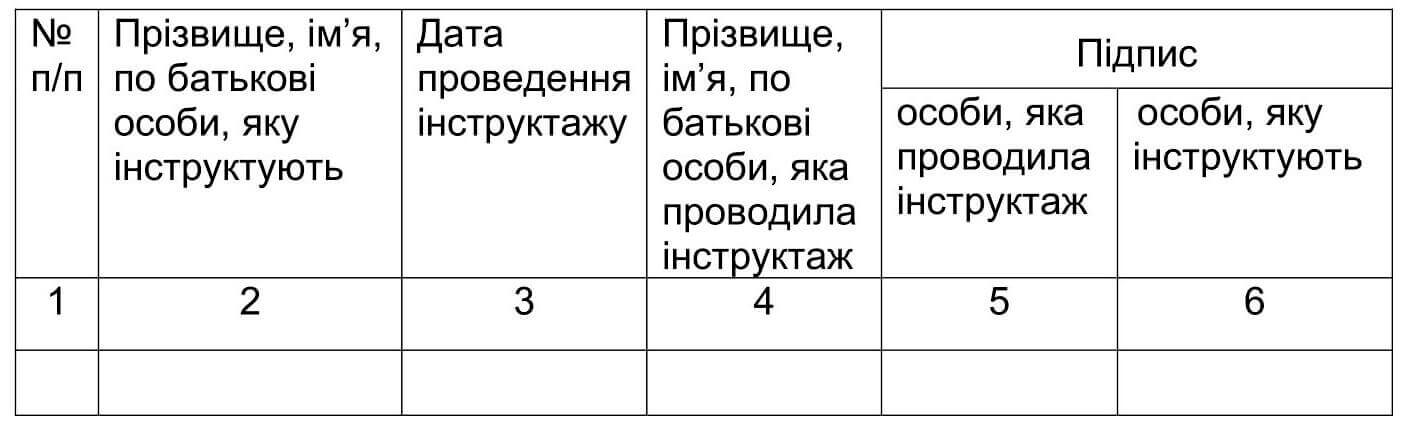

Appendix 2 to clauses 3.1.6; 6.10; 7.10
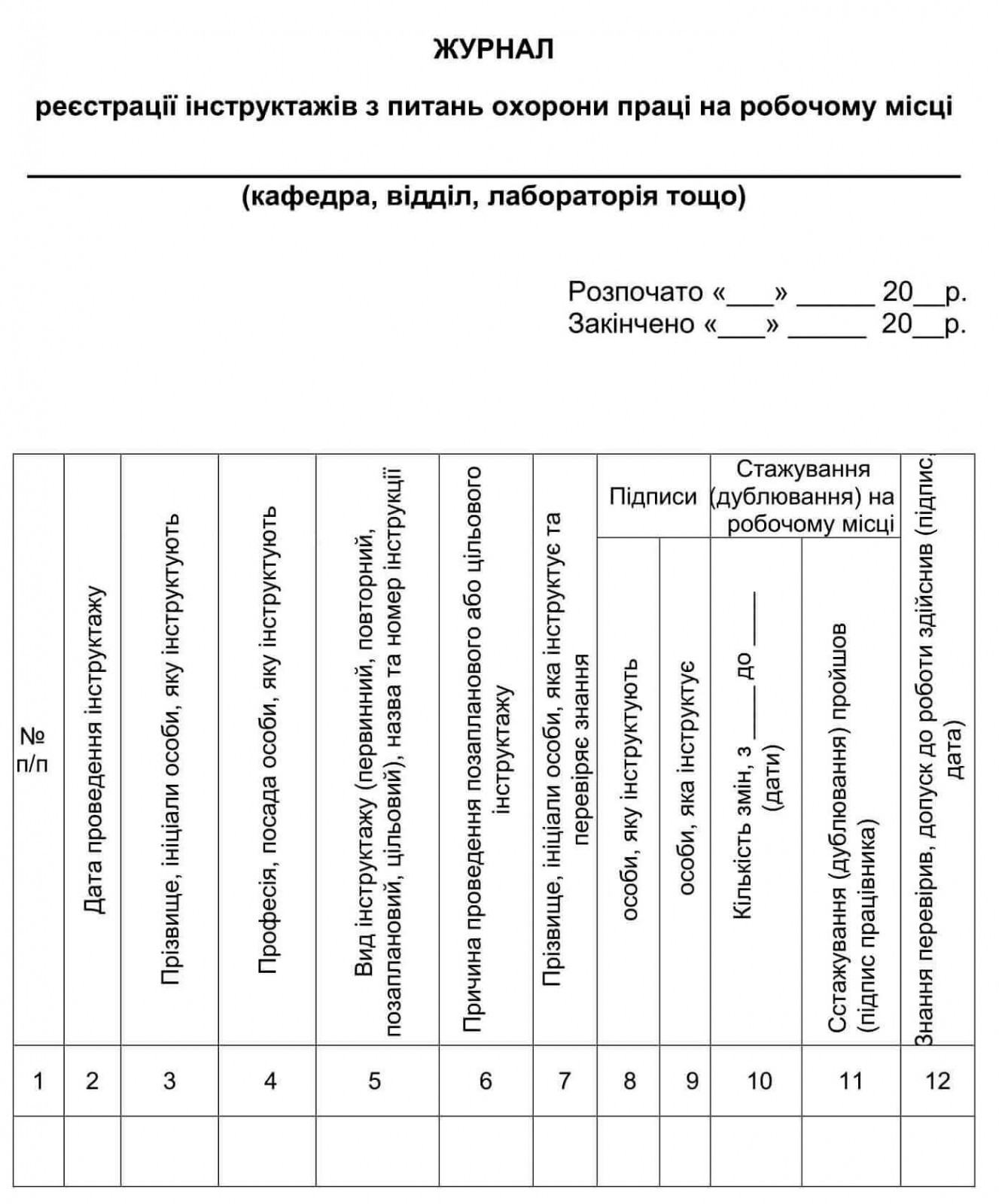
Appendix 3 to clause 3.2.2
Registration of Initial Introductory Life Safety Briefing with Students
(separate page in the class record logbook)
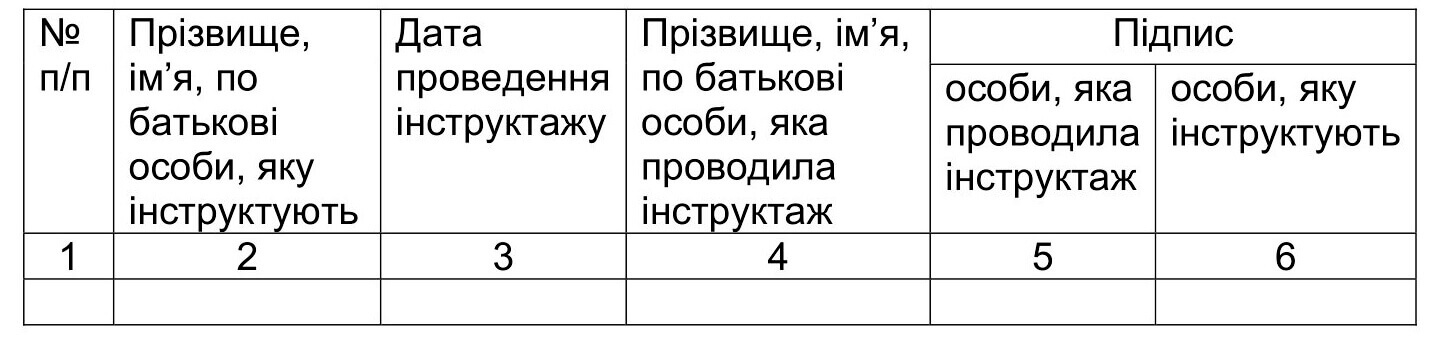
Appendix 4 to clauses 3.2.4; 3.2.5; 3.2.9
Logbook for Registration of Initial, Unscheduled, and Targeted Life Safety Briefings for Students
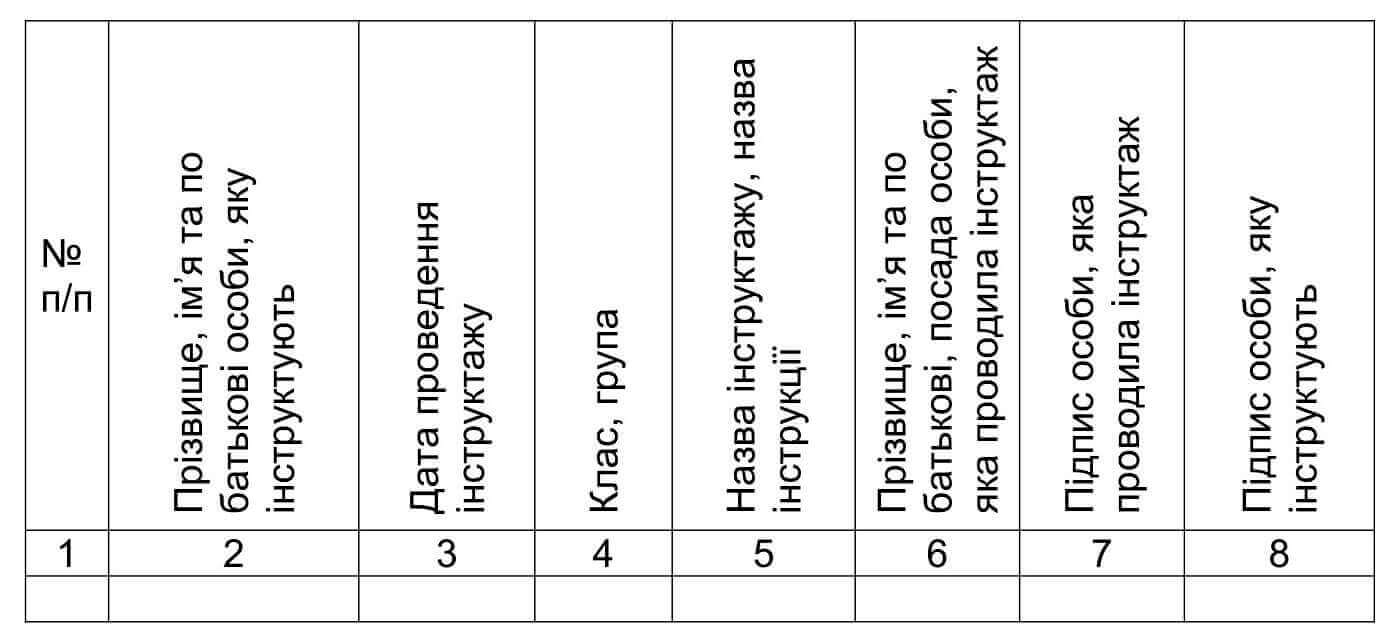
Appendix 7 to clause 6.4
List of professions and positions of employees
exempted from repeated occupational safety briefings,
approved by University Order No. 611 dated December 26, 2018
1. Rector.
2. Vice-Rectors.
3. Heads of departments.
4. Instructors of the discipline "Occupational Safety".
5. Head of the Research Institute.
6. Laboratory heads.
7. Heads of structural units and their deputies.
8. Head of the Occupational Safety Department.
9. Specialists of the Occupational Safety Department.
Appendix 8 to clause 6.4
List of high-risk works
requiring special training
and annual testing of knowledge on occupational safety,
approved by University Order No. 611 dated December 26, 2018
1. Electric welding, gas-flame works.
2. Works on cable lines, active electrical installations.
3. Works involving the use of lasers.
4. Maintenance, repair, and adjustment of equipment for cutting, thermal spraying, coating application, and other electric welding equipment.
5. Maintenance of compressor and refrigeration equipment.
6. Works using substances belonging to Hazard Classes I and II.
7. Operation of accelerator units (electron microscopes, X-ray diffraction analysis units).
8. Works on disinsection, deratization, and disinfection of premises.
9. Application of paint and varnish coatings, primers, and putties based on nitrocellulose paints, polymer compositions (polyvinyl chloride, epoxy, etc.).
10. Maintenance and repair of rechargeable storage batteries.
11. Melting, pouring works, and heat treatment of castings.
12. Testing and maintenance of hot-water boilers, hot water pipelines, heat exchangers, thermomechanical equipment, and maintenance of pressure vessels.
13. Works in wells, trenches, chambers, and utility tunnels. Works in confined spaces (tanks, glove boxes, pipelines).
14. Earthworks performed in the area of underground utilities at a depth of more than two meters.
15. Works at height (above 1.3 m).
16. Operation of elevators.
17. Operation and maintenance of metalworking and woodworking machine tools.
18. Maintenance of gas-fired units and boilers.
19. Mounting, demounting, and inflation of tires.
20. Driving tractors.
21. Works on copying and duplicating machines.
22. Installation, repair, and preventive maintenance of security alarm systems.
23. Works related to driving motor vehicles.
24. Operation of lifting machinery and mechanisms.
25. Loading and unloading operations using machinery and mechanisms.
26. Works related to storage and application of air separation products.
Appendix 9 to clause 6.4
List of positions and professions
of employees of the National Aerospace University
"Kharkiv Aviation Institute",
who are required to undergo an internship (shadowing),
approved by University Order No. 63 dated February 04, 2019
1. Electric gas welder, welder.
2. Boiler house operator.
3. Deaeration plant operator.
4. Operator (chemical water treatment plant operator).
5. Fitter for repair of boiler house equipment and pulverization shops.
6. Instrumentation and automation fitter (electromechanics).
7. Fitter for operation and repair of gas equipment.
8. Fitter for heating network maintenance.
9. Heat engineering technician.
10. Plumber.
11. Pumping station operator.
12. Maintenance fitter.
13. Electrician for repair and maintenance of electrical equipment.
14. Electrician for electrical installation maintenance.
15. Motor vehicle driver.
16. Self-propelled machinery driver (tractor driver).
17. Disinfector.
18. Elevator operator.
19. Employees of structural units performing painting works.
20. Employees of structural units performing works at height.
21. Employees of structural units who operate and maintain pressure vessels, refrigeration, and compressor equipment.
22. Employees of structural units who operate and maintain lifting machines and mechanisms.
23. Employees of structural units performing loading and unloading operations using machinery and mechanisms.
24. Employees of structural units who operate and maintain metalworking and woodworking machine tools.
Appendix 10 to clause 6.4
List of works
performed under a work permit
at the National Aerospace University
"Kharkiv Aviation Institute",
approved by University Order No. 64 dated February 04, 2019
1. Repair of pumps (feed, circulation, network, booster, etc.).
2. Repair of rotating machinery (forced draft fans, induced draft fans, etc.).
3. Hot work and gas-hazardous work on equipment, in the zone of active equipment, and in industrial premises.
4. Installation and removal of pipe plugs (except for water pipelines with pressure not exceeding atmospheric and temperatures up to +45°C).
5. Repair of pipelines and fittings without removing them from pipelines, repair of hot water pipelines with temperatures exceeding +45°C.
6. Repair of heating networks.
7. Hydropneumatic flushing of pipelines.
8. Testing of the heating network at the design pressure and design coolant temperature.
9. Thermal insulation works.
10. Earthworks in the area of underground utilities.
11. Gas-hazardous work in accordance with the requirements of the current Safety Rules for Gas Supply Systems*.
11.1. Works in tanks, wells, etc.
11.2. Work in combustion chambers of boilers designed for burning gas, as well as in gas flues.
12. Loading, topping up, and removal of filter material when opening filters.
13. Works related to the removal and installation of cylinders on air springs.
14. Works in electrical installations with voltages above 1 kV in cells, on switchboards, in transformer chambers, and on busbars.
15. Works in electrical installations with voltages up to 1 kV on switchgear busbars, distribution switchboards, assemblies, as well as on connections of the listed devices through which voltage can be applied to the busbars.
16. Connecting and disconnecting electrical cables with voltages above 1 kV.
17. Repair of termination sleeves and sealing of electrical cables located in switchgears, central distribution substations, transformer substations, complete transformer substations, and electrical cables running through the territory and in cable channels:
- above 1 kV;
- up to 1 kV.
18. Works on cable lines running in cable channels of energized switchgears, central distribution substations, and transformer substations.
19. Performing measurements on electrical cables with voltages above 1 kV.
20. Installation and removal of electricity meters and other measuring instruments connected to instrument transformers without contacts (blocks) that allow working without opening the circuits connected to the secondary windings of the current transformer.
21. Installation and removal of current and voltage instrument transformers.
22. Installation and replacement of wires and cables on overhead power lines, luminaires, fittings, lamp replacement, and cleaning of luminaire fittings on outdoor lighting poles.
23. Works at heights greater than 5 m.
24. Works in switchgears, central distribution substations, transformer substations, complete transformer substations, and on cable lines with voltages above 1 kV using mechanisms and lifting machines.
25. Repair of the structural part inside switchgears, central distribution substations, transformer substations, and complete transformer substations.
26. Works involving the use of mechanisms, motor vehicles, and lifting machines within the safety zone of overhead power lines and open distribution switchgears.
27. Under any circumstances, any work in explosion-hazard zones or explosion- and fire-hazardous premises, confined and hard-to-reach spaces.
28. Dismantling and installation of equipment in the zone of active equipment.
29. Assembly and disassembly of scaffolding higher than 2.0 m.
* - According to clause 7.5 of the Safety Rules for Gas Supply Systems, approved by Order of the Ministry of Energy and Coal Industry of Ukraine dated May 15, 2015 No. 285, gas-hazardous works that recur periodically and are performed under similar conditions, usually by a permanent team of workers, may be carried out without issuing a work permit according to production instructions and safe working practice instructions approved for each type of work. However, the initial execution of specified works is carried out with the issuance of a work permit.
Appendix 11 to clause 6.4
List of works
performed by verbal/written order
at the National Aerospace University
"Kharkiv Aviation Institute",
approved by University Order No. 64 dated February 04, 2019
1. Inspection of building heating system control frames to take readings of coolant temperature and pressure parameters.
2. Inspection (without descending into the thermal chamber) of thermal chambers for routine inspection.
3. Inspection (without descending into the manhole) of sewer manholes for routine inspection.
4. Inspection (without descending into the chamber) of water supply chambers for routine inspection.
5. Inspection of heating networks.
6. Switching boilers on and off.
7. Switching pumps.
8. Switching taps on power transformers, tightening and cleaning single contacts on busbars and equipment, topping up oil in oil-filled bushings and eliminating oil leaks from them, topping up oil in individual apparatuses of switchgears, central distribution substations, transformer substations, and complete transformer substations.
9. Works in drives and control cabinets, switching devices, secondary switching devices, relay protection, automation, telemechanics, and communication equipment of electrical installations over 1000 V.
10. Works in electrical installations with voltages up to 1 kV (cells, distribution switchboards) with single-ended power supply.
11. Earthworks on energized cable lines passing through the territory.
12. Performing measurements of electrical cables, wires, and electrical equipment with voltages up to 1 kV.
13. Installation and removal of electricity meters and other measuring instruments connected to instrument transformers, provided there are contacts (blocks) in the electricity meter circuits that allow working without opening the circuits connected to the secondary windings of the current transformer.
14. Installation and removal of direct-connected electricity meters.
15. Works at heights greater than 2.5 m.
16. Repair of the structural part outside switchgears, central distribution substations, transformer substations, and complete transformer substations.
Works performed under verbal order (with registration in the operational logbook of the structural unit)
17. Unscheduled inspection of switchgears, central distribution substations, transformer substations, complete transformer substations, cable lines, outdoor lighting, electrical equipment, and networks.
18. Taking readings of electricity meters and other measuring instruments.
19. Checking the absence of voltage in electrical installations:
- above 1 kV;
- up to 1 kV.
20. Measurement of voltage and current using clamp meters up to 1000 V.
21. Renewal of inscriptions on doors, equipment covers, and barriers outside switchgear cells.
22. Disconnecting busbars or disconnecting cables with voltages up to 1 kV.
23. Repair of lighting equipment and replacement of lamps located outside cells and compartments (provided voltage is removed from the section of the lighting network where work is being performed).
24. Replacement of lamps and repair, replacement, and cleaning of luminaire fittings on small outdoor lighting poles.
Appendix 12 to clause 6.5
Regulations
on Safety and Health Requirements
for the Use of Personal Protective Equipment
at the Workplace by Employees
at the National Aerospace University
"Kharkiv Aviation Institute"
Enacted by Order No. 220 dated April 23, 2019
1. General Provisions
1.1. Regulations on Safety and Health Requirements for the Use of Personal Protective Equipment at the Workplace by Employees at the National Aerospace University "Kharkiv Aviation Institute" (hereinafter referred to as the Regulations) establish the procedure for purchasing, completing, issuing, and maintaining personal protective equipment for employees working in hazardous and dangerous working conditions, as well as work involving pollution or carried out in adverse meteorological conditions.
1.2. The Regulations have been developed on the basis of the Minimum Safety and Health Requirements for the Use of Personal Protective Equipment by Workers at the Workplace, approved by Order of the Ministry of Social Policy of Ukraine dated 29.11.2018 No. 1804 and registered with the Ministry of Justice of Ukraine on 27.12.2018 under No. 1494/32946.
1.3. In these Regulations, the terms have the following meanings:
- PPE - all equipment intended to be worn or held by an employee for personal protection against one or more risks that could pose a threat to safety and health at work, as well as any additions, accessories, or replaceable components intended for this purpose;
- employee - a person working at an enterprise, organization, or institution who performs duties or functions under an employment contract (contract);
- business entities - participants in economic relations who carry out economic activity, exercising economic competence (a set of economic rights and obligations), having separate property, and bearing liability for their obligations within the limits of this property, except as provided by law;
- duty personal protective equipment (duty PPE) - special clothing, special footwear, or other PPE intended for collective (impersonal) use, such as dielectric gloves or galoshes for electrical installations, a sheepskin coat or waterproof cloak at outdoor posts, assigned to specific workstations or issued to employees only for the duration of the work for which they are intended, and handed over from one shift to another.
1.4. The requirements of these Regulations do not apply to:
- special work clothing and uniforms not intended to ensure the safety and health protection of the employee;
- special protective equipment used by emergency rescue services for emergency response and disaster recovery;
- PPE for road (motor) transport;
- sports equipment;
- self-defense and deterrence equipment;
- portable devices for detecting and warning of risks and obstacles.
1.5. PPE should be used when risks to the life and health of workers cannot be avoided or sufficiently limited by technical means of collective protection or by measures, methods, or rules of work organization.
1.6. PPE is used strictly as intended in accordance with operating instructions, which must be clear to employees.
2. Duties of the University Administration
2.1. To ensure employee safety and health protection, the University administration is obligated to ensure, at the University's expense, the purchase, completion, issuance, and maintenance (ensuring serviceability and proper hygienic condition) of PPE, taking into account the requirements of clauses 1.4 and 1.5 of these Regulations.
2.2. These PPE must comply with the requirements of the Technical Regulation on Personal Protective Equipment regarding safety and standards for design and manufacture, namely:
- correspond to the level of existing risks to employee life and health and not lead to any increase in the level of this risk;
- match the existing working conditions at the workplace;
- fit the user after necessary adjustments.
2.3. For work with harmful and dangerous working conditions, as well as work involving pollution or carried out in adverse meteorological conditions, employees are provided with free special clothing, special footwear, and other PPE according to established standards, which constitute the mandatory minimum of free PPE provision for the employer, specifying the protective properties of PPE and their terms of use.
2.4. For employees whose professions and positions (job titles) are provided for in the Norms for Free Provision of Special Clothing, Special Footwear, and Other Personal Protective Equipment, approved by Order of the State Committee of Ukraine for Industrial Safety, Labor Protection, and Mining Supervision dated April 16, 2009 No. 62 and registered with the Ministry of Justice of Ukraine on May 12, 2009 under No. 424/16440 (hereinafter referred to as the Norms for Free Provision of PPE), as well as employees of general (cross-cutting) professions across various industries, PPE is issued regardless of the type of economic activity of the enterprise, except in cases where these professions and positions (job titles) are provided for in the relevant Norms for Free Provision of PPE taking into account specific working conditions.
2.5. If the existence of more than one risk to the life and health of employees requires them to wear more than one PPE simultaneously, such equipment must be compatible and effective against the existing risk (risks).
2.6. Prior to selecting PPE (exceeding the established Norms for Free Provision of PPE), it is necessary to evaluate whether the PPE planned for use complies with the requirements of clauses 2.2 and 2.5 of this section.
The evaluation of PPE consists of the following:
- analysis and evaluation of risks to the life and health of employees that cannot be avoided by other means;
- determination of the characteristics that the PPE must possess to effectively protect the life and health of employees against the identified risks, taking into account any risks that the PPE itself may create;
- comparison of the characteristics of PPE available to the business entity with the characteristics determined during this evaluation.
2.7. The evaluation of PPE provided for in clause 2.6 of this section must be conducted repeatedly if any elements of this evaluation have undergone changes.
2.8. PPE is issued for a wearing period determined taking into account the level of risk to the life and health of employees, the frequency of employee exposure to this risk, the characteristics of each employee's workplace, and the effectiveness of the PPE itself; in this case, the wearing period of PPE in calendar days is calculated from the day of their actual issuance and must not exceed the shelf life/service life specified in the manufacturer's documents (operating instructions, data sheets, etc.).
2.9. PPE is intended for personal (individual) use.
If one PPE under certain circumstances must be used by several employees, the employer, prior to each application of this PPE, shall take the measures necessary to prevent health and personal hygiene issues for users, namely:
- regarding the restoration of PPE serviceability (following procedures for repair and component replacement of PPE in accordance with their operating instructions);
- regarding the provision of proper hygienic condition (following procedures for cleaning (dry cleaning), washing, dusting, degassing, decontamination, disinfection, etc., in accordance with their operating instructions).
The maximum period of use for such PPE, depending on their wear and tear, is established by the University administration in agreement with the University trade union organization, which must be provided for in the collective agreement, and cannot exceed the periods of use for the corresponding PPE issued exclusively for individual use.
2.10. Duty PPE should be kept in a designated storage area in a proper hygienic condition. They are issued under the responsibility of work supervisors or shift supervisors.
The terms of use for duty PPE in each specific case, depending on the nature and conditions of work, are established by the University administration in agreement with the enterprise's trade union organization; moreover, the terms of use for duty PPE must be no less than the terms of use for corresponding PPE issued for individual use in accordance with the Norms for Free Provision of PPE.
2.11. According to the Minimum Requirements and the Norms for Free Provision of PPE, students studying at the University during practical training (work-based training) at an enterprise, instructors, as well as employees performing work temporarily or part-time in professions and positions for which PPE is provided, are issued the relevant PPE for the duration of such work.
2.12. In cases where PPE such as safety belts, dielectric galoshes and gloves, dielectric rubber mats, safety glasses and shields, respirators, gas masks, protective helmets, balaclavas, mosquito nets, hard hats, shoulder pads, elbow pads, self-rescuers, noise-canceling headphones, earplugs or helmets, light filters, anti-vibration gloves, and other PPE not specified in the Norms for Free Provision of PPE, but provided for by other occupational safety regulatory acts (rules, occupational safety instructions, etc.), they must be issued to employees depending on the nature and conditions of the work performed, for a period of use (wearing) until worn out, but not exceeding the maximum period of use specified in the certificate (declaration) of conformity of the PPE manufacturer.
2.13. The head of a structural unit of the University must inform the employee, prior to issuing PPE, about the risks to their life and health that this PPE is intended to prevent.
In addition, the head of the structural unit of the University must ensure regular training of employees on the rules of using PPE and demonstrate their correct application.
2.14. The University administration must inform employees and the primary trade union organization of the University in advance of all measures to be taken to ensure the safety and health of employees when using PPE at workstations.
2.15. The University administration must organize consultations with employees and the primary trade union organization of the University, as well as provide them with the opportunity to participate in discussions on all matters related to ensuring their safety and health when using PPE at workstations.
3. Other Provisions
3.1. PPE should be purchased from business entities that manufacture and/or sell products in accordance with applicable law, provided that the purchased PPE complies with essential health and safety requirements, has a positive conclusion from conformity assessment bodies, a certificate or declaration of conformity, and satisfies the requirements of the Technical Regulation on Personal Protective Equipment.
3.2. When determining the need for PPE, the University administration must provide for special clothing and special footwear separately for men and women, specifying the name of the PPE, taking into account their models, intended purpose by protective properties, size, and height, and for safety helmets and safety belts—standard sizes.
3.3. In individual cases, taking into account the specifics of production, the University administration may, in agreement with the trade union organization of the University, substitute: coveralls with a suit and vice versa; a suit with overalls and a shirt (blouse) or a jumper dress with a blouse; a wool suit with a fire-retardant or acid-resistant impregnated suit; a canvas suit with a fire-retardant or water-repellent impregnated suit; leather shoes (low boots) with rubber boots and vice versa; shoes (low boots) with boots and vice versa; felt boots with boots and vice versa.
In the event of substituting certain types of special clothing and special footwear with others, their protective properties and working conditions for the user must not deteriorate.
3.4. The University administration ensures the acceptance and verification of PPE delivered to the University for compliance with regulatory document requirements and the results of the evaluation conducted in accordance with clause 2.6 of this Regulations section, for which a committee composed of representatives of the administration and the enterprise's trade union organization is established.
3.5. In case of non-compliance of PPE with the requirements of regulatory documents, as well as with the results of the evaluation conducted in accordance with clause 2.6 of these Regulations, the University administration, in accordance with the established procedure, takes measures to return or replace defective PPE in accordance with the requirements of current legislation and the contract concluded with the supplier.
3.6. Purchased PPE is the property of the University; it is accounted for as inventory and is subject to mandatory return by employees in case of:
- dismissal from the University;
- transfer to another job or another workplace at the University;
- change in the type of work;
- introduction of new technologies;
- introduction of new or replacement of existing tools of labor, and in other cases where the use of issued PPE is not necessary;
- expiration of their periods of use in exchange for newly received PPE.
The University administration may issue two sets of special clothing to employees for two periods of use (wearing), depending on working conditions and the capability to maintain the PPE.
3.7. In the event of premature wear and tear of PPE through no fault of the employee, the University administration is obliged to replace them at its own expense. In the event that an employee purchases special clothing and/or other PPE at their own expense, the employer is obliged to compensate all expenses under the conditions provided for in the collective agreement.
3.8. The University administration is obliged to organize proper accounting and control over the issuance of PPE to employees within established deadlines at the University.
3.9. The issuance of PPE to employees and their return by employees must be recorded in the personal record card for accounting special clothing, special footwear, and other PPE, the form of which is given in Appendix 1 to these Regulations.
The periods of PPE use in calendar days are calculated from the day of their actual issuance according to the Norms for Free Provision of PPE and must not exceed their shelf life/service life.
3.10. For employees combining professions or working part-time, in addition to the PPE issued to them for their main profession, additional PPE should be issued for performing work in the part-time or combined profession, taking into account their shelf life/service life.
3.11. Selection of PPE based on the nature of the work performed is carried out taking into account the classification of PPE in accordance with national standards in force in Ukraine.
To facilitate the selection of such PPE, the following should be used:
- indicative list of hazards for which additional PPE is used, given in Appendix 2 to the Minimum Safety and Health Requirements for the Use of Personal Protective Equipment by Workers at the Workplace, approved by Order of the Ministry of Social Policy of Ukraine dated 29.11.2018 No. 1804 (hereinafter referred to as the Minimum Requirements);
- indicative list of works requiring the use of relevant PPE, given in Appendix 3 to the Minimum Requirements.
Based on the results of the measures taken, a risk assessment table for substantiating the selection and use of PPE is drawn up according to the form in Appendix 4 to the Minimum Requirements.
3.12. Heads of structural units and work supervisors must not admit employees to work without necessary PPE, or if the PPE is contaminated, defective, or past the due date for periodic testing conducted in accordance with their operating instructions.
3.13. Employees are obliged to report any deficiencies regarding the intended use of PPE to the employer.
3.14. Heads of structural units are obliged to ensure, in accordance with the operating instructions, periodic testing and verification of PPE suitability, as well as the timely replacement of their components, assemblies, or other parts if their protective properties have deteriorated or if they have not been used for a certain period. After testing, a mark must be placed on the PPE indicating the date of the next test.
3.15. Care and maintenance of PPE at the University must be performed by trained personnel familiar with the requirements of their operating instructions, or by a specialized organization. Information regarding care and maintenance is provided to each employee using PPE during their issuance and during periodic occupational safety briefings.
3.16. In case of operational necessity, the enterprise should equip drying facilities for special clothing and special footwear, chambers for dusting special clothing, as well as installations for degassing, decontamination, disinfection, and neutralization of special footwear and other PPE.
3.17. Cleaning (dry cleaning), washing, dusting, degassing, decontamination, disinfection, neutralization, repair of PPE, replacement of their components, and verification of PPE operational and protective properties must be carried out during non-working hours (on weekends) or during inter-shift breaks. In case of failure to meet this condition, the University administration must issue several sets of PPE to the employee (the established period of use for these PPE is correspondingly increased).
3.18. The procedures specified in clause 3.16 of these Regulations regarding the maintenance of PPE for workers engaged in work with substances hazardous to health (lead, its alloys and compounds, mercury, leaded gasoline, radioactive substances, etc.) must be carried out in accordance with their operating instructions and the conclusions, instructions, and orders of officials of institutions and facilities exercising state sanitary and epidemiological supervision.
3.19. Mandatory dry cleaning applies to all insulated special clothing, as well as special clothing treated with protective impregnation, unless otherwise specified in their operating instructions. If the University administration fails to organize timely dry cleaning or washing of special clothing, it is obliged to issue replacement PPE.
3.20. In the event of an employee's infectious disease, the special clothing, special footwear, and other PPE used by them, as well as the room where they were stored, are subject to disinfection.
3.21. Issued PPE, including special clothing of workers engaged in work with substances hazardous to health (lead, its alloys and compounds, mercury, leaded gasoline, radioactive substances, etc.), must be stored in specially equipped rooms complying with DBN V.2.2-28-2010 "Administrative and Domestic Buildings" and the requirements of occupational health and safety regulatory acts.
3.22. Used warm special clothing and special footwear accepted for storage should be disinfected, thoroughly cleaned of dirt and dust, dried, and repaired. During storage, they must be periodically inspected.
3.23. In cases where employees work outside the University and on business trips, where the specified storage procedure for PPE cannot be applied due to working conditions, they may remain with the employees during non-working hours, which must be stipulated in the collective agreement or in the internal labor regulations of the University.
Appendix 1 to clause 3.9
First page of the personal card
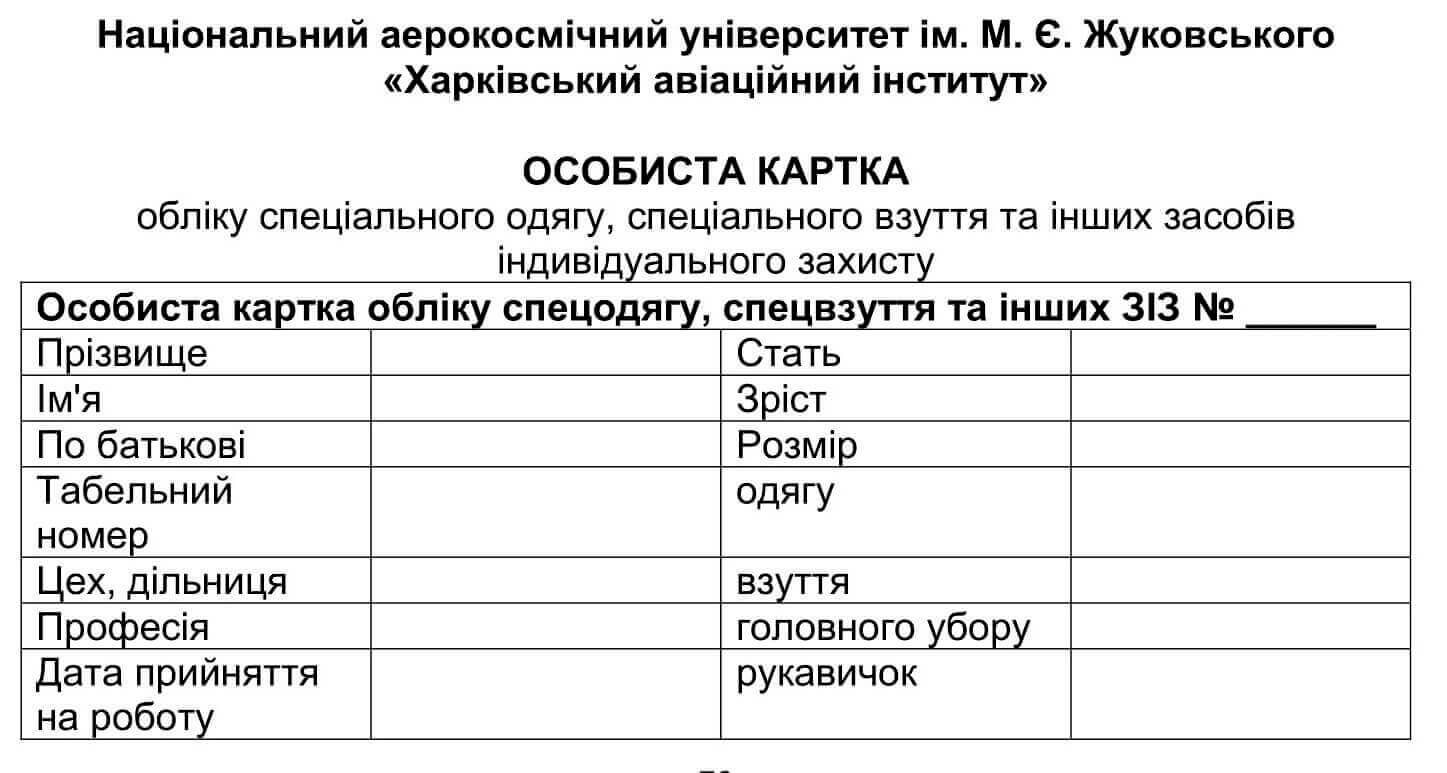
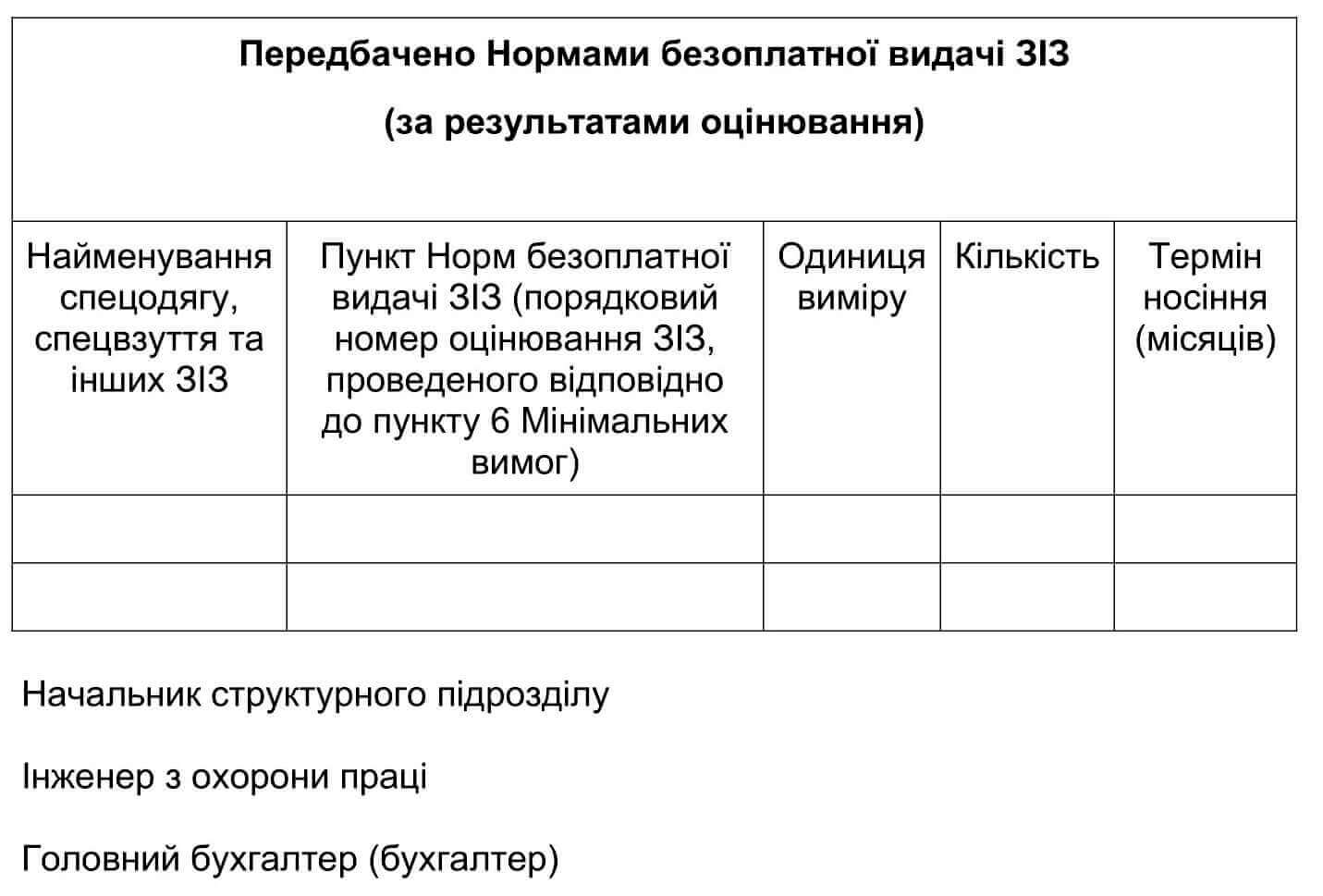
Second page of the personal card