Regulations on Dissertation Defenses
and the Procedure for Awarding the Scientific Degree of Doctor of Sciences
at the National Aerospace University
«Kharkiv Aviation Institute»
Approved by:
The Academic Council of the
National Aerospace University
«Kharkiv Aviation Institute»
Protocol No. 1 dated August 27, 2025
Enacted by Order No. 391 dated August 28, 2025
QMS KhAI-VR-P/001:2025
Effective Date: September 01, 2025
Edition No. 1
1. General Provisions
1.1. The Regulations «On Dissertation Defenses and the Procedure for Awarding the Scientific Degree of Doctor of Sciences at the National Aerospace University «Kharkiv Aviation Institute» (hereinafter referred to as the Regulations) determine the procedures for conducting preliminary expert review and consideration of completed dissertation works by specialized academic councils, and also regulate organizational matters regarding the preparation of documents used in the certification of scientific and scientific-pedagogical personnel for the award of the scientific degree of Doctor of Sciences.
1.2. These Regulations have been developed in accordance with the Law of Ukraine «On Higher Education» dated July 1, 2014, No. 1556-VII, in accordance with the requirements of the Procedure for Awarding and Depriving of the Scientific Degree of Doctor of Sciences, approved by the Resolution of the Cabinet of Ministers of Ukraine dated November 17, 2021, No. 1197, taking into account the Resolution of the Cabinet of Ministers of Ukraine dated July 30, 2025, No. 928 «On Amendments to the Procedure for Awarding and Depriving of the Scientific Degree of Doctor of Sciences», the Regulations on the Specialized Academic Council for Awarding the Scientific Degree of Doctor of Sciences, approved by the Order of the Ministry of Education and Science of Ukraine dated December 13, 2021, No. 1359, and the requirements for publishing the results of dissertation works for the scientific degree of Doctor of Sciences, approved by the Order of the Ministry of Education and Science of Ukraine dated September 23, 2019, No. 1220 «On Publishing the Results of Dissertations for Obtaining the Scientific Degrees of Doctor and Candidate of Sciences» (as amended by the Order of the Ministry of Education and Science of Ukraine dated May 27, 2022, No. 496), and the Resolution of the Cabinet of Ministers of Ukraine dated May 3, 2024, No. 507 «On Amendments to Certain Resolutions of the Cabinet of Ministers of Ukraine on Issues of Training and Certification of Scientific-Pedagogical and Scientific Personnel».
2. Requirements for the Level of Scientific Qualification of an Applicant for the Scientific Degree of Doctor of Sciences
2.1. The applicant must hold the degree of Doctor of Philosophy (Candidate of Sciences), after receiving which at least 5 years have passed by the moment of submitting the dissertation for the scientific degree of Doctor of Sciences.
It is permitted to conduct the defense of a dissertation work for the scientific degree of Doctor of Sciences earlier than the 5-year period by a decision of the Ministry of Education and Science of Ukraine in the event of a significant personal contribution by the applicant to ensuring the development of the respective branch of science, which is reflected in the scientific results of the doctoral dissertation.
2.2. The presence of published works on the topic of the doctoral dissertation in domestic and / or international peer-reviewed professional journals that quantitatively and qualitatively meet the requirements of the Order of the Ministry of Education and Science of Ukraine dated September 23, 2019, No. 1220 «On Publishing the Results of Dissertations for Obtaining the Scientific Degrees of Doctor and Candidate of Sciences» (as amended by the Order of the Ministry of Education and Science of Ukraine dated May 27, 2022, No. 496).
Scientific works published in publications of a state recognized by the Verkhovna Rada of Ukraine as an aggressor state shall not be credited for the topic of the doctoral dissertation.
3. Requirements for the Level of Preparation of a Dissertation for the Scientific Degree of Doctor of Sciences
3.1. A dissertation for the scientific degree of Doctor of Sciences may be prepared in the form of a manuscript, a monograph, or a scientific report.
A dissertation in the form of a manuscript shall be formatted in accordance with the requirements approved by the Order of the Ministry of Education and Science of Ukraine dated January 12, 2017, No. 40 «On Approval of Requirements for Dissertation Formatting».
A dissertation research in the form of a monograph shall be formatted in accordance with the «Requirements for a Published Monography Submitted for Obtaining the Scientific Degrees of Doctor and Candidate of Sciences», approved by the Order of the Ministry of Education and Science of Ukraine dated September 23, 2019, No. 1220.
A dissertation in the form of a scientific report shall be formatted in accordance with Section II of the Requirements for Dissertation Formatting, approved by the Order of the Ministry of Education and Science of Ukraine dated January 12, 2017, No. 40 «On Approval of Requirements for Dissertation Formatting».
3.2. The main scientific results of the doctoral dissertation must be covered in at least 20 scientific publications. The presence of scientific publications on the topic of the doctoral dissertation in scientific periodicals included in the Web of Science Core Collection and/or Scopus databases is mandatory.
3.3. A dissertation for the scientific degree of Doctor of Sciences must have a main text volume of 11 – 13 author's sheets (264 – 312 pages), formatted in accordance with the requirements of the Ministry of Education and Science of Ukraine.
An author's sheet is a conventional unit of measurement of the volume of textual information used in publishing and serving as the basis for accounting for the labor of the author, compiler, reviewer, etc.
One author's sheet equals 40,000 printed characters, including numbers, punctuation marks, and spaces.
The volume of an author's sheet can be considered as 24 pages of printed text with approximately 1,800 characters per page.
3.4. A dissertation for the scientific degree of Doctor of Sciences (regardless of the form of submission) shall be accompanied by a separate abstract with a volume of 1 – 2 author's sheets, which is submitted in the state language and consists of a general description of the doctoral dissertation, its main content and conclusions, and a list of scientific publications credited for the topic of the doctoral dissertation.
Requirements for the formatting of the abstract are given in Appendix A to these Regulations.
3.5. A dissertation is accepted for consideration provided that the applicant observes the norms of academic integrity.
3.6. Technical verification of a dissertation submitted in the form of a manuscript or a monograph is carried out using the TURNITIN system or another resource for checking academic texts.
The applicant certifies with their own signature on the title page of the doctoral dissertation that the scientific provisions submitted for defense are their own development and all used ideas, scientific results, quotes are accompanied by proper references to their authors and sources of publication, as well as all parts of the text of the dissertation during the writing of which artificial intelligence technologies were used have been checked and edited by them personally.
3.7. The completion of the applicant's training in the University's doctoral studies is confirmed by the conclusion of the scientific consultant, which is drawn up in two copies (Appendix B).
In the event that the scientific consultant refuses to prepare the conclusion, they shall notify the applicant one month before the completion of training. In such a case, the applicant shall submit a written application to the Academic Council of the University for the provision of a conclusion from the structural unit in which the applicant's training was carried out.
The relevant structural unit shall, within one month from the date of receipt of the application, review the documents submitted by the applicant regarding the completion of their training and hold a meeting, which shall be deemed competent if at least two-thirds of the composition of the relevant structural unit participate in it.
At the meeting of the relevant structural unit, the applicant's scientific report is heard and, by open voting with a simple majority of votes of the scientific (scientific-pedagogical) employees present at the meeting, a decision is made on granting / refusing to grant such a conclusion.
In the case of independent preparation of the doctoral dissertation by the applicant, a scientific consultant is not appointed (the scientific consultant's conclusion is not provided).
4. Procedure for Conducting Preliminary Expert Review
4.1. The preliminary expert review of a dissertation aims to assess the scientific level and practical suitability of the dissertation work performed by an applicant for the scientific degree of Doctor of Sciences at the University.
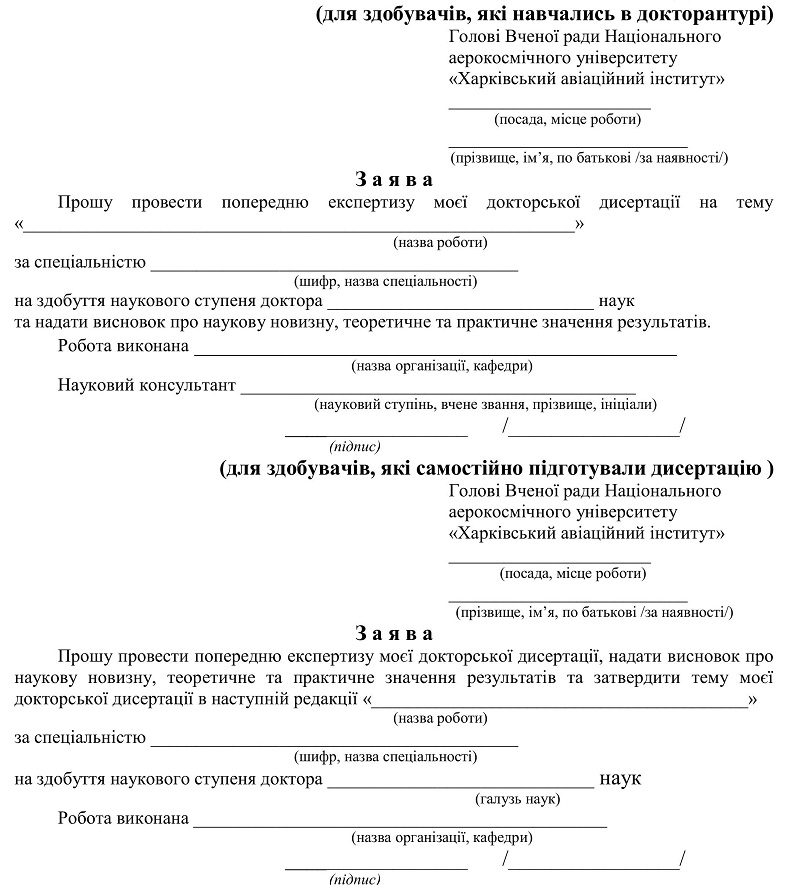
4.2. An applicant whose training was carried out in the University's doctoral studies, as well as an applicant who prepared the dissertation independently and is a scientific or scientific-pedagogical employee of the University, shall apply to the Chairperson of the Academic Council of the University with a written application to conduct a preliminary expert review of the doctoral dissertation and provide a conclusion on the scientific novelty, theoretical and practical significance of the results of the doctoral dissertation.
4.3. An applicant whose training was carried out in the doctoral studies of another higher education institution / scientific institution, as well as an applicant who did not undergo training in doctoral studies but independently prepared a doctoral dissertation and is not an employee of the University, shall apply with a written application to the Chairperson of the Academic Council of the University to conduct a preliminary expert review of their doctoral dissertation and provide a conclusion on the scientific novelty, theoretical and practical significance of its results (and in the case of independent preparation – also the approval of the topic of the doctoral dissertation).
4.4. To conduct the preliminary expert review of the doctoral dissertation, the applicant's application with the visa of the Chairperson of the Academic Council of the University is forwarded to the designated specialized department.
4.5. The preliminary expert review of the doctoral dissertation is carried out within three months from the date of receipt of the applicant's written application for such expert review in the name of the Chairperson of the Academic Council of the University.
For the preliminary expert review, the applicant shall submit to the department:
1) the review of the scientific consultant;
2) the dissertation;
3) photocopies of the applicant's publications on the topic of the dissertation;
4) excerpts from orders on enrollment in doctoral studies, approval of the dissertation topic, and appointment of the scientific consultant;
5) copies of documents on education, scientific degree, and academic title.
Based on the study of the submitted documents and consultations withйна the management of the specialized academic council where the applicant's doctoral dissertation defense is planned, the Head of the Department takes measures to confirm the validity of the documents on higher education and academic degree, and submits proposals to the University Academic Council on the appointment of three reviewers from among the scientific and pedagogical staff of the department and/or invited experts from other departments of the University (Appendix B).
Proposals shall be submitted no later than 10 days before the meeting of the University Academic Council.
The applicant's close relatives, the scientific advisor and their close relatives, as well as a co-author of any of the applicant's scientific publications cannot be appointed as reviewers.
4.6. The University Academic Council approves the candidates of reviewers and provides the applicant with an excerpt from the meeting minutes containing the relevant decision.
4.7. Reviewers examine the doctoral dissertation and scientific publications containing the main research results, and prepare a draft conclusion on the scientific novelty, theoretical and practical significance of the results of the doctoral dissertation.
In case of a negative review by at least one of the reviewers, the conclusion shall not be provided (Art. 11 of the Resolution of the Cabinet of Ministers of Ukraine No. 1197 dated November 17, 2021).
4.8. The head of the structural unit of the University, where the preliminary examination of the doctoral dissertation is carried out, organizes and holds a professional seminar for the approbation of the dissertation.
At the professional seminar (meeting of the specialized department or interdepartmental seminar), the approbation (public presentation) of the doctoral dissertation by the applicant is carried out.
4.9. Based on the discussion of the dissertation work at the professional seminar, a conclusion on the scientific novelty, theoretical and practical significance of the research is prepared.
The conclusion must necessarily indicate information on the compliance of the dissertation with the requirements provided for in paragraphs 3, 7, 8, 9 of the "Procedure for Awarding the Academic Degree of Doctor of Science":
- a list of scientific provisions and new scientifically sound results obtained personally by the applicant, which have practical and theoretical value and are confirmed by documents certifying the applicant's relevant research;
- the presence of the required number of publications on the topic of the doctoral dissertation in journals classified in the first and second quartiles (Q1, Q2) according to the SCImago Journal and Country Rank or Journal Citation Reports (excluding publications of the state recognized by the Verkhovna Rada of Ukraine as an aggressor state);
- compliance with the scientific specialty within the branch of science;
- compliance with the specialty passport;
- grounded conclusions based on the obtained results;
- characteristics of content unity;
- the applicant's personal contribution to science in solving an important theoretical or applied problem;
- compliance with the principles of academic integrity.
The subject of the examination also compares texts visually or using appropriate software to check for the presence / absence of references to the author and / or the used source, and analyzes the detected overlapping text fragments regarding the legitimacy / illegitimacy of their use in accordance with the requirements of the Law of Ukraine "On Copyright and Related Rights".
It is mandatory to indicate when and by whom the dissertation topic was approved (re-approved). The results of voting by participants of the department meeting are given, indicating the number of attendees and the number of persons who voted "for", "against" or "abstained".
4.10. Personal responsibility for the timely and correct drafting of the conclusion on the scientific novelty, theoretical and practical significance of the results of the doctoral dissertation, its objectivity and quality is vested in the reviewers.
4.11. The conclusion is signed by the Head of the Department (chairperson of the meeting), the secretary of the department, and the reviewers. The conclusion is approved by the Vice-Rector for Scientific Work. The applicant is provided with two copies of the conclusion on the scientific novelty, theoretical and practical significance of the results of the doctoral dissertation. The conclusion is valid for one calendar year from the date of its approval.
4.12. Remuneration of reviewers, in accordance with paragraph 12 of clause 11 of the Awarding Procedure, is carried out in accordance with the legislation regulating the remuneration rates of experts involved in conducting state scientific and scientific-technical expertise.
5. Awarding the Academic Degree of Doctor of Science by the Specialized Academic Council
5.1. In case the conclusion of the scientific advisor (structural unit) and/or the conclusion on the scientific novelty, theoretical and practical significance of the results of the doctoral dissertation is positive, the applicant submits an application to the chairperson of the specialized academic council for the defense of the doctoral dissertation in order to be awarded the academic degree of Doctor of Science and the documents in accordance with the list established by the MES.
5.2. The secretary of the specialized academic council accepts the applicant's application and doctoral dissertation and checks the availability of documents in accordance with the established list. The chairperson of the council puts a corresponding resolution on the applicant's application, indicates the date of acceptance of documents for consideration, and signs it.
5.3. The specialized academic council for awarding the academic degree of Doctor of Science appoints a commission for the preliminary review of the doctoral dissertation, which checks the coverage of the scientific results of the doctoral dissertation in the applicant's scientific publications, determines the completeness of the presentation of the doctoral dissertation materials in them and credits the scientific publications on the topic of the doctoral dissertation in accordance with the legislation, conducts a preliminary review of the doctoral dissertation according to the procedure regulated by the Regulations on the Council, recommends accepting the doctoral dissertation for defense, and submits candidates for the appointment of opponents no later than three months from the date of acceptance of documents for consideration.
Remuneration of the members of the doctoral council's commission for the preliminary review of the doctoral dissertation and opponents, in accordance with paragraph 6 of clause 21 of the Awarding Procedure, is carried out in accordance with the legislation regulating the remuneration rates of experts involved in conducting state scientific and scientific-technical expertise.
5.4. It is prohibited to eliminate shortcomings identified by the doctoral council in the doctoral dissertation (abstract) after its acceptance for defense.
5.5. Heads (their deputies) of higher education institutions (scientific institutions) and their close relatives are not allowed to defend doctoral dissertations in councils formed at the place of main employment of the specified persons. The effect of this norm extends to the chairperson, deputy, and secretary of the specialized academic council for awarding the academic degree of Doctor of Science.
5.6. To review a dissertation for the academic degree of Doctor of Science, three opponents are appointed, of whom only one can be a member of the council where the defense will take place, or a full-time employee of the University.
5.7. Based on the study of the dissertation for the academic degree of Doctor of Science and scientific publications credited for the topic of the dissertation, the opponent submits a review to the specialized academic council for awarding the academic degree of Doctor of Science.
The opponent's review determines the degree of relevance of the chosen topic, the validity of scientific provisions, conclusions, and recommendations formulated in the dissertation, their novelty and national or global significance, the completeness of the presentation of the material in scientific publications credited for the topic of the dissertation, the absence (presence) of academic plagiarism, fabrication, falsification, with remarks and/or debatable issues regarding the provisions of the dissertation.
The opponent is responsible for the objectivity and quality of the review prepared by them.
5.8. Regarding the acceptance of the dissertation for the academic degree of Doctor of Science for defense and the appointment of opponents, the specialized academic council sends a notification to the MES, which, together with other such notifications received by the MES during the month, is posted on the official website of the MES on the third working day of the next month.
The defense of a dissertation for the academic degree of Doctor of Science is held no earlier than one month after the posting of such a notification on the official website of the MES.
5.9. Within three working days after determining the date of the defense of the dissertation for the academic degree of Doctor of Science, such information is posted on the official website of the University.
5.10. No later than ten working days before the date of the dissertation defense, the secretary of the specialized academic council places in electronic form on the official website of the University in the section containing information on the activities of specialized academic councils: a copy of the dissertation for the academic degree of Doctor of Science with the provision of open text data formats (excluding the monograph), the abstract, the conclusion on the scientific novelty, theoretical and practical significance of the dissertation results, the opponents' reviews, and the dissertation record card in the established form.
The specified materials are kept publicly available on the official website of the University for three months from the date of entry into force of the MES order approving the decision of the specialized academic council on awarding the academic degree of Doctor of Science and issuing the Doctor of Science diploma to the applicant.
5.11. The public defense of the dissertation for the academic degree of Doctor of Science is held at a meeting of the specialized academic council for awarding the academic degree of Doctor of Science. The defense of the dissertation must be in the nature of an open scientific discussion, in which members of the council who are competent scientists in the relevant specialty, as well as those present at the meeting at their will, must take part.
5.12. During the meeting, the specialized academic council for awarding the academic degree of Doctor of Science establishes the level of the applicant's acquisition of the highest competencies in the field of developing and implementing research work methodology, conducting original research, and obtaining scientific results that ensure the solution of an important theoretical or applied problem of national or global significance.
5.13. A meeting is considered competent (quorate) if at least two-thirds of the council's composition, as well as at least four Doctors of Science in the specialty of the submitted dissertation, took part in its conduct.
5.14. If for a valid reason one of the opponents cannot take part in the council meeting, the defense of the dissertation can be held in the presence of a positive review from the absent opponent. In this case, their review is announced at the meeting of the specialized academic council by the scientific secretary of this council.
The defense of a dissertation for the academic degree of Doctor of Science is not held in the absence of two opponents.
5.15. The University ensures the live broadcast of the dissertation defense. A video recording of such a council meeting is published on the official website of the University no later than the next working day from the date of the meeting and is stored on the corresponding website for at least six months from the date of entry into force of the MES order approving the decision of the specialized academic council on awarding the academic degree of Doctor of Science and issuing the Doctor of Science diploma to the applicant.
5.16. Based on the public discussion during the dissertation defense, a secret ballot is held regarding the award of the academic degree of Doctor of Science. If the council meeting is held using real-time video communication tools, the secret ballot of all council members is carried out using software (a tool) that ensures the anonymity and verifiability of such voting. The software (tool) for conducting a secret ballot is used by decision of the council.
5.17. In the event that the specialized academic council makes a decision to refuse to award the academic degree of Doctor of Science, all shortcomings, violations, and remarks identified by the council during the review of the dissertation and expressed during its defense that served as the basis for making such a decision are indicated in the decision of the specialized academic council.
The applicant is provided with a duly certified copy of the specified decision, and the documents submitted by them are returned, except for the application, the conclusion of the scientific advisor (structural unit), the conclusion on the scientific novelty, theoretical and practical significance of the dissertation results, and one copy of the dissertation.
5.18. The specialized academic council for awarding the academic degree of Doctor of Science draws up the decision on awarding the academic degree of Doctor of Science (in two copies) within 15 working days after the meeting.
All documents related to the review of the dissertation and its defense in the specialized academic council are formed into the first copy of the applicant's attestation file, which is stored in the University archive for ten years from the date of entry into force of the MES order approving the decision of the specialized academic council on awarding the academic degree of Doctor of Science and issuing the Doctor of Science diploma, while the decision of the specialized academic council on awarding the academic degree of Doctor of Science and one copy of the dissertation (in the University library) are subject to permanent storage.
The second copy of the applicant's attestation file is sent to the MES within a month from the date of the dissertation defense.
6. Final Provisions
6.1 The Regulations on the Defense of Dissertations and the Procedure for Awarding the Academic Degree of Doctor of Science are approved by the University Academic Council and put into effect by the rector's order.
6.2. Amendments and/or additions to these Regulations are made in the manner established for their adoption.
6.3. The general scheme of the stages of the defense procedure for the academic degree of Doctor of Science is shown in Fig. 1.
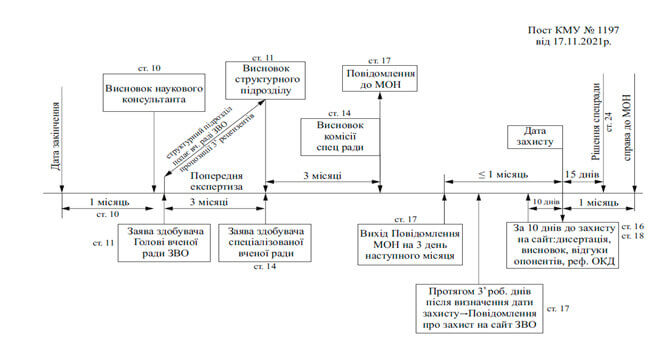
Figure 1 – Stages of the defense procedure of the dissertation work for the academic degree of Doctor of Science
Appendix A
Requirements for the formatting of the abstract of a dissertation for the academic degree of Doctor of Science
A.1. General Provisions
A1.1. These Requirements define the structure and formatting rules for the abstract of a dissertation for the academic degree of Doctor of Science.
A1.2. The requirements for formatting the abstract of a dissertation for the academic degree of Doctor of Science (hereinafter referred to as the Abstract) have been developed in accordance with the Resolution of the Cabinet of Ministers of Ukraine dated November 17, 2021, No. 1197 "Procedure for Awarding and Depriving of the Academic Degree of Doctor of Science", the order of the Ministry of Education and Science of Ukraine dated December 13, 2021, No. 1359 "Regulations on the Specialized Academic Council for Awarding the Academic Degree of Doctor of Science", the order of the Ministry of Education and Science of Ukraine dated January 12, 2017, No. 40 "On Approval of Requirements for Dissertation Formatting" as amended by the Order of the Ministry of Education and Science of Ukraine No. 759 dated May 31, 2019, in accordance with the Requirements for Formatting Dissertations and Dissertation Abstracts (developed on the basis of DSTU 3008-95 "Documents. Reports in the field of science and technology. Structure and formatting rules". Bulletin of the Higher Attestation Commission of Ukraine. 2011. No. 9-10. pp. 1-10), as well as the National Standard of Ukraine DSTU 8302:2015 "Information and documentation. Bibliographic reference. General provisions and compilation rules", and the State Standard of Ukraine DSTU 3008-95 "Documents. Reports in the field of science and technology. Structure and formatting rules".
A.2. General requirements for the abstract
A2.1. The abstract of a dissertation for the academic degree of Doctor of Science is a concise presentation of the doctoral dissertation, which is carried out after its actual completion. Without the Abstract, the dissertation cannot be admitted to defense.
A2.2. The purpose of the Abstract is to familiarize researchers with the main ideas and conclusions of the dissertation, the applicant's contribution to the development and solution of a scientific problem, the research results, and the structure of the dissertation research.
A2.3. The Abstract must thoroughly and concisely reveal the content of the dissertation; it should not contain information that is not covered in the dissertation.
A2.4. The abstract of a dissertation for the academic degree of Doctor of Science is submitted in the state language.
A2.5. Writing the Abstract is the final stage of completing the dissertation work before submitting it for defense to the specialized academic council.
A2.6. The essence of the Abstract lies in its exact compliance with the content of the dissertation, and its content must form a complete understanding of the scientific value and practical significance of the dissertation research.
A2.7. Publishing the Abstract on the official website of the University makes it possible to receive reviews from specialists in the relevant field before the day of defense.
A2.8. The volume of the dissertation abstract must be 1 – 2 author's sheets. An author's sheet is a conventional unit of measurement for the volume of a textual and illustrative publication. One author's sheet is equal to 40 thousand printed characters, taking into account numbers, punctuation marks, and spaces between words. The volume of the Abstract does not include the cover of the Abstract, the list of works published by the author, and abstracts.
A.3. Structure of the abstract
A3.1. The abstract must contain the following structural elements:
– general description of the dissertation (justification of the choice of the research topic; purpose and tasks of the research; research methods; scientific novelty of the obtained results; personal contribution of the applicant; approbation of the dissertation materials; structure and scope of the dissertation; connection of the work with scientific programs, plans, and topics; practical significance of the obtained results; publications);
– main content of the dissertation;
– conclusions;
– list of the applicant's publications on the topic of the dissertation;
– abstracts in Ukrainian and English.
A3.2. The general description of the work presented in the Abstract must correspond to its qualification characteristics given in the introduction to the dissertation, while revealing the essence and state of the scientific problem and its significance, the grounds and initial data for researching the topic, and the justification for the need to conduct the research.
A3.2.1. The justification for the choice of the research topic involves highlighting the connection of the dissertation topic with modern research in the relevant field of knowledge through critical analysis with the definition of the essence of the scientific problem or task; at the same time, it indicates within the framework of which programs, thematic plans, scientific topics, and grants, in particular sectoral, state, and/or international ones, the dissertation research was performed, with the indication of the state registration numbers of research and development works and the name of the organization where the work was performed.
A3.2.2. The purpose and tasks of the dissertation research are determined in accordance with the subject and object of the research.
The object of research is a process or phenomenon that generates a problem situation and is chosen for research. The subject of research is within the boundaries of the object. The object and subject of research as categories of the scientific process relate to each other as the general and the partial.
That part of the object which is the subject of research is singled out within the object. It is on this that the Applicant's main attention is focused, since the subject of research meaningfully determines the topic (title) of the dissertation work, which is indicated on the title page.
A3.2.3. As research methods, the applied scientific research methods are listed and it is meaningfully noted what exactly was investigated using each method; the choice of methods that ensure the reliability of the obtained results and conclusions is justified.
This structural element also indicates the experimental base of the research.
A3.2.4. The scientific novelty of the obtained results is a reasoned, brief, and clear presentation of the main scientific provisions submitted for defense, indicating the difference between the obtained results and previously known ones. The degree of novelty of the obtained results is revealed (for the first time, improved, underwent further development). Each scientific provision is formulated clearly, highlighting its main essence and focusing special attention on the level of novelty achieved thereby.
The formulated scientific provision must be perceived easily and unambiguously. This item cannot include a description of new applied (practical) results obtained in the form of methods, devices, techniques, schemes, algorithms, etc. One should always distinguish between the obtained scientific provisions and new applied results that follow from the Applicant's theoretical achievements. All scientific provisions, taking into account the level of novelty achieved by them, are the theoretical basis of the scientific problem solved in the dissertation.
A3.2.5. Scientific publications credited for the topic of the dissertation – this is the number of scientific works in which the main scientific results of the dissertation are published, as well as the number of works that additionally reflect the scientific results of the dissertation. Requirements for publications are determined by the MES of Ukraine.
Approbation of the doctoral dissertation materials at scientific conferences, congresses, symposia, etc. is mandatory.
A3.2.6. If the dissertation uses ideas or developments belonging to co-authors with whom the applicant has published scientific works, the applicant's specific personal contribution to such works or developments must be indicated; the applicant must also add references to the co-authors' dissertations in which the results of joint work were used.
A3.2.7. As approbation of the dissertation materials, the names of conferences, congresses, symposia, seminars, the place and date of their holding are indicated.
A3.2.7. Structure and scope of the dissertation – all structural elements of the dissertation work are indicated with the mandatory indication of the full scope of the dissertation and the scope of the main text. The total number of appendices, figures, tables, and the number of titles in the list of used sources are indicated.
A3.2.8. Connection of the work with scientific programs, plans, topics, grants – it is indicated within the framework of which programs, thematic plans, scientific topics, and grants, in particular sectoral, state, and/or international ones, the dissertation research was performed, with the indication of the state registration numbers of research and development works and the name of the organization where the work was performed;
A3.2.9. Practical significance of the obtained results – information on the use of research results or recommendations for their use is provided. When noting the practical value of the obtained results, it is necessary to provide information on the degree of their readiness for use or the scale of use. Information on the implementation of research results must be provided with the indication of the names of organizations where the implementation was carried out, forms of implementation, and requisites of relevant documents.
A3.3. The main content of the abstract contains a briefly stated description of the dissertation by sections; it should give a complete and convincing idea of the work performed. If the introductory part of the abstract (general description of the work) allows only a general impression of the dissertation to be formed, the main part, which is actually abstracting in nature, gives a more complete idea of its content and structure.
The presentation of the main content of the dissertation is subordinated to the leading idea of the research, clearly defined by the author. In this part of the abstract, it is important to show how the results were obtained, demonstrate the course of the research, state the essence of the methods used, provide data on their accuracy and labor intensity, and describe the conditions and main stages of the research. Nuances of covering the content of the dissertation may vary depending on the scientific field, topic, and other factors.
This structural element must reflect:
– literature review on the topic and selection of research areas;
– presentation of the general methodology and main research methods;
– experimental part and research methodology;
– information on conducted theoretical and (or) experimental studies;
– analysis and generalization of research results.
In the first chapter, the Applicant outlines the main stages of scientific thought within the framework of the solved problem briefly, critically highlighting the works of other scientists. The Applicant must single out those issues that remained unresolved and, therefore, determine their place in solving the scientific problem.
The total volume of the literature review should not exceed 20% of the volume of the main part of the dissertation.
In the second chapter, the choice of the research direction is justified, the general methodology of conducting the dissertation research is set forth, methods for solving tasks and their comparative evaluations are given. The main trends, regularities, calculation methods, considered hypotheses, principles of operation and characteristics of used software and/or hardware, laboratory and/or instrumental methods and techniques, measurement error estimates, etc., are described. In theoretical works, the calculation methods and hypotheses used are revealed; in experimental ones – the principles of operation and characteristics of the developed equipment, measurement error estimates.
Subsequent chapters describe the course of research, conditions and main stages of experiments, and set forth the results of the Applicant's own research with exhaustive completeness, how they were obtained, and what their novelty consists of. The Applicant must evaluate the completeness of solving the tasks set, evaluate the reliability of the obtained results (characteristics, parameters), compare the obtained results with similar results of domestic and foreign researchers, and justify the need for additional research or negative results that necessitate the termination of further research.
A3.4. Conclusions are concise information about the results of the work performed. The conclusions set forth the most important scientific and practical results of the dissertation, reveal the methods for solving the specified scientific problem, their practical analysis, comparison with known solutions, indicate the scientific problems for the solution of which the research results can be applied, as well as possible directions for continuing research on the topic of the dissertation. In the conclusions, it is necessary to emphasize the qualitative and quantitative indicators of the obtained results, substantiate the reliability of the results, and set forth recommendations for their use. Each scientific and applied conclusion of the dissertation must be formulated clearly and specifically (unambiguously). The wording of the conclusions must reflect the essence and novelty of the conducted research.
The conclusions must match the general conclusions of the dissertation.
A3.5. The list of published works on the topic of the dissertation is submitted with the mandatory inclusion of the last names of all co-authors. The works are arranged by categories in the following order:
– works in which the main scientific results of the dissertation are published;
– published works of an approbation nature;
– published works that additionally reflect the scientific results of the dissertation.
For the bibliographic description of the list of published works on the topic of the dissertation, it is necessary to use the National Standard of Ukraine DSTU 8302:2015 "Information and documentation. Bibliographic reference. General provisions and compilation rules" or one of the styles from the recommended list of styles for formatting the list of scientific publications:
– MLA (Modern Language Association) style;
– APA-1,2 (American Psychological Association) style;
– Chicago/Turabian style-1;
– Harvard style-1;
– ACS (American Chemical Society) style;
– AIP (American Institute of Physics) style;
– IEEE (Institute of Electrical and Electronics Engineers) style;
– Vancouver style-1;
– OSCOLA.
A3.6. To familiarize readers with the generalized summary of the main content and results of the dissertation for the academic degree of Doctor of Science, abstracts in Ukrainian and English are submitted. The presentation of information in the abstract must be concise and accurate. It is necessary to use syntactic structures inherent in the language of business documents and standardized terminology, avoiding little-known terms and symbols.
When preparing the abstract, the following are indicated: the last name and initials of the applicant, the title of the dissertation, the type of dissertation (as a manuscript or monograph) and the academic degree for which the applicant is applying, the specialty (code and title), the name of the institution where the defense will take place, city, year, and the content of the abstract. At the end of each abstract, keywords in the corresponding language are provided. The set of keywords must correspond to the main content of the scientific work, reflect the research topic, and ensure the thematic search of the work. The number of keywords ranges from five to fifteen. Keywords are provided in the nominative case and printed in a line separated by commas.
The abstract in Ukrainian must be an expanded information piece with a volume of 2 pages of typescript (up to 5,000 characters including spaces) regarding the content and results of the dissertation work, highlighting the main ideas and conclusions of the dissertation. The abstract in English, with a volume of up to 0.5 pages of typescript (up to 1,200 characters including spaces), must be of identical content.
A.4. Rules for formatting the abstract
A4.1. The abstract of a dissertation for the academic degree of Doctor of Science is formatted in accordance with the state standard of Ukraine DSTU 3008-95 "Documents. Reports in the field of science and technology. Structure and formatting rules", as well as taking into account the "Requirements for Formatting Dissertations and Dissertation Abstracts" (Bulletin of the Higher Attestation Commission of Ukraine. 2011. No. 9-10), and the Requirements for Dissertation Formatting (Order of the Ministry of Education and Science of Ukraine dated 12.01.2017 No. 40 "On Approval of Requirements for Dissertation Formatting" as amended by Order of the Ministry of Education and Science of Ukraine No. 759 dated 31.05.2019).
The abstract is formatted as a brochure and consists of a cover and text.
A4.2. On the front side of the abstract cover, the following are presented:
– the name of the institution and organization whose specialized academic council accepted the dissertation for defense (printed in capital letters in bold and centered on the page);
– the last name, first name, and patronymic of the Applicant (the last name is printed in capital letters, the first name and patronymic in lowercase (except for the first capital letter) in bold, centered on the page);
– UDC index (aligned to the right edge);
– the title of the dissertation (printed in capital letters in bold and centered on the page);
– code and title of the specialty in accordance with the list of scientific specialties (printed in lowercase letters and centered on the page);
– subtitle «ABSTRACT (in bold) of the dissertation for the academic degree of Doctor (branch of science)» (the subtitle is printed in lowercase letters except for the first word, centered on the page);
– city, year (the name of the city is printed in capital letters in bold, followed by a hyphen – the year, centered on the page).
The content and authorship of the dissertation abstract are confirmed by the signature of the applicant for the academic degree, which is located next to the last name on the title page.
An example of formatting the front side of the abstract cover is given in the appendix to these Requirements.
A4.3. On the back side of the abstract cover, the following are indicated:
– the organization where the doctoral dissertation work was performed;
– academic degree, academic title, last name, first name, and patronymic of the scientific consultant, their place of work and position;
– academic degrees, academic titles, last names, first names, patronymics, places of work, and positions of official opponents;
– date and time of the defense, code of the specialized academic council, and address;
– the library where one can review the dissertation;
– the date of posting the Abstract on the official website of the University;
– the signature of the scientific secretary of the specialized academic council.
Among the academic titles of the scientific consultant and opponents, it is not recommended to mention their membership in public (non-state) academies of sciences.
An example of formatting the back side of the abstract cover is given in the Appendix to these Requirements.
On page 3 of the abstract cover, bibliographic data must be indicated in accordance with state standards for library and publishing business.
A4.4. The structural parts of the Abstract are not numbered; their titles are printed in capital letters symmetrically to the text. The abstract is prepared for printing using Word text editor fonts of size 14 pt with single line spacing on one side of an A4 sheet (210×297 mm). Top, left, and bottom margins – 20 mm, right – 10 mm.
The pages of the Abstract are numbered starting from the first page containing the general description of the dissertation. Page numbers are placed in Arabic numerals in the center of the top margin.
The paragraph indentation of the text of the entire Abstract must be uniform and equal to 1.25 cm.
The format for submitting the text of the Abstract is given in the Appendix to these Requirements.
The dissertation abstract is published by printing in the form of a brochure with a print run of 100 copies.
The text is printed on both sides of an A5 sheet (148x210 mm).
Appendix to the Requirements
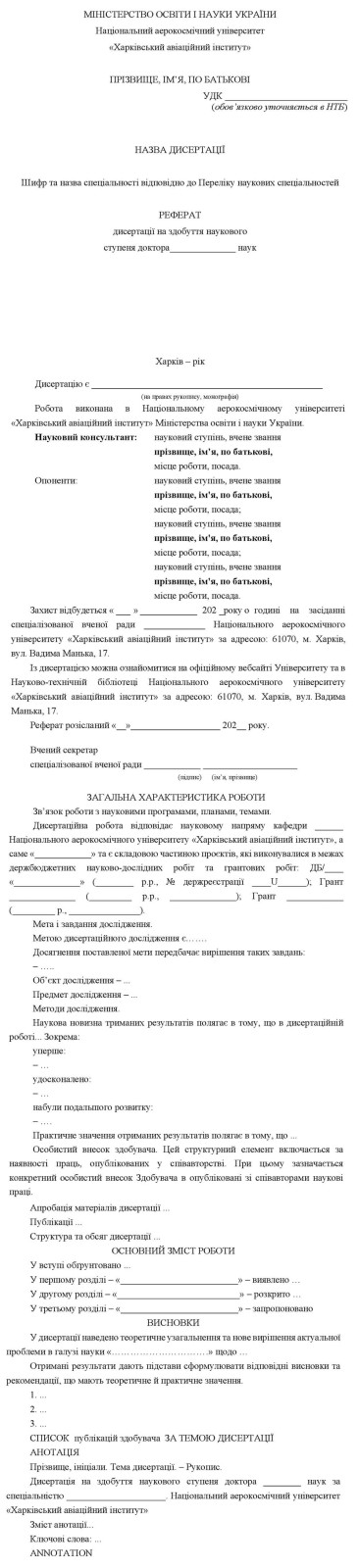
Appendix B
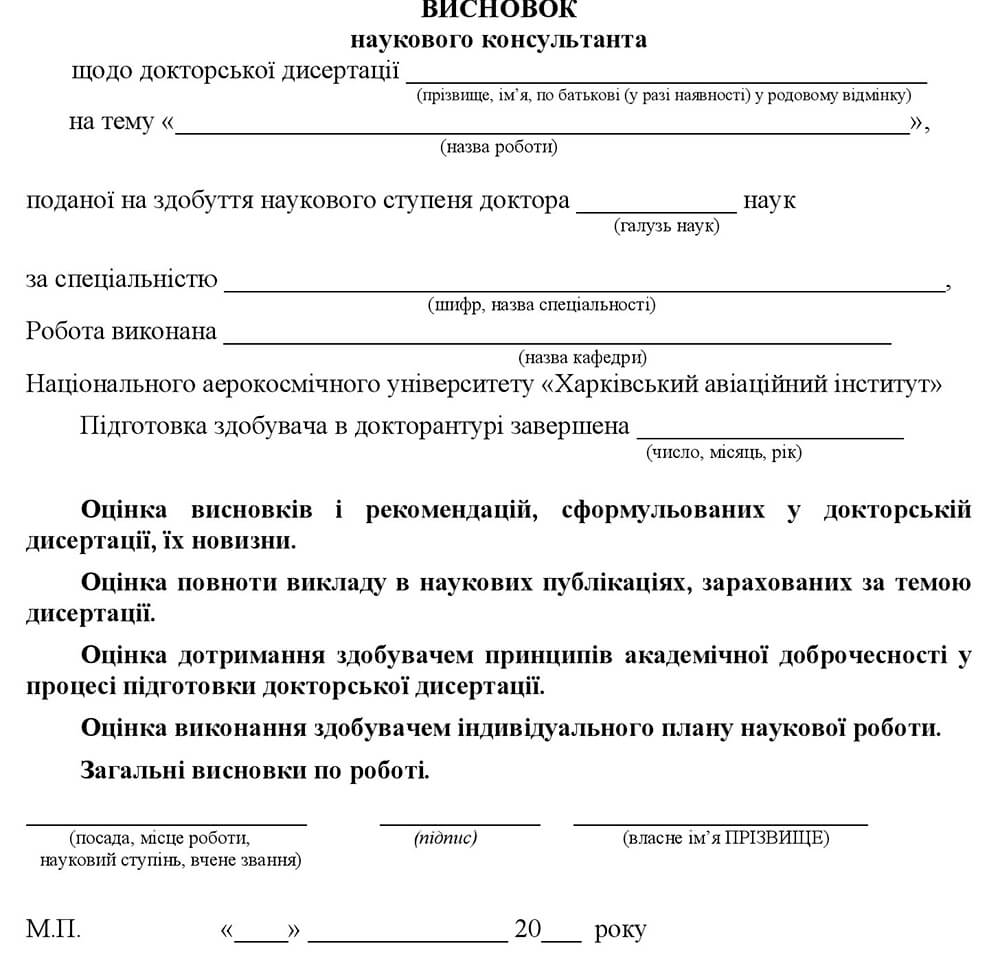
Appendix V