Enacted by Order No. 224 dated May 19, 2025
QMS KhAI-VDA-ID/001:2025
Effective Date: May 19, 2025
Revision No. 1
1. General Provisions
1.1 Instruction on Records Management of the National Aerospace University "Kharkiv Aviation Institute" (hereinafter referred to as the Instruction) establishes general requirements for documenting management information and organizing work with documents created in paper and electronic form at the National Aerospace University "Kharkiv Aviation Institute" (hereinafter referred to as the University), regardless of the method of recording and reproducing information contained in the documents, including their preparation, registration, accounting, and control over execution.
1.2 The University organizes records management on the basis of the Constitution of Ukraine, requirements of the Laws of Ukraine "On Education", "On Higher Education", "On Scientific and Scientific-Technical Activity", "On the National Archival Fund and Archival Institutions", "Standard Instruction on Records Management in Ministries, Other Central and Local Executive Bodies Approved by Resolution of the Cabinet of Ministers of Ukraine dated 17.01.2018 No. 55 (as amended)", "Rules for the Organization of Records Management and Archival Storage of Documents in State Bodies, Local Self-Government Bodies, Enterprises, Institutions, and Organizations Approved by Order of the Ministry of Justice of Ukraine dated 18.06.2015 No. 1000/5 (as amended)", "List of Standard Documents Created During the Activities of State Bodies and Local Self-Government Bodies, Other Institutions, Enterprises, and Organizations, Indicating Document Retention Periods, Approved by Order of the Ministry of Justice of Ukraine dated 12.04.2012 No. 578/5 (as amended)", as well as regulations and national standards for organizational and administrative documentation, including DSTU 2732:2023 "Records Management and Archival Science. Terms and Definitions", DSTU 4163-2020 "Unified System of Organizational and Administrative Documentation. Requirements for Document Preparation", as well as the University Charter, Order for the University dated 03.10.2024 No. 394 "On the Distribution of Functional Duties and Subordination of Structural Units of the University", and regulations on structural units of the University.
1.3 The procedure for organizing electronic document management at the University using an electronic digital signature, working with electronic documents, and conducting records management regarding documents containing restricted information, citizens' appeals, and requests for information, is determined by separate regulatory legal acts.
Simultaneous processing of the same document in electronic and paper forms is not permitted.
The provisions of this Instruction regarding work with the specified documents, as well as with primary accounting, banking, financial, reporting-statistical, scientific-technical, and other special documentation, apply only to the extent of general principles of document handling and preparation of documents for transfer to archival storage.
1.4 According to document flow rules, a centralized document registration system is applied at the University. When applying a centralized records management system at the University, current office work, file formation, and operational file storage at the University are provided for.
Records management at the University is conducted in paper and electronic forms.
Possessing confident skills and competencies to fulfill the requirements of the Instruction is part of the job responsibilities for heads of structural units of the University and employees responsible for records management in the unit. Compliance with the rules and recommendations regarding the procedure for conducting records management established in this Instruction is mandatory for all University employees.
1.5 Responsibility for the organization of records management and archival matters rests with the Rector. The organization of records management at the University in accordance with state standards requirements and this Instruction is assigned to the Records Management and Archive Department of the University.
The primary task of the Records Management and Archive Department is establishing a unified procedure at the University for documenting management information in paper and electronic forms, working with documents in the electronic document management system "Deka Office", and providing methodical management and control over compliance with the established procedure for working with documents in structural units.
In accordance with its assigned tasks, the Records Management and Archive Department:
- develops the Instruction (amendments thereto) and the consolidated Nomenclature of Files of the University;
- organizes document flow at the University, formation of files, and their storage;
- performs registration and keeps accounting of incoming and outgoing correspondence documents, including through the electronic document management system "Deka Office";
- ensures implementation and monitors compliance with the requirements of this Instruction by faculties and structural units of the University;
- conducts audits of the state of records management at faculties and structural units of the University;
- exercises control within its competence over the timely consideration and processing of documents at the University;
- performs analysis of document flow information necessary for making management decisions;
- organizes the preservation and use of the University's documentation collection;
- initiates and participates in professional development organization for University employees on records management issues;
- affixes the official seal onto documents signed by the University management.
The Head of the Records Management and Archive Department of the University, within their assigned duties:
- monitors compliance with established requirements for working with documents at the University;
- reports to the Rector on the organizational state and operation of records management at the University;
- has the right to demand from heads of structural units and individual University employees data necessary for current work and improvement of forms and methods of document processing;
- has the right to return documents to originators and demand their revision in case of violation of requirements established in this Instruction.
1.6 Responsibility for content, quality of preparation, and proper formatting of documents, for organization of records management at faculties and in structural units of the University (including separate structural units), compliance with the rules of this Instruction by all employees, as well as preservation of documents from creation or receipt until dispatch or transfer to the Records Management and Archive Department rests with heads of structural units.
Heads of structural units of the University, within their granted rights, are obliged to:
- ensure regular verification of incoming new documents;
- organize and ensure training for employees designated as responsible for records management in the unit in order to enhance their qualifications;
- ensure compliance in the unit with requirements regarding organization of records management processes while working with the electronic document management system "Deka Office".
Conducting records management in structural units of the University in paper and (or) electronic forms is assigned to one or several employees of the structural unit in accordance with their functional duties. Heads of structural units of the University must timely inform the Records Management and Archive Department of the University about changes in the personal composition of employees responsible for conducting records management in the unit.
Upon the dismissal of an employee who performs records management functions in a structural unit, as well as in the event of their leave or business trip, all unexecuted official documents, as instructed by the head of the structural unit, are transferred to the person replacing them.
In the absence of a person responsible for conducting records management in the unit in paper and (or) electronic forms, their functions are performed personally by the head of the unit.
An employee responsible for conducting records management in a unit is guided in their work by:
- this Instruction;
- requirements specified in the normative legal acts of the University (cl. 1.3 of this Instruction), in particular on the procedure for organizing electronic document management at the University using an electronic digital signature, working with electronic documents;
- user operation instructions for the "Deka Office" electronic document management system;
- other documents regarding the implementation of office management processes at the University;
- functional duties of the employee approved in accordance with the established procedure.
An employee responsible for conducting records management in a unit is obliged to:
- develop the nomenclature of files for the structural unit of the University, submit it to the Records Management and Archive Department for approval and inclusion in the consolidated nomenclature of files of the University;
- check the document box for the unit at the Records Management and Archive Department, the unit's corporate email, and the "Deka Office" electronic document management system for new arrivals;
- pass documents for execution according to the resolution of the head, receive processed documents from executors;
- monitor document execution and inform the head of the unit;
- send prepared outgoing correspondence through the Records Management and Archive Department;
- systematize executed documents and file them into folders;
- prepare files for permanent and long-term (over 10 years) storage and transfer them in an orderly condition according to inventories to the Records Management and Archive Department;
- in cases of technical failure of the "Deka Office" electronic document management system, notify its system administrator.
1.7 Certain issues regarding the organization of records management at the University, in particular defining and refining the list of documents created, registered, and stored in electronic form, introducing changes to established procedures for document routing, designating responsible persons for the storage of specific types of documents, and establishing certain document flow rules at the University in educational, scientific, and economic activities, may be regulated by orders of the rector and directives of vice-rectors within the limits of granted powers.
The specified documents, together with this Instruction and other normative legal acts of the University (cl. 3 of this Instruction) accompanying this Instruction, are an integral part of the established procedure for conducting office management processes at the University.
2. Documenting Management Information
General Requirements for Document Creation
2.1 Documenting management information consists in creating documents in which information about managerial actions is recorded in compliance with established rules (Annex 1).
2.2 During the preparation of organizational and administrative documents in paper form, University employees format them taking into account the requirements of
DSTU 4163-2020.
2.3 The right to create, sign, endorse, and approve documents is determined by legislative acts, the University Charter, regulations on structural units, and job descriptions.
2.4 The University determines the set of documents provided for in the nomenclature of files that are necessary and sufficient for documenting information about its activities. On issues of mutual interest belonging to the competence of different institutions, joint documents may be created.
2.5 The choice of document type intended for documenting management information (directive, resolution, decision, minutes, etc.) is determined by the legal status of the University, the competence of the official, and the procedure for adopting managerial decisions (on the basis of sole leadership or collegiality).
2.6 A document must comply with the provisions of acts of state authorities and be directed towards the fulfillment of the tasks and functions assigned to the University.
2.7 Classes of management documentation are determined according to the State Classification of Management Documentation NK 010:2021 "Classifier of Management Documentation", approved by Order of the Ministry for Development of Economy, Trade and Agriculture of Ukraine dated 12.03.2021 No. 526.
2.8 A document must contain mandatory elements (requisites) for its specific type, placed in the established order, namely: name of the institution - author of the document, title of the document type (except letters), date, document registration index, title to the text, text, and signature.
During the preparation and formatting of documents, not only mandatory but also other elements (requisites) may be applied if this corresponds to the purpose of the document or the method of its processing.
2.9 In order to increase the efficiency and speed of organizing work with documents, documents identical in content may be unified by developing standardized (template) texts included in the compilation (album) of unified (standard) document forms of the University. The list of unified (standard) document forms is established by the rector, the form and content of which are approved by the Academic Council of the University, or by the rector, or on behalf of the rector by a vice-rector of the University. Approved standard document forms are published for general access on the official website of the University, in the "Deka Office" electronic document management system, in the University's local network "Document Exchange" at the following link: \\10.0.0.250\file exchange, and are mandatory for use and application.
2.10 The University conducts records management in the state language. Documents are drawn up in the state language, except in cases provided for by the legislation on languages in Ukraine.
Documents sent to foreign addressees are formatted in the state language, or in the language of the addressee's state, or in one of the languages of international communication.
2.11 Certain internal documents (applications, explanatory and internal notes, etc.), authored by officials and other natural persons, are allowed to be executed in handwritten form.
Document Letterheads
2.12 Organizational and administrative documents are formatted on letterheads manufactured in accordance with the requirements of this Instruction.
For the manufacture of letterheads, paper sheets of A4 (210 x 297 mm) and A5 (210 x 148 mm) formats are used. It is permitted to use A3 format letterheads (297 x 420 mm) for formatting documents in the form of tables.
Document letterheads must have the following margins (in millimeters):
- 30 – left;
- 10 – right;
- 20 – top and bottom.
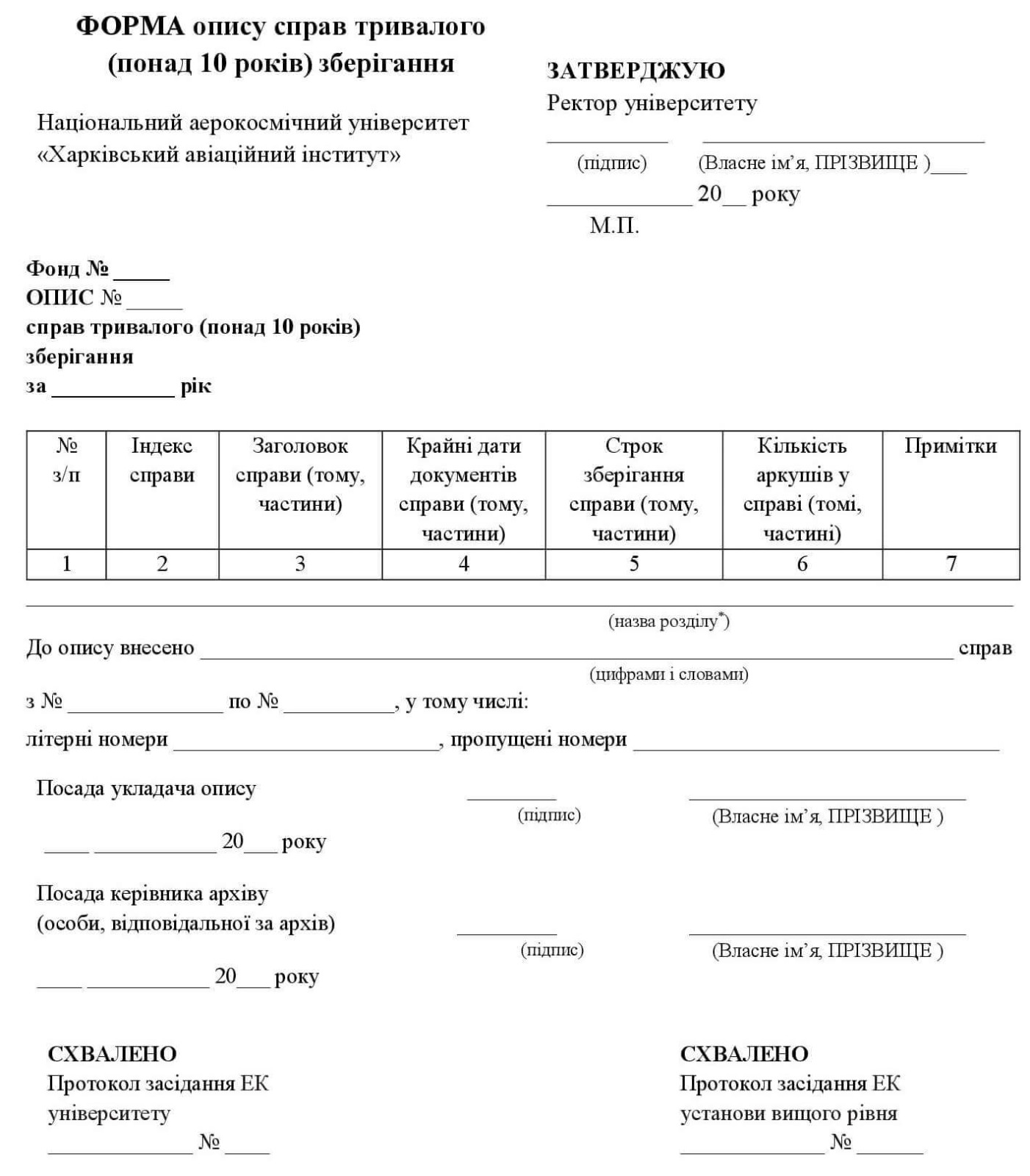
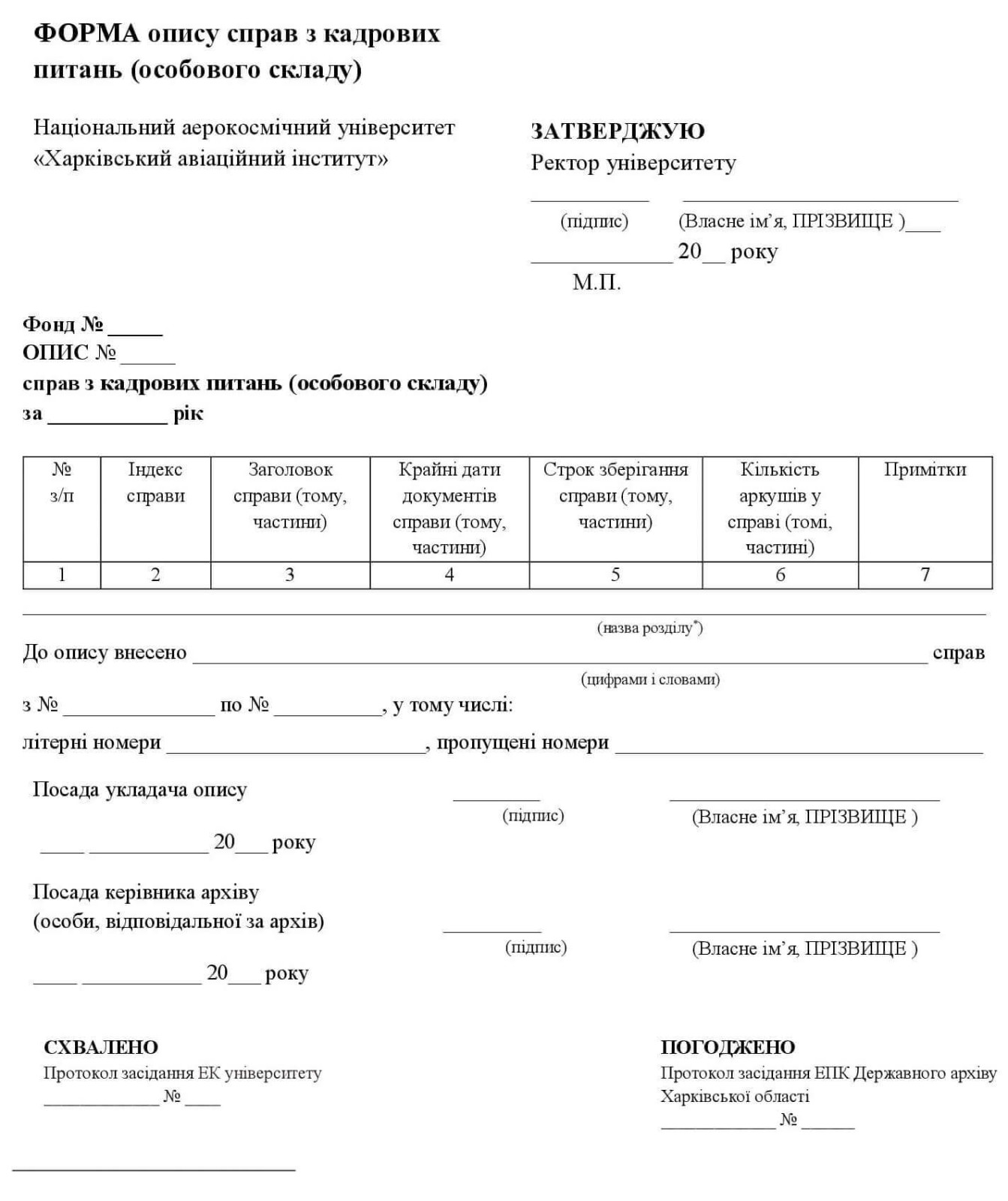
The following letterheads are used at the University:
- letters (Annex 2);
- orders (Annex 3);
- directives (Annex 4).
Letterheads of each type are produced on the basis of angular or longitudinal placement of requisites. Header requisites are placed in a centered (the beginning and end of each line of the requisite are equally distant from the boundaries of the requisite placement area) or flush-left/flagged (each line of the requisite begins from the left boundary of the requisite placement area) manner.
2.13 The University applies document letterheads of both the University and structural units in cases where the head of the unit has the right to sign documents within the limits of their authority.
2.14 Document letterheads are produced in a printing house on high-quality white paper with rich color inks.
2.15 Types of paper letterheads produced by printing methods are subject to accounting and are tracked.
Accounting is carried out by sequential numbers placed by a numbering machine, printing, or other method on the bottom margin of the reverse side or on the left margin of the front side of the letterhead.
Persons personally responsible for accounting, storing, and using letterheads are appointed by the Rector of the University, for which an administrative document is issued.
The manufacture of letterheads for specific types of documents is allowed if the number of registered paper documents of such type in the institution exceeds 2 thousand units per year. If the number of registered paper documents is less than 2 thousand units, the document is printed from the text editor in which it was created, without using printed letterheads.
2.16 Certain internal documents (employee applications, internal notes, certificates, etc.) and documents created on behalf of several institutions are not executed on letterheads.
Image of the State Coat of Arms of Ukraine
2.17 The image of the State Coat of Arms of Ukraine is placed on document letterheads pursuant to Resolution of the Verkhovna Rada of Ukraine dated February 19, 1992 No. 2137-XII "On the State Coat of Arms of Ukraine" in accordance with regulatory legal acts.
2.18 The image of the State Coat of Arms of Ukraine or the Coat of Arms of the Autonomous Republic of Crimea is placed in the center of the top margin. The size of the image is 17 mm high and 12 mm wide.
Codes
2.19 The University code is entered according to the Unified State Register of Enterprises and Organizations of Ukraine (EDRPOU) and is placed after the "Reference Data on the Institution" requisite.
2.20 The code of the unified document form (if available) is placed according to NK 010:2021 above the title of the document type.
The decision on the necessity of recording the unified document form code is made by the Rector of the University separately for each type of document.
Name of the University
2.21 The name of the University, author of the document, including the abbreviated form (KhAI), must correspond to the name contained in the Charter and in the Unified State Register of Legal Entities, Individual Entrepreneurs and Public Formations. The abbreviated name may be placed (in parentheses or without them) below the full name on a separate line centered on the document.
The name of a higher-level institution is indicated in abbreviated form, or fully if there is no officially defined abbreviation. On the letterheads of an institution with dual or triple subordination, the names of all higher-level institutions are indicated.
The name of a structural unit of the institution is indicated when it is the author of the document, and is placed below the name of the institution.
Reference Data on the University
2.22 Reference data on the University contains the postal address, telephone numbers, fax numbers, email address, official website address, and is placed below the name of the University.
The elements of the postal address must correspond to the information contained in the Charter of the University and the Unified State Register of Legal Entities, Individual Entrepreneurs and Public Formations, and are specified in the following sequence: street name, building number, name of settlement, district, region, postal code.
Title of Document Type
2.23 The title of the document type (order, decision, internal note, etc.) is indicated on the letterhead and must correspond to the titles provided in NK 010:2021.
Document Date
2.24 The date of a document is the date of its signing, approval, adoption, registration, or issuance. The date is indicated in Arabic numerals on a single line in the following sequence: day, month, year. The date is formatted in a digital or alphanumeric format. In the case of digital date formatting, the day and month are represented by two pairs of digits separated by a dot; the year by four digits, with no dot at the end, for example: 02.01.2025.
In the texts of regulatory legal acts, references to them, and documents containing financial information, the alphanumeric method of date indication is used with a leading zero in the day of the month if it consists of a single digit, for example: 02 December 2024. It is permitted to use the word "year" in an abbreviated form "y." [or "yr."], for example: 03 December 2024 y.
If a document is not created on a letterhead, the date is indicated below the signature on the left. The document date is entered by the official who signs or approves it.
Mandatory dating and signing apply to all official marks on documents related to their routing and execution (resolutions, approvals, endorsements, marks on document execution, and filing).
On a document issued by two or more institutions, a single date is indicated, corresponding to the date of the last signature.
Document Registration Index
2.25 Indexing of documents consists of assigning conditional designations – indices – to them, which are assigned to documents during their registration.
The assignment of a registration index is carried out in automatic or automated mode using software and hardware tools.
The registration index consists of a sequential number of the document within the registered document group, supplemented by indices applied at the university, in particular indices according to the file nomenclature, structural unit, correspondents, officials reviewing or signing the document, executors, and subject matters covered by the document.
The component parts of a registration index are separated from each other by a forward slash. The sequence of writing the component parts of a registration index may change depending on which document is being registered: incoming or created at the University, for example: 38-01/845, where 845 is the sequential number, 38-01 is the index of the University and the file according to the nomenclature, or 25-12/10, where 10 is the sequential number, 25-12 is the index of the file according to the nomenclature.
The location of the registration index is determined by the letterhead form.
A barcode and/or a QR code may be used to apply the registration index.
Reference to a Document
2.26 A reference in the text of a document to a document being answered or in pursuance of which this document was prepared is provided in the following sequence: title of document type, name of institution – author of document, date and registration index, brief content of the document. In the case of referring to a registered regulatory legal act, the following registration data are additionally specified: date of state registration, act number according to the State Register of Regulatory Legal Acts of Ministries and Other Executive Bodies.
References in the document text to sequential numbers of sections, subsections, chapters, articles, points, and subpoints of a regulatory legal act are made in digits; sequential numbers of parts of articles, paragraphs, and sentences – in words. References in the text of a regulatory legal act to this document or its structural units are made using the demonstrative pronoun "this".
Place of Compilation or Issuance
2.27 Details regarding the place of compilation or issuance are specified on all documents, except letters. The specified details are formatted in accordance with the administrative-territorial division of Ukraine. If details regarding the geographical location belong to the name of the institution, this requisite is not indicated.
Addressee and Personal Salutation
2.28 Documents are addressed to an institution, its structural units, or a specific official. If a document is addressed to an institution or its structural units without specifying an official, their names are given in the nominative case, for example:
National Agency
for Civil Service
If a document is sent to an official, the name of the institution and its structural unit are given in the nominative case, and the position and surname of the addressee – in the dative case, for example:
State Archival Service
To the Head of the Financial and Economic Department
First Name SURNAME
In cases where a document is addressed to the head of an institution or their deputy, the name of the institution is part of the job title of the addressee, which is given in the dative case, for example:
To the Head of the State Customs Service
First Name SURNAME
If a document is addressed to several institutions of a similar nature of activity, a generalized name of the addressees is specified, for example:
To Central State Archives
A document should not have more than four addressees. The word "copy" before the name of the second to fourth addressees is not placed. In the case of sending a document to more than four addressees, a distribution list is drawn up indicating only one addressee on each document.
The "Addressee" requisite may contain an address. The order and form of recording institution address details must comply with the Rules for the Provision of Postal Services, approved by Resolution of the Cabinet of Ministers of Ukraine dated March 05, 2009 No. 270 (as amended). The full address is indicated when sending a document to one-time correspondents, for example:
Ministry of Justice
13 Horodetskoho St., Kyiv, 01001
In the case of sending a document to an individual, first the first name and surname are specified in the dative case, then the postal address, for example:
To Oleksandr Honcharuk
3a Surikova St., Apt. 1, Kyiv, 03178
When sending a document to legislative and executive authorities, as well as regular correspondents, their postal address on documents is not specified.
In the event that a document is addressed to a specific person, a personal salutation in the vocative case may be given in the letter below the "addressee" attribute:
Dear Mr. (Ms.) First Name
or
Dear Mr. (Ms.) Surname
or
Dear Mr. (Ms.) position or rank
or
Ladies and Gentlemen,
for example:
Dear Mr. Oleksii
Dear Ms. Ivanenko
Dear Director
Dear Colonel
If necessary, the word "Dear" or "Respected" may be used before the word "Sir", "Madam", or "Ladies and Gentlemen" respectively, for example:
Dear Madam Kowalska.
Document Approval Stamp
2.29 A document may be approved by an administrative document of the University or, in cases specified in Annex 5, by an official (officials) whose authority covers the issues specified in such document. Regulatory legal acts (regulations, instructions, rules, procedures, etc.) are approved by an administrative document of the University that issued the relevant act.
A document that is not a copy or exemplar of a document created in electronic form may be approved by a specific official. In such a case, the approval stamp consists of the word "APPROVED", the position title, signature, first name, and surname of the person who approved the document, and the date of approval. For example:
APPROVED
Minister of Culture
signature First Name SURNAME
12 March 2025
In cases where a document is approved by a resolution, decision, order, or directive, the approval stamp consists of the word "APPROVED", the title of the type of document approving the created document in the nominative case, indicating its date and number. For example:
APPROVED
Order of the Ministry of Finance
12 March 2017 No. 298
The approval stamp is placed in the upper right corner of the first page of the document.
In case of approval of a document by several officials, the approval stamps are located on the same level.
Resolution
2.30 The resolution is the main form of implementing administrative instructions in writing, which provides for setting a specific task, defining its subject, goal, deadline, and the person responsible for execution, set out in the form of an inscription on the document.
The resolution has the following mandatory components: surname, first name of the executor(s) in the dative case, content of the instruction, deadline, personal signature of the manager, date. For example:
First Name SURNAME
Please prepare a response
Signature
Date
If an instruction is given to several officials, the primary executor of the document is the person listed first, who is granted the right to convene other executors.
The creation of resolutions that are non-specific in content ("speed up", "improve", "activate", "pay attention", etc.) is not permitted.
On documents with deadlines that do not require additional instructions, the resolution specifies the executor, the signature of the author of the resolution, and the date.
The resolution is placed directly on the document below the "Addressee" requisite parallel to the main text. If there is insufficient space for the resolution, it may be placed in a text-free space in the upper part of the first page of the document on the front side, but not on the margin of the document intended for binding.
Brief Summary of the Document
2.31 The heading to the text (brief summary) of the document must contain a brief statement of the essence of the document. A heading to the text of a document (brief summary) exceeding 150 characters (five lines) in volume is permitted to continue to the edge of the right margin. A period is not placed at the end of the heading.
The heading (brief summary) answers the questions "about what?", "of whom?", "of what?". For example: order (about what?) on granting leave; letter (about what?) on organizing a meeting; minutes (of what?) of a meeting of the attestation commission; job description (of whom?) of a chief specialist.
Cover letters, reports, and memos are allowed to be drawn up without a heading.
Control Mark
2.32 A control mark means that the document has been placed under control to ensure its execution within the established timeframe.
The control mark is made by placing the letter "K" or the word "Control" (by hand or using a stamp) on the left margin of the first page of the document at the level of the heading to the text.
Text of the Document
2.33 The text of the document contains the information for the recording of which it was created. Information in the text of the document is presented concisely, accurately, clearly, and objectively. The document must not contain repetitions, as well as words and phrases that carry no meaningful load. When drafting documents, an official style is used, which is characterized by a neutral tone of presentation, devoid of imagery and emotionality.
The text of the document is formatted as continuous coherent text, a questionnaire, or a table, or by combining these forms.
Continuous coherent text of a document contains grammatically and logically consistent information about administrative actions. This form of text presentation is used when drafting regulations, procedures, rules, administrative documents, and letters.
The text usually consists of introductory, motivational, and concluding parts. The introductory part contains the basis, justification, or purpose of drafting the document; the motivational part contains the justification of the institution's position; the concluding part contains conclusions, proposals, decisions, or requests.
Texts of complex and voluminous documents (regulations, rules, instructions, reviews, reports, etc.) are divided into sections, subsections, points, and subpoints, which are numbered with Roman or Arabic numerals without a period or bracket. The paragraph of a point and subpoint begins with an indent from the left margin of the page without any mark (hyphen, period, etc.). Each structural unit of a regulatory legal act (except a paragraph) is separated from the previous one by a line break. Definitions of terms in a regulatory legal act are given in alphabetical order and in the nominative case.
2.34 The questionnaire form is used when presenting information about a single object across a specific set of attributes in numerical or verbal form. Constant information in a questionnaire consists of generalized names of attributes used to describe the object, while variable information consists of specific characteristics.
2.35 The tabular form of a document is used in the case of presenting information about several objects according to certain characteristics in numerical or verbal form. Column headings in tables are capitalized, subheadings begin with a lowercase letter. Periods are not placed at the end of column headings and subheadings. Headings and subheadings of table columns and rows must be presented as a noun in the nominative singular case. Only generally accepted abbreviations and conventional designations are used in headings and subheadings of table rows and columns. Table columns displayed across multiple pages are numbered. On the second and subsequent pages of the table, column numbers are specified, as well as the words "Continuation of annex" in the top right corner.
Marks on the Presence of Annexes
2.36 Annexes to documents, except annexes to cover letters, are compiled to supplement or explain individual issues or the document as a whole.
2.37 Annexes to documents can be of several types:
- those approved by administrative documents (regulations, instructions, rules, procedures, etc.);
- those supplementing and/or explaining the content of the main document;
- those sent with a cover letter.
In the text of the main document, a mark on the presence of annexes is made as follows: "attached", "according to the annex", "(Annex 1)", "pursuant to Annex 2", or "(see Annex 3)".
2.38 Annexes are usually formatted on standard sheets of paper. On the second and subsequent pages of the annex, the following mark is made: "Continuation of annex", "Continuation of Annex 1".
On annexes to regulations, rules, instructions, etc., a mark is placed in the upper right corner of the first page of the annex containing the annex number, title of the regulatory legal act, and reference to the relevant structural unit. In case of supplementing a regulatory legal act subject to state registration with a new structural unit with a reference to an annex, or deleting a structural unit containing a reference to an annex from the text of a regulatory legal act, the numbering of annexes and corresponding references in the text of the regulatory legal act are changed.
The pages of each annex have their own numbering. At the end below the text of the annex, a dash is placed indicating its conclusion.
If there are several annexes, sequential numbers are placed on them, for example: Annex 1, Annex 2. The "No." sign is not placed before the numerical designation.
All annexes to documents are endorsed by the employee who created the document and the head of the structural unit in which it was created.
In cases where annexes are sent with a cover letter, the mark on the presence of annexes is placed after the text of the letter before the signature.
If a document has an annex whose full title is given in its text, the mark on the presence of this annex is formatted in the following manner:
Annex: on 7 pp. in 2 copies.
If a document has annexes whose full titles are not given in the text, they must be listed after the text indicating the number of pages in each annex and the number of their copies, for example:
Annexes:
1 Certificate on execution of the unloading operations plan for the 1st quarter of 2025 on 5 pp. in 1 copy.
2 Schedule of repair works for the 1st quarter of 2025 on 3 pp. in 1 copy.
If another document containing annexes is attached to the document, the mark on the presence of the annex is formatted in the following manner:
Annex: letter of Ukrderzharkhiv dated September 20, 2024
No. 595/04-12 and its annex,
total 20 pp. in 1 copy.
2.39 If a document contains more than ten annexes, an inventory is compiled with a mark made in the document as follows:
Annex: according to the inventory on 3 pp.
If an annex is not sent to all addresses specified in the document, the mark on the presence of the document is formatted in the following manner:
Annex: on 5 pp. in 2 copies to the first address.
Signature
2.40 Officials of the University sign documents within their authority established by legislative acts and other regulatory legal acts in accordance with the Electronic Records Management Instruction and the Records Management Instruction of the institution. The procedure for signing documents by other persons in the absence of the Rector and University officials authorized to sign them is established by an order (directive) of the Rector.
2.41 The signature consists of the title of the position of the person signing the document (full – when the document is not printed on a letterhead, abbreviated – when the document is printed on a letterhead), personal signature, first name, and surname, for example:
Minister of Finance
signature
First Name SURNAME
or
Minister
signature
First Name SURNAME
2.42 In case of sending a paper document simultaneously to several institutions, only the original is signed, which remains in the file of the author institution, and copies certified by the records management service are distributed to the recipients.
2.43 Documents are usually signed by a single official, but in cases where several persons bear responsibility for the content of the document (acts, financial documents, etc.), by two or more officials. In this case, signatures of officials are placed one below the other in accordance with their chain of command. For example:
Director
signature
First Name SURNAME
Chief Accountant
signature
First Name SURNAME
2.44 In case of signing a joint document by several persons holding equal positions, their signatures are placed on the same level and sealed with the seals of the institutions, for example:
Minister of Justice Minister of Finance
signature signature
First Name SURNAME First Name SURNAME
coat of arms seal impression coat of arms seal impression
Documents of collegial bodies are signed by the chair of the collegial body and the secretary, for example:
Chair of Commission
signature
First Name SURNAME
Secretary of Commission
signature
First Name SURNAME
2.45 In the absence of an official whose position title, surname, and first name are indicated on the draft document, it is signed by the person acting in their capacity or their deputy. In such a case, the actual position, first name, and surname of the person who signed the document must be specified, with corrections made by hand by the person signing the document. When signing a document, placing the preposition "For" or a forward slash before the position title is not permitted. In case of replacing the head under an order (directive), the symbols "Acting" [or "A.i."] are added to the position title.
2.46 Facsimile reproduction of an official's signature on documents is not allowed.
2.47 In case of creation of a document by the institution in paper form on justified grounds, for their further sending to institutions, the records management service creates an electronic copy of the paper original of the relevant document in the prescribed manner, which is sent to addressees via the system of electronic interaction of executive authorities.
Endorsements and Approval Stamp for Documents Created in Paper Form
2.48 Approval of a document, if necessary, may be carried out both within the University (internal) and outside it by other interested institutions (external).
2.49 Internal approval of a document is formatted by applying an endorsement, which contains a personal signature, first name, and surname of the person endorsing the document, endorsement date, indicating, if necessary, the title of the position of this person.
2.50 The endorsement is placed on the front side or, if there is insufficient space on the front side of the last sheet, on the reverse side of the last sheet of the draft document. Endorsements are placed on paper copies of documents created when there are grounds recognized as justified for the creation of documents by the institution in paper form, and remain in the institution.
2.51 Comments and proposals to the draft document are set out on a separate sheet, about which a corresponding mark is made on the draft:
Head of General Department
Date signature First Name SURNAME
Comments and proposals attached.
2.52 The procedure for endorsing an electronic document is determined in the Regulations on Organization of Internal Electronic Document Flow.
2.53 For the content of a document endorsed by several persons, such persons bear responsibility according to their competence.
2.54 External approval of draft documents created in paper form is formatted by applying an approval stamp on them, which contains the word "AGREED", position title of the person and institution with which the draft document is agreed, personal signature of the official sealed with a coat of arms seal, first name, surname, and date or title of the document confirming approval, its date and number (index), for example:
AGREED
Minister of Justice
signature First Name SURNAME
Date
AGREED
Minutes of Meeting
of Central Expert Inspection
Commission of Ukrderzharkhiv
Date No.
2.55 The approval stamp is placed below the signature on the last page of the draft document.
2.56 In cases where the content of the document concerns more than three institutions, an approval sheet is drawn up, about which a mark is made in the document at the place of the approval stamp, for example:
Approval sheet attached.
2.57 The approval sheet is formatted on the front and, if necessary, on the reverse side of a single sheet in the following form:
APPROVAL SHEET
Title of draft document
Position title signature First Name SURNAME
Date
2.58 External approval, if required by legislation, is carried out in the following sequence: institutions of the same level and other institutions; public organizations; bodies exercising state control in a specific field; higher-level institutions.
The period between the date of external approval of a draft regulatory legal act subject to state registration and the date of adoption of such act must not exceed 60 days.
Seal Impression
2.59 On documents certifying the rights of citizens and legal entities, on which the fact of expenditure of funds and transactions with material assets is recorded, the signature of the official (responsible person) is sealed with the coat of arms seal of the institution.
The list of other documents whose signatures must be sealed with the coat of arms seal is determined by the University on the basis of regulatory legal acts and a standard list of documents whose signatures are sealed with the coat of arms seal (Annex 6).
2.60 An impression of a seal containing the name of the University or its structural unit (without the image of the coat of arms), if necessary, is placed on copies of documents and on duplicated copies of administrative documents.
The seal impression is placed in such a way that it covers the last few letters of the position title of the person who signed the document, but not the signature of the official, or in a specially designated space marked "MP" [place of seal].
Signatures of employees are certified by the HR Department or the Records Management and Archive Department of the University. Signatures of academic staff members of the University on documents related to scientific and educational activities (reviews, peer reviews, dissertations, etc.) are certified by the Scientific Secretary of the University.
2.61 Separate Regulations of the University determine the procedure for use, storage location of the coat of arms seal and other seals and stamps of the University, officials responsible for storage, as well as the list of persons whose signatures are sealed with the coat of arms seal.
Mark on Certification of Paper Copies of Documents
2.62 The University may certify copies of only those documents that are created within it, except in cases of creating paper copies of electronic documents received by the University through the system of electronic interaction of executive authorities (hereinafter – interaction system), as well as in cases provided for in this clause.
In case of preparing documents for submission to judicial authorities, resolving issues regarding hiring citizens, admission to studies, certifying their labor, housing, and other rights in relations with the institution, as well as when forming personal files of employees, the institution may produce copies of documents issued by other institutions (copies of diplomas, educational certificates, etc.).
The "Copy" mark is placed in the upper right corner of the first page of a paper document.
2.63 The inscription certifying a paper copy of a paper document consists of the words "Certified True Copy", position title, personal signature of the person certifying the copy, first name, surname, and date of copy certification, and is placed below the "Signature" requisite of the document, for example:
Certified True Copy
Lead Specialist of Records Management and Archive Department
signature First Name SURNAME
Date
In cases of sending copies of documents via the electronic interaction system, sending copies of documents to several addressees (distribution list), and other cases provided for by the University Records Management Instruction, certification of paper copies of a paper document is carried out in accordance with the requirements of the Electronic Records Management Instruction.
2.64 The paper copy certification inscription is sealed with a seal specifying the name of the relevant institution (without the image of the coat of arms) or with a seal of a structural unit (Records Management and Archive Department, HR Department, Accounting Department, etc.) of the University.
2.65 On copies of paper documents subject to seizure, the position title of the person certifying the copy, their personal signature, certification date, and seal impression of the Records Management and Archive Department are specified, for example:
Certified True Copy
Lead Specialist of Department signature First Name SURNAME
seal impression of Records Management and Archive Department
Date
2.66 Copies of outgoing documents remaining in the University's files must contain endorsements of officials with whom they were agreed, and endorsements of the creators/executors in accordance with the requirements of the University Records Management Instruction.
2.67 A copy of a document must conform to the original.
Marks on Document Creation and Execution
2.68 The first name and surname of the employee who created the document and their office phone number are indicated in the bottom left corner of the last page of the paper document, for example:
Olena Petrenko 256 23 29
2.69 Upon completion of work with a document, a mark on its execution is placed. The execution mark indicates that work on the document has been completed and it can be attached to a file. The mark may contain the words "To file", file number, reference to the date and registration index of the document certifying its execution, position title, signature, and date. If the document does not require a written reply, brief information on execution is indicated. The signature and date of the mark are placed by the employee who created the document or the head of the structural unit. The specified requisite is placed by hand in the left corner of the bottom margin of the first page, for example:
To file No. 03-10 To file No. 05-19
Or
Reply letter dated 20.05.2011 No. 03-10/01/802 Issue resolved positively
during telephone conversation
04.03.2025
position signature First Name SURNAME position signature First Name SURNAME
21.03.2025 04.04.2025
2.70 A mark on the receipt of a paper document at the University is applied by hand or using a stamp, automatic numbering machine, or barcode on the front margin in the right corner of the bottom margin of the first sheet of the original document. Elements of the specified requisite are the abbreviated name of the institution receiving the document, registration index, date (if necessary, hour and minutes) of the document's receipt.
If correspondence is not opened in accordance with clause 148 of the Standard Records Management Instruction in Ministries, Other Central and Local Executive Bodies, approved by Resolution of the Cabinet of Ministers of Ukraine dated January 17, 2018 No. 55, the document receipt mark is applied on the envelopes (packages).
In case of receipt of bound documents together with a cover letter, the mark is placed on the cover letter.
State Registration Entry
2.71 A state registration entry is made in respect of regulatory legal acts of institutions included in the Unified State Register of Regulatory Legal Acts. Orders (directives, resolutions, decisions) of a regulatory legal nature shall not include structural units approving, amending, or invalidating documents not subject to state registration, except for orders (directives, resolutions, decisions) on approval of reporting forms and instructions for filling them out.
In case of submitting a regulatory legal act for state registration in electronic form, the state registration entry is entered into the registration and monitoring card, and may, if necessary, be visualized by means of the electronic records management system during document visualization.
Drafting Certain Types of Documents
Orders (Directives)
2.72 Orders (directives) are issued as decisions of an organizational-administrative or regulatory legal nature. According to the content of administrative action, orders are issued on core activities of the University, administrative-operational, or personnel issues.
2.73 Draft orders (directives) on core activities and administrative-operational issues are prepared and submitted by structural units on the instructions of the Rector of the University or on their own initiative.
Draft orders (directives) on personnel issues (personnel staff) (on hiring, dismissal, granting leave, business trips, etc.) are prepared by the HR Department based on decisions (instructions) of the Rector of the University of an organizational-administrative or regulatory legal nature, memos of heads of structural units, competitive documents (minutes and decisions of attestation or other commissions), employee applications, employment contracts, and other documents.
2.74 Draft orders (directives) on core activities, administrative-operational issues, and annexes thereto are endorsed by the head of the structural unit (or the employee who created the document), head of the Legal Department (or the employee assigned to perform the duties of an authorized person on corruption prevention and detection), and other officials concerned by the document.
Draft orders (directives) on personnel issues (personnel staff) are endorsed by the head of the HR Department (or the employee who created the document), head of the Legal Department (or the employee assigned to perform the duties of an authorized person on corruption prevention and detection), head of the Planning and Finance Department, and other officials concerned by the document.
In the presence of signs of a potential or actual conflict of interest in an official required to endorse a draft order (directive) on personnel issues (personnel staff), the draft of such order is reviewed and endorsed by another official of this department, or an employee assigned to perform the duties of an authorized person on corruption prevention and detection, or another official of the University on the instructions of the Rector.
In case of necessity to conduct an evaluation of the content and expediency of issuing an order (directive), external approval of the draft document with other interested institutions may be carried out.
2.75 The head of the Legal Department mandatory endorses draft orders of a regulatory legal nature, as well as orders on personnel issues (personnel staff).
2.76 If amendments are made to the draft order (directive) during approval, it shall be subject to re-approval (endorsement).
2.77 Orders (directives) are signed by the Rector of the University, and in the absence of the Rector, by the official acting in their capacity.
2.78 Orders (directives, resolutions, decisions) that are regulatory legal acts enter into force from the date of their official publication, unless otherwise established by such orders (directives, resolutions, decisions), but not earlier than the date of their official publication.
2.79 An order (directive) is drawn up on an order (directive) letterhead. The content of the order (directive) is briefly stated in the title, which begins with the preposition "On" and is formulated using a deverbal noun ("On approval of...", "On introduction of...", "On creation of...") or a noun ("On results of...", "On measures for...").
2.80 The text of an order (directive) on core activity issues of the institution and administrative-operational issues consists of a preamble and an operative part.
2.81 The preamble indicates the basis, justification, or purpose of issuing the order. This part begins with the words "In pursuance of", "In order to", etc. If the document is issued on the basis of another administrative document, a reference to the relevant document is indicated in the stating part (preamble).
The operative part begins with the word "I order" [for orders], and for directives – "I oblige", printed in bold font, followed by a colon.
2.82 The operative part is divided into items and sub-items numbered with Arabic numerals. Each item must specify an organizational-administrative action (approval or introduction of instructions, regulations, etc.) or a specific assignment (instruction) with its execution deadline and structural units as its executors, for example:
- to Document Flow Support Department;
- to heads of structural units;
- to heads of district state administrations.
2.83 Non-specific ("accelerate", "improve", "activate", "pay attention", etc.) and non-controllable ("bring to notice", "acquaint", etc.) instructions in orders are not used.
2.84 After an order (directive) enters into force, making amendments to it, declaring it invalid, or repealing it is carried out solely by issuing a new order (directive).
2.85 An order (directive) introducing amendments is formatted taking into account the following requirements:
1) the title of the order begins with the words "On amending the order (directive)..." indicating the date, number, and title of the type of administrative document to which changes are being made;
2) the operative part of the order (directive) begins with the clause:
"1. Amend order (directive) … as follows:" in case of setting out the changes in the text of the order (directive);
"1. Amend order (directive) … as attached." in case of setting out the changes as a separate document;
3) changes are formulated in the form of administrative items and sub-items, for example:
"1. Item 2 shall be read as follows:...";
"2. Item 3 shall be deleted";
"1) the second paragraph of item 4 shall be supplemented with the words...";
"2) in sub-item 2 of item 7, the words "if necessary" shall be replaced by the word "required".
2.86 In case of issuing an order (directive) declaring another order invalid or repealing it, a clause is indicated in the operative part that must begin with the words "Declare invalid..." or "Repeal …" respectively.
2.87 Control over the execution of tasks (assignments) specified in the order (directive) is assigned to responsible officials.
2.88 For acquaintance with the order (directive), the drafter prepares and submits for registration, together with the signed administrative document, a list of structural units and official (salaried) persons to be acquainted with this document.
2.89 Orders (directives) on personnel issues (personnel staff) are drawn up in the form of individual and consolidated orders (directives). Individual orders (directives) contain information about one employee, while consolidated orders contain information about several, regardless of what administrative decisions are made regarding them (hiring, appointment to a position, transfer to another position (job), dismissal, etc.).
2.90 The content of an individual order (directive) on personnel issues (personnel staff) is briefly stated in the title, which begins with the preposition "On" and is formulated using a deverbal noun, for example: "On the appointment...", "On hiring...". In consolidated orders (directives), a generalized title may be used, for example: "On personnel issues", "On personnel staff".
2.91 In the text of orders (directives) on personnel issues (personnel staff), the stating part (preamble) is usually omitted, except in cases of appointment to or dismissal from a executive position by a higher-level body or under another procedure. In such case, the stating part (preamble) contains a reference to the relevant regulatory legal act of the higher-level body in the following order: type of act, authoring institution, date, number, full title.
2.92 The operative part of an order (directive) on personnel issues (personnel staff) usually begins with a verb in the infinitive form "HIRE", "APPOINT", "TRANSFER", "DISMISS", "SECOND", "GRANT", "ANNOUNCE", etc. Next, the surname of the employee covered by the order (directive) is indicated in CAPITAL LETTERS, and their First Name and the text of the order in lowercase.
In each item of an order (directive) on personnel issues, the grounds for its issuance shall be indicated.
During acquaintance with the order (directive), the persons listed in it put their signatures on the first copy of the order or on a special form, indicating the date of acquaintance.
An order (directive) on the appointment or dismissal of an employee indicates the full date (day, month, year) of the actual start of work (termination of employment relations), the amount of their official salary according to the staffing schedule, allowances, and surcharges.
2.93 In consolidated orders (directives) on personnel issues (personnel staff), the operative part includes information placed in the following order: hiring (appointment), transfer, dismissal. At the same time, information that has different retention periods under applicable law cannot be included in a single consolidated order.
In consolidated orders (directives), surnames of persons within items are listed alphabetically.
2.94 A joint order (directive) of institutions of the same level is drawn up on blank sheets of A4 paper (210 x 297 mm). The State Emblem of Ukraine is not reproduced when formatting such orders. The names of the institutions are placed on the same level, and the title of the document type is in the middle. The date of the joint order (directive) must be single, corresponding to the date of the last signature, and the registration index of the document consists of registration indices separated by a slash in the sequence of signing the order by the heads of the institutions. The operative part begins with the word "WE ORDER" ("WE OBLIGE"). The signatures of the heads of institutions are located below the text on the same level and sealed with the official seals of these institutions.
The number of copies of joint orders (directives) must correspond to the number of institutions issuing them.
2.95 Orders (directives) are numbered in the order of their issuance within a calendar year; orders (directives) on core activities, administrative-operational, and personnel issues (personnel staff) have separate sequential numbering.
2.96 Copies of orders (directives) are certified by the Records Management and Archives Department or the HR Department and sent to interested institutions, officials, and employees. If it is necessary to send a copy of an order to an institution that is not a participant in the interaction system, a copy is sent to it by email or in paper form. In such case, a distribution list is drawn up (only regarding those institutions to which it is sent in paper form), which is signed by the employee who compiled it.
Minutes
2.97 Minutes record information on conducting meetings and decision-making at the University by commissions, boards, advisory bodies, working groups, etc. Minutes are compiled on the basis of records made directly during meetings, submitted texts and abstracts of reports and speeches, certificates, draft decisions, etc.
2.98 Minutes may be compiled in full or concise form. In minutes compiled in concise form, only decisions taken are recorded without discussion of the issues.
2.99 Minutes are drawn up on the official letterhead of a collegial body or on a blank sheet of A4 paper (210 x 297 mm) with a longitudinal arrangement of requisites.
2.100 The date of the minutes is the date of the meeting. If the meeting lasted several days, the first and last day of the meeting are indicated separated by a hyphen.
2.101 The number (index) of the minutes must correspond to the sequential number of the meeting. Minutes are numbered within a calendar year separately for each group of meeting minutes of the corresponding commission, board, advisory body, working group, etc.
2.102 In the "place of meeting" requisite, the name of the settlement in which the meeting took place is indicated.
2.103 The short summary of the text of the minutes must reflect the type of meeting (conference, gathering, session, etc.) or collegial activity (commission, council, board, advisory body, working group, etc.) and contain the name of the document type.
2.104 The text of the minutes consists of an introductory and a main part.
2.105 In the introductory part of the minutes, the surnames and first names of the chairperson or the presiding secretary, invitees, as well as attending persons are indicated.
In the list of attendees, the surnames and first names of attending permanent members of the collegial body are indicated first in alphabetical order, followed by invitees indicating their positions and, if necessary, the names of institutions. If the number of attendees exceeds 15 persons, their total number is indicated with a reference to the list attached to the minutes.
The introductory part contains the agenda – a list of issues scheduled for consideration at the meeting and arranged in order of their importance, specifying the speaker for each issue. The agenda is provided at the end of the introductory part.
The words "Agenda" are printed from the left margin, followed by a colon. Each item is numbered with Arabic numerals and printed starting with an indent. The formulation of items on the agenda begins with the preposition "On".
2.106 The main part of the minutes consists of sections that must correspond to the agenda items. Sections are numbered with Arabic numerals and constructed according to the following scheme: HEARD – SPOKE – DECIDED (ADOPTED, RESOLVED).
These words are printed in capital letters without indenting from the left margin. The words are followed by a colon.
2.107 After the word "HEARD", the text of the main speaker's speech is indicated. The surname and first name of each speaker are printed on a new line. The text of the speech is presented in the third person singular.
2.108 Texts or abstracts of reports and speeches framed as separate documents are not included in the text of the minutes. After the information about the speaker, a dash is placed and "Text of report (speech) attached to minutes" is indicated.
2.109 After the word "SPOKE", the speeches of those persons who took part in the discussion of the report are recorded. Speeches are framed in the minutes indicating the position titles, surnames, and first names of speakers in the nominative case, as well as presenting the content of the issue and answers to it. The content of speeches is presented in the third person singular.
2.110 After the word "DECIDED" ("ADOPTED", "RESOLVED"), the decision made on the considered agenda item is recorded. The decision must be specific and contain components answering the following questions: who, what to do, and by what deadline.
Decisions containing several issues are divided into items and sub-items numbered with Arabic numerals. Sub-items are numbered with numerals followed by a closing parenthesis.
2.111 In the event that a decision is made at the meeting to approve a document discussed during the meeting, this document is attached to the minutes and reference to the number and date of the minutes is made in it. In the presence of other documents considered at the meeting and the fact of whose discussion is recorded in the text of the minutes, they are numbered with Arabic numerals (Annex 1, Annex 2). Reference to these annexes is made in the relevant items of the minutes.
The "Mark on the presence of annexes" requisite at the end of the text of the minutes is not indicated.
2.112 The minutes are signed by the chairperson and the secretary at the meeting of the collegial body.
2.113 Paper copies of minutes or extracts from them are certified by the seal of the University (structural unit) and sent, if necessary, to interested institutions, officials, and employees. The distribution list is compiled and signed by the secretary.
Extract from Order
2.114 An extract from an order may be drawn up on a special letterhead or on a blank sheet of A4 paper depending on the text volume, reproducing the following mandatory requisites: name of the University, title of document type (EXTRACT FROM ORDER), date of document, registration index of document, place of drafting or issuance of document, security classification marking (if this requisite is present in the order), title to document text, document text, signature, copy certification mark.
When drawing up an extract from an order, the following should be kept in mind:
- the following requisites are transferred from the relevant order to the extract without any changes, abbreviations, or additions: "Name of University", "Date of document", "Registration index of document", "Place of drafting document", "Title to document text";
- the "Signature" requisite is formatted in a special way; the title of the head's position, their first name, and surname are transferred from the original order to the extract. The head personally does not have to sign the extract from the order;
- the mark certifying the extract from an order is a mandatory requisite of this document, as it gives it legal force;
- the signature of the person who formatted the mark certifying the extract from an order must be verified with an impression of the seal of the University or structural unit.
Official Letters
2.115 Official letters are drafted for the purpose of exchanging information between institutions as responses to tasks specified in acts of state authority bodies, instructions of higher officials, to inquiries, appeals, correspondence of the Verkhovna Rada of Ukraine, instructions of higher-level institutions, inquiries of other institutions, citizens' appeals, requests for information, as well as initiative and cover letters.
2.116 An official letter is drawn up on a letterhead specifically for letters of A4 format (210 x 297 mm). If the text of the letter does not exceed seven lines, an A5 format letterhead (210 x 148 mm) is used.
2.117 A letter must have the following requisites: date, registration index, reference to the document being replied to, addressee, title to the text, text (main requisite of an official letter) and personal salutation (if necessary), mark on the presence of annexes (if necessary), signature, mark on the creator/executor.
2.118 The date of the letter is the date of registration of outgoing correspondence in the Records Management and Archive Department.
2.119 Usually, a letter raises one issue.
2.120 The text of a letter is presented in the first person plural using the words: "we request to inform...", "we clarify that...", or in the third person singular – "the ministry informs...", "the department considers it expedient".
If the letter is drawn up on an official's letterhead, the text is presented in the first person singular – "I request...", "I propose...".
2.121 Official letters are signed in accordance with this Instruction. Only letters of guarantee are sealed with the coat of arms seal.
2.122 An official letter is endorsed by the author of the document, head of the structural unit of the University in which it was created, if necessary (if the letter raises important and fundamental issues) – heads of interested structural units of the University, as well as Vice-Rectors of the University according to functional duties (if the letter is to be signed by the Rector of the University).
Reports (Service Memos)
2.123 Reports (service memos) are drafted to notify the Rector (Vice-Rectors) or another official of a certain fact or event, as well as to report information on the results of inspections, business trips, etc.
The text of such documents consists of two parts. The first part provides the facts that serve as the grounds for drafting the document, and the second part presents conclusions, proposals, and requests regarding the information set forth therein.
2.124 A service memo sets out information of an official nature, for example:
"Please appoint ... as acting head of department for the period of my leave from 03.06.2024 to 23.06.2024"
A submission sets out a proposal for appointment, transfer, awarding of an regular special rank, or incentive for a University employee, for example:
"Please bonus the specialist of the human resources department for conscientious work and in connection with their 70th anniversary…"
A report memo reports on consequences arising after committing certain actions, for example:
"I bring to your attention that as a result of checks conducted in the University dormitories, no disciplinary violations were revealed…"
2.125 Requisites of report (service) memos: name of the University, structural unit, type of document (report/service memo, submission), date, addressee, text, signature.
2.126 Report memos on behalf of a structural unit are signed by its head; those submitted by an individual are signed by their executor.
2.127 Report memos (submissions) submitted to the Ministry of Education and Science of Ukraine and to other state institutions are printed on letterheads, while those used within the University are drawn up on A4 sheets of paper.
Acts
2.128 An act is a document confirming any facts, events, or actions and serving various purposes.
Acts are drawn up during inventories, acceptance and transfer of material values, testing of new products, write-off and destruction of documents, etc.
2.129 The form of each act contains the following requisites: name of the ministry, University, structural unit, type of document (act), place of drafting, date, index, approval stamp, title to text, text, signatures.
2.130 An act is signed by the persons who took part in its drafting and approved by the Rector (Vice-Rector) of the University.
Powers of Attorney, Certificates, Applications
2.131 A power of attorney is a written authorization issued by the University to an official or by an individual person to another person to represent their interests in a certain institution or before a third party.
Power of attorney forms are strictly controlled forms, accounted for in the Records Management and Archive Department. A power of attorney is signed by the Rector and certified with the coat of arms seal.
Power of attorney forms for material values are accounted for in the University's accounting department. Powers of attorney are signed by the Rector and the Chief Accountant and certified with the coat of arms seal.
2.132 A certificate is a document containing a description or confirmation of any facts or events.
Requisites of a certificate: addressee (name of the ministry, University, unit), document title, date, place of document drafting, title to text, text, position, signature, first name and surname of the person who signed the certificate, seal.
Certificates are divided into two groups:
- personal, confirming biographical or legal facts of a specific person (confirmation of employment or study, data on position held, salary amount, place of residence, etc.);
- official, containing information about facts and events of an official nature.
A certificate states only facts (without conclusions and proposals). A certificate submitted to an official of the University is signed by the drafter and the Rector or Vice-Rector.
Certificates to employees or students are issued by relevant structural units according to their line of work.
2.133 An application is a document in which a private person or an official addresses a request, i.e., a proposal, to the University or an official.
An application for employment, resignation, transfer to another position, provision of financial assistance, etc. must bear the endorsement of immediate supervisors, and if necessary, trade union leaders expressing a positive or negative opinion.
Requisites of an application:
"Addressee" – position, surname, and initials of the head to whom the application is addressed;
"Author's name" – position, surname, and initials of the applicant;
"Application" – indication of the type of document, as well as text; signature and date.
Documents for Meetings of Collegial Bodies
2.134 Preparation and drafting of documents for meetings of collegial bodies are carried out to provide organizational support for the relevant body.
2.135 Meetings of collegial bodies are held in accordance with approved plans of their work and as necessary.
In the work plan of a collegial body, the issues to be considered, the date of consideration, the surname, first name of the speaker, and the name of the structural unit preparing documents for consideration of the issue by the collegial body are indicated.
The draft work plan of a collegial body is compiled by the secretary of this body, taking into account proposals from structural units.
Heads of structural units submit for inclusion in the work plan of a collegial body a list of issues they consider necessary to discuss at its meeting. A note justifying the grounds for submitting the issue for consideration by the collegial body is attached to the list.
The work plan approved by the collegial body is brought to the attention of the members of the collegial body and heads of structural units. Additional issues to the approved work plan of the collegial body may be included by decision of its chairperson. The secretary of the collegial body informs all members of the collegial body and responsible executors about changes made to the plan.
2.136 Documents on issues submitted for consideration by a collegial body must be submitted no later than five days before the meeting, and in the case of an extraordinary meeting – no later than one day before. The specified documents contain:
- a report memo addressed to the collegial body (if necessary), in which the issue is thoroughly set forth with conclusions and proposals;
- a draft decision (directive, resolution) of the collegial body, endorsed by the heads of interested structural units, and documents thereto (analytical notes, tables, diagrams, etc.), endorsed by their heads, and, if necessary, a draft order;
- a note on approval of the draft decision (directive, resolution) with interested structural units of the institution and, if necessary, other institutions;
- a list of persons invited to the meeting of the collegial body;
- other documents necessary for consideration of issues.
2.137 Documents prepared for consideration by a collegial body, as well as one copy of their duplicates, are stored by the secretary of the collegial body.
2.138 In the event of holding a closed meeting of a collegial body or a closed discussion of individual issues, the preparation of documents on relevant issues is carried out in compliance with the procedure for working with documents containing restricted access information.
2.139 Heads of interested structural units are responsible for preparing documents for meetings of the collegial body.
2.140 The secretary of the collegial body exercises control over the timely submission of documents for consideration and verifies them for completeness and correct formatting.
Documents submitted in violation of the established procedure and deadlines are not accepted for consideration.
2.141 Results of the meeting of a collegial body are drawn up as minutes in accordance with the requirements specified in clauses 2.97–2.113 of this Instruction.
2.142 Decisions of the University's collegial bodies are implemented by issuing University orders and directives that put them into effect.
2.143 Extracts from minutes are drawn up on the appropriate letterhead and certified with the seal of the University (structural unit).
Documents on Business Trips
2.144 Sending University employees on business trips is formatted by an order of the Rector.
2.145 Business trips of employees may be provided for in the work plan of the University. In case of a need to send an employee on a business trip not provided for in the work plan of the University, or upon receipt by the University from another organization or institution of an invitation for a specific employee to participate in a certain event (conference, meeting, etc.), the head of the structural unit where the employee works or the employee's direct supervisor prepares a report memo addressed to the Rector of the University, stating where, for what period, and for what purpose the employee is being sent on a business trip. Vice-Rectors of the University, assistants to the Rector, and heads of structural units of the University directly reporting to the Rector prepare report memos addressed to the Rector of the University independently when preparing their own business trip.
The report memo together with the draft order on the business trip is submitted to the addressee usually no later than three days before the start of the business trip.
2.146 To register business trips, a logbook is kept, the form of which is determined by a separate regulatory legal act.
2.147 After returning from a business trip, the employee prepares, within a three-day period in accordance with the procedure established in the University's order, a written report on the business trip (fulfillment of assignment), and also submits a report on the use of funds within the timeframes specified by legislation.
The report on the business trip (fulfillment of assignment) and the report on the use of funds are signed by the employee who was on the business trip and submitted to the accounting department of the University.
3. Organization of Document Flow and Execution of Documents
Requirements for Rationalization of Document Flow
3.1 Documents created in paper form pass and are processed at the University on unified organizational and legal principles of document flow organization.
3.2 For effective organization of document flow, the following is provided:
- passage of documents at the University along the shortest path;
- reduction in the number of document passage stages (in particular, during approval);
- avoidance of duplicate operations when working with documents;
- centralization (performing same-type operations with documents in one place);
- elimination of manual routine operations that can be automated.
Receipt and Initial Processing of Documents Arriving at the University
3.3 Delivery of documents to the University may be carried out through the interaction system, as well as using postal communication means, courier, and special courier services.
Written correspondence is delivered by post and courier service in cases where there are grounds recognized as valid for the creation of documents in paper form by the University, postcards, printed papers, small packets, as well as periodic printed publications.
Special correspondence is delivered by special courier service.
3.4 All documents arriving at the University are received centrally by the Records Management and Archive Department.
Registered mail, special correspondence, and declared-value correspondence are accepted against signature in a logbook, registry, or delivery advice.
3.5 Upon receipt of correspondence marked "Urgent", not only the date, but also the hour and minutes of delivery are recorded.
Documents received through the interaction system are printed and formatted by the records management department as a paper copy of the electronic original.
3.6 Envelopes are preserved and attached to documents in cases where only the envelope can establish the sender's address, time of dispatch and receipt of the document, or if individual documents are missing from the envelope, or a discrepancy between document numbers and numbers indicated on the envelope is established, as well as address labels of registered envelopes and packages.
In case annexes indicated in the document or individual sheets are missing, or if there are errors in the document's formatting that make its execution impossible (missing signature, seal impression, approval stamp, etc.), the document is not registered and is returned to the sender indicating the reason for return, or the sender is notified of the document's return by telephone.
In case of envelope damage, a corresponding note is made in the postal registry.
In case enclosures are missing or their integrity is violated due to damage to the envelope or packaging resulting in the inability to read the text of the document, an act is drawn up in two copies, one of which is sent to the correspondent, and the other is stored in the Records Management and Archive Department.
3.7 A document is returned to the sender without consideration in case it arrives at the wrong address, arrival of a paper copy of a document already received in electronic form through the interaction system, or arrival of a document in paper form without existing grounds recognized as valid for the creation of documents in paper form by the University.
3.8 In the event of receiving a facsimile message, the document is not registered.
Preliminary Consideration of Documents
3.9 All incoming documents are subject to preliminary consideration in the Records Management and Archive Department.
3.10 During preliminary consideration, the following is determined:
- whether the document can be admitted for registration;
- whether it requires consideration by the leadership of the University or transfer after registration to a structural unit or structural units in accordance with the functional division of duties at the University;
- whether it belongs to documents for urgent consideration (processing).
3.11 At the stage of preliminary consideration, documents that are not subject to registration by the Records Management and Archive Department are selected, as well as those transferred for special accounting to structural units as specified in Annex 7 to this Instruction.
Registration of Documents
3.12 Registration of documents of all categories consists of creating a record of accounting data about the document and filling out a registration card in electronic form in the electronic document management system, indicating the mandatory requisites by which the fact of creation, dispatch, or receipt of the document is fixed by affixing a registration index on it with subsequent entry of the necessary information into the registration card.
If necessary, the list of mandatory requisites of the registration card may be supplemented. The arrangement procedure of requisites in the registration card is determined by this Instruction.
Registration of documents is carried out to ensure their accounting, monitoring of execution status, and operational use of information contained in documents.
3.13 Registration of documents is carried out centrally by the Records Management and Archive Department (Annexes 8 and 9).
Structural units of the University register report memos and internal memos created by them.
Other documents related to the areas of activity of the structural units of the University and executed by them may be registered in these structural units.
3.14 Documents are registered only once: incoming ones – on the day of receipt, created ones – on the day of signing or approval.
3.15 In case of transferring a registered document from one structural unit to another, a new registration index is not affixed to the document.
3.16 Documents are registered by groups depending on the name, type, author, and content of the documents. For example, the following are registered separately:
- acts of state power bodies, assignments of senior officials, requests, inquiries, as well as correspondence of the Verkhovna Rada of Ukraine received by the University;
- orders (directives) on primary activities of the University;
- orders (directives) on administrative and operational matters;
- orders (directives) on personnel matters (staffing) (according to their types and retention periods);
- decisions of collegial bodies;
- audit reports of financial and economic activities;
- accounting documents;
- requests for material and technical supply;
- business letters;
- citizens' appeals;
- requests for information.
3.17 During document registration, an employee of the Records Management and Archive Department fills out an electronic registration and monitoring card (enters the necessary information about the document).
Organization of Document Transfer and Execution
3.18 Registered documents are transferred for consideration to the University leadership on the day of their receipt or on the next working day if received after 5:00 PM. Acts of state power bodies, assignments of senior officials, requests and inquiries of People's Deputies, as well as correspondence of the Verkhovna Rada of Ukraine, the Administration of the President of Ukraine, the Cabinet of Ministers of Ukraine, and correspondence received from higher-level institutions are transferred for consideration immediately.
3.19 Documents reviewed by the Rector of the University are transferred for execution with an appropriate resolution.
3.20 A document whose executors are several structural units is transferred to the executors simultaneously in the form of copies, with the original handed over to the primary executor identified first in the resolution.
3.21 The fact of transferring documents to executors is recorded by placing a corresponding mark in the registration logbook, specifying information about the executors to whom the paper original of the document and its copies were handed over.
3.22 The transfer of a document from one structural unit to another is mandatorily carried out through the Records Management and Archive Department (secretaries of managers), which makes a corresponding mark in the registration form (registration logbook).
3.23 Transfer of documents within a structural unit is carried out through the person responsible for records management in the structural unit (secretary).
3.24 Responsibility for document execution lies with the persons specified in the administrative document, the resolution of the University leadership, and employees directly assigned to execute it.
The primary executor organizes the work of co-executors, in particular defining deadlines for their submission of proposals, the procedure for approval, and preparation of the draft document.
Co-executors are responsible for preparing proposals at an appropriate level and submitting them to the primary executor in a timely manner. In case of untimely submission of proposals by co-executors, the primary executor informs the manager who issued the assignment.
3.25 During document execution, collection and processing of necessary information, preparation of a draft response to the document or a new document, its formatting, approval, and submission for signing (approval) to the University leadership are provided for.
3.26 Before submitting a draft document for signature to the University leadership, the author of the document is obliged to verify the correctness of its drafting and formatting, references to regulatory legal acts, clarify numerical data, and confirm the presence of necessary visas and attachments.
3.27 The document is submitted for signature together with the documents on the basis of which it was drawn up.
3.28 If a document is sent to several institutions that are not users of the interaction system, after its registration, the executor organizes the production of the necessary number of copies.
3.29 In the event of vacation, business trip, or dismissal, the author of the document is obliged to transfer all unexecuted documents to another employee in accordance with the current distribution and inform the Records Management and Archive Department about the transfer of documents whose execution is monitored.
Organization of Document Execution Monitoring
3.30 Monitoring involves direct observation of the document execution process and the identification of deviations from execution deadlines and indicators.
3.31 Control over the execution of documents is carried out to ensure their timely and proper execution.
3.32 In structural units, direct control over the execution of documents is carried out by the person responsible for records management.
3.33 The deadline for document execution may be established in a regulatory legal act, an administrative document, or a resolution of the Rector of the University.
3.34 Deadlines may be standard or individual.
Standard deadlines for document execution are established by legislation. Execution deadlines for key documents are specified in Annex 10.
Individual deadlines are set by the Rector of the University.
3.35 Documents that do not specify an execution deadline, are not informational in nature, or do not contain monitoring tasks must be executed no later than 30 days from the moment of document registration at the University.
3.36 If a task requires urgent execution, a specific final deadline for execution must be specified in the text.
3.37 Co-executors are obliged to submit proposals to the primary executor during the first half of the period allotted for executing the order or task.
3.38 If necessary, an individual deadline for document execution may be extended upon a substantiated request of the executor, submitted without coordination with other structural units directly to the official who established the deadline. The corresponding request is submitted no later than three working days before the expiration of the established deadline.
3.39 A proposal to extend the deadline for executing tasks defined by the Verkhovna Rada of Ukraine or the President of Ukraine and sent by the Cabinet of Ministers of Ukraine is submitted to the Secretariat of the Cabinet of Ministers of Ukraine by the institution responsible for execution, together with a draft letter addressed to the Head of the Apparatus of the Verkhovna Rada of Ukraine or the Head of the Administration of the President of Ukraine, seven days before the expiration of the established deadline.
3.40 Direct monitoring of document execution is carried out on the basis of the resolution of the Rector of the University.
3.41 Registration cards of documents subject to execution monitoring may be grouped for convenience by deadlines (approaching deadlines) of document execution, by executors, by correspondents, or by groups (orders on main activities, orders on administrative and operational matters, assignments of higher state authorities, assignments of the Rector of the University, etc.).
3.42 Only one registration card may be opened for a single document, regardless of the number of executors or deadlines for executing individual tasks specified in the document.
3.43 Data on document execution may be entered into the registration card based on a telephone inquiry or during an inspection of the operating unit's work.
Information and Reference Work with Documents
3.44 Information and reference work with documents consists of searching for necessary documents using registration and monitoring cards.
3.45 The search for a specific document is carried out by requisites (heading, name of document type, date of adoption, document number, author of the document, etc.) or by context (key word or phrase).
Procedure for Processing and Sending Outgoing Documents
3.46 Outgoing documents are sent to addressees using postal services, telecommunications, as well as delivered by courier and express courier services.
3.47 Processing of documents for dispatch by postal services is carried out by the Records Management and Archive Department in accordance with the Rules for the Provision of Postal Services.
3.48 Sending or transferring documents without their registration in the Records Management and Archive Department is not permitted.
3.49 When accepting outgoing documents from executors, employees of the Records Management and Archive Department are obliged to check:
- correctness of document formatting (composition and placement of all requisites in it);
- presence and correctness of the specified address;
- presence of an attachment note on the document;
- presence of all necessary signatures (seals/stamps) on the document and its attachments;
- presence of attachments and their compliance with the declared composition;
- correspondence of the number of copies to the number of addressees.
3.50 On originals of documents subject to return, a stamp "Subject to return" is placed in the upper right margin of the first page.
3.51 Documents sent simultaneously to the same addressee are enclosed in one envelope (package). Registration indices of all documents contained in the envelope are indicated on the envelope.
3.52 Addresses may be printed on the envelope.
3.53 Additional sending or replacement of a previously sent document is carried out as instructed by the official who signed the document, or the head of the Records Management and Archive Department. In such a case, the document shall state that it is an additional sending or is sent to replace a previously sent one.
3.54 Outgoing correspondence and other postal items are handed over by executors or authorized persons (responsible for records management in the structural unit) to the Records Management and Archive Department, which dispatches documents, during specifically designated hours: Monday, Wednesday, Friday until 11:00 AM.
4. Systematization and Storage of Documents in Records Management
Compilation of the File Nomenclature
4.1 Nomenclature of files is a mandatory systematic list of titles (headings) of files formed in the record-keeping of every institution, indicating the retention periods of the corresponding files (Annexes 11 and 12).
The nomenclature of files is intended to establish a unified procedure at the University for forming files, ensuring their accounting, efficient document retrieval by content and type, and determining file retention periods. The nomenclature of files serves as the basis for compiling file inventories for permanent and long-term (over 10 years) storage, as well as for keeping records of files with temporary (up to 10 years inclusive) retention periods.
4.2 The consolidated nomenclature of files of the University is compiled in four copies, each of which must bear an approval stamp from the relevant state archive. The first (master) copy of the consolidated nomenclature of files is kept in the Records Management and Archive Department, the second is used by the Records Management Department as a working copy, the third is transferred to the University Archive to control the formation of files in structural units, and the fourth is sent to the state archive.
4.3 Structural units of the University receive extracts from the relevant sections of the approved consolidated nomenclature of files for use in their work.
4.4 The columns of the nomenclature of files are filled out as follows.
In column 1, the index of each file is entered. The file index of a structural unit consists of the structural unit's index within the University and the sequential file number within the unit. For example: 25-12, where 25 is the index of the structural unit and 12 is the sequential number of the file; or 101.1-07, where 101.1 is the index of a laboratory within a department and 07 is the sequential number of the file.
If a file consists of multiple volumes, the index is placed on each volume, for example: Vol. 1, Vol. 2.
In column 2, the headings of the files (volumes) are entered.
The title of a file must clearly reflect the composition and content of the documents in the file in a concise, generalized form.
The use of vague formulations in file headings ("miscellaneous materials", "general correspondence", "incoming correspondence", "outgoing correspondence", etc.), as well as parenthetical words and complex syntactic phrases, is not permitted.
When formulating file headings, features of file formation such as nominal, author, correspondent, subject-question, chronological, and geographic are taken into account.
Documents are grouped into files based on an individual feature or a combination of features.
A file title consists of elements placed in the following sequence: name of the type of file (correspondence, journal, book, etc.) or type of documents in the file (orders, minutes, acts, etc.); author of the documents (name of the institution, structural unit); correspondent or addressee (name of the institution to which documents are addressed or from which they were received); brief summary of the contents of the file documents (the subject matter of the file); name of the region (territory) to which the content of the document relates; date (period) to which the documents in the file belong; indications of the presence of copies of documents in the file (if necessary).
In the titles of personal (personnel) and other files containing documents on a single subject linked by the sequence of record-keeping procedures, the term "file" is used, for example: "Personal File", "Personnel File".
In the titles of files containing documents on a single subject that are not linked by a sequence of record-keeping procedures, the term "documents" is used, followed by the main types of documents of the file in parentheses, for example: "Documents (plans, questionnaires, certificates) on inspecting the state of record-keeping and archiving in higher education institutions".
The term "documents" is also used in the titles of files containing supplementary documents attached to any regulatory legal act or administrative document of the University.
In the titles of files intended for grouping documents of one type, the type of document is indicated in the plural alongside the author of the documents, for example: "Minutes of meetings of the Collegium of the State Archival Service".
In the titles of files containing correspondence, the correspondent and a brief summary of the document contents are indicated, for example: "Correspondence with the Ministry of Finance on the approval and amendment of the staffing table".
In the titles of files containing correspondence with correspondents similar in the nature of their activities, such correspondents are not enumerated; instead, their generalized name is indicated, for example: "Correspondence with local government bodies on matters of social protection for the population".
In the titles of files containing correspondence with diverse correspondents, such correspondents are not specified, for example: "Correspondence on organizing a professional development seminar for human resources personnel".
In the titles of files containing planning and reporting documentation, the period (month, quarter, half-year, year) in which the documents are scheduled to be created or the period of their actual execution is indicated, for example:
1. Plan of main organizational measures of the institution for 2025.
2. Report on the use of budget funds by the institution for 2024.
If a file consists of several volumes, a general title for the file is formulated, indicating the volume number.
When arranging file titles in the nomenclature, the importance of the documents included in the file, their relationship, and their retention periods are taken into account. Titles of files related to documents received from higher authorities are placed first, followed by organizational and administrative documentation, planning and reporting documentation, correspondence, and reference/accounting document types.
Column 3 of the nomenclature is filled out at the end of the calendar year.
In column 4 of the nomenclature, file retention periods and article numbers according to the list of documents with retention periods are indicated.
In column 5, notes are made regarding ongoing (multi-year) files; the format of document creation (electronic, paper, mixed); officials responsible for forming the files; the transfer of files to the University Archive or other institutions for their continuation, etc.
Formation of Files
4.5 File formation is the grouping of executed documents into files according to the nomenclature of files.
4.6 During file formation, draft copies, personal documents, duplicated copies, and documents subject to return must not be included in the files. Documents for permanent and temporary storage are grouped into separate files. In volume, a hard-copy file must not exceed 250 pages (30–40 mm thick).
4.7 Documents are grouped into files in chronological and/or logical order.
4.8 Regulations, rules, instructions, etc., approved by administrative documents, are grouped together with the specified administrative documents.
4.9 Orders (directives) regarding core activities of the University, administrative and operational matters, and personnel (staff) matters are grouped into different files. Personnel (staff) orders are grouped according to their types and retention periods.
4.10 Documents of collegiate body meetings are grouped into two files:
- minutes and documents attached to them (reports, certificates, draft decisions, etc.);
- meeting organization documents (agenda, seating arrangement, guest list, etc.).
4.11 Minutes of meetings of collegiate bodies are grouped into files in chronological order and by number. Documents for meetings of these bodies are systematized by the dates and numbers of the minutes, and within the group of documents relating to one minute, according to the meeting's agenda.
4.12 Instructions from higher-level institutions and documents related to their execution are grouped into files according to the University's areas of activity or by the authors of the initiative documents. Within the file, documents are systematized by the dates of the instructions.
4.13 Approved plans, reports, and estimates are grouped into files separately from draft versions of these documents.
4.14 Correspondence is grouped by content and correspondent criteria and is systematized in chronological order: the response document is placed after the inquiry document.
4.15 Personal files of University employees are formed in accordance with Section IV, Chapter 2, Clause 12 of the Rules for the Organization of Record-Keeping and Archival Storage of Documents in State Bodies, Local Self-Government Bodies, Enterprises, Institutions, and Organizations, approved by Order of the Ministry of Justice of Ukraine dated June 18, 2015, No. 1000/5 (as amended).
4.16 Payroll statements (personal accounts) of University employees are systematized within a year alphabetically by surname, and statements on the payment of funds (payroll calculation) must be formed on a monthly basis for the calendar year.
4.17 Methodological guidance and control over the formation of files at the University and its structural units are carried out by the Records Management and Archive Department.
Storage of Documents at the University
4.18 Documents from the time of creation (receipt) until transfer to the University Archive are stored at the place of their creation. Regulatory acts are stored at the place of their issue, and documents regarding their drafting, approval, etc., are stored at the place of creation.
Originals of the charter, collective agreement, internal regulations, registration documents, permits, and documents on the core activities of the University are stored in the Records Management and Archive Department of the University.
Local regulations of the University, which have been put into effect or approved by an order of the Rector and specified in the order as an annex to it, are stored together with the order. Other local regulatory acts, after being put into effect or approved by an order of the Rector, are stored by the University official who initiated the document's creation or by the Vice-Rector responsible for that area of work.
Contracts, agreements, memorandums, and correspondence with enterprises, organizations, and institutions regarding educational matters are stored in the Center for Education Quality, Licensing, and Accreditation of the University.
Contracts, agreements, memorandums, and correspondence with enterprises, organizations, and institutions regarding scientific matters are stored in the Research Department of the University.
Contracts, agreements, memorandums, and correspondence with enterprises, organizations, and institutions regarding international cooperation of the University are stored in the Center for International Relations and European Integration of the University.
Court documents involving the University are stored in the Legal Department of the University.
4.19 Files are stored in a special room in a vertical position in lockable cabinets. To increase operational efficiency in locating documents, files are arranged in accordance with the nomenclature of files. File indices according to the nomenclature are indicated on the spines of the file covers.
4.20 The issuance of files for temporary use to employees of structural units of the institution is carried out with the permission of the Head of the Archive; to other institutions—with the written permission of the Rector of the University. A replacement card is drawn up for each issued file. The card indicates the file index, file title, issue date, full name of the person to whom the file was issued, return date of the file, and signatures of the persons who issued and accepted the file.
4.21 Providing files for temporary use is carried out for a period not exceeding one month.
4.22 The removal of documents from a permanent storage file is prohibited. In exceptional cases, the removal of documents is permitted with the approval of the Rector of the University, provided that properly certified copies are retained in the file.
5. Procedure for Preparing Files for Transfer to Archival Storage
Appraisal of the Value of Documents
5.1 Conducting an appraisal of the value of documents consists of their comprehensive examination in order to include them in or exclude them from the National Archival Fund and to establish retention periods for documents that are not subject to inclusion in the specified Fund.
5.2 To organize and conduct the appraisal of the value of documents at the University (and if necessary, in structural units), expert commissions are established on a permanent basis.
5.3 The appraisal of the value of documents is carried out annually in the structural units of the University directly by persons responsible for organizing record-keeping in these units, together with the expert commission under the methodological guidance of the Records Management and Archive Department.
5.4 The removal of documents for destruction without prior appraisal of their value is prohibited.
5.5 Selection of documents for permanent storage is carried out on the basis of standard and departmental (sectoral) lists of documents with retention periods, as well as the University's nomenclature of files, by reviewing each leaf of the file. Directives from higher-level authorities received by the University as paper copies cannot be selected as permanent or long-term (over 10 years) storage documents.
5.6 Based on the results of the document appraisal at the University, an act on the withdrawal of documents for destruction is drawn up (Annex 13).
5.7 Consolidated inventories of files for permanent, long-term (over 10 years) storage, and personnel (staff) matters, along with the act on the withdrawal of documents not included in the National Archival Fund for destruction, are considered simultaneously by the University's expert commission. After the act is approved, the University has the right to destroy the documents.
5.8 The act on the withdrawal of documents for destruction is drawn up for documents not included in the National Archival Fund. The name of the structural unit is indicated before the group of file titles of that unit.
Compilation of File Inventories
5.9 A file inventory is an archival reference tool designed to account for and disclose the content of storage units and record units, as well as to establish their systematization within the archival fund.
5.10 File inventories are compiled separately for permanent and long-term (over 10 years) storage files, as well as for personnel (staff) files. Inventories are not compiled for temporary (up to 10 years) storage files. In the event of liquidation or reorganization of the University, such inventories must be compiled without fail.
5.11 File inventories of a structural unit of the University are compiled annually according to the established form (Annex 14) by the official responsible for record-keeping in the structural unit, with methodological assistance from the University Archive.
5.12 The file inventory number of a structural unit of the University must consist of the structural unit's index according to the nomenclature of files, with the addition of the initial letter of the category name of the documents included in the inventory, and the four digits of the year in which the files included in the inventory were opened.
5.13 When compiling file inventories, the following requirements must be observed:
- each file is entered into the inventory under an independent ordinal number (if a file consists of several volumes, each volume is entered into the inventory under a separate number);
- the columns of the inventory are filled out in accordance with the details specified on the cover of the file;
- in the case of entering several consecutive files with the same title into the inventory, only the title of the first file is stated in full, and all other homogeneous files are indicated by the words "the same", while other details about the files are entered into the inventory in full;
- the "Note" column of the inventory is used for notes on the specifics of the physical condition of the files, the transfer of files to other structural units of the University or another institution, and the presence of document copies in the file.
5.14 File inventories are compiled over several years using a single continuous numbering system. The files of each year constitute an annual section of the inventory.
5.15 At the end of the inventory, a summary entry is made indicating the number (in figures and words) of files recorded under the inventory, and any specific numbering details of files in the inventory (lettered and omitted file numbers) are noted.
5.16 Files not completed within the calendar year are also added to the annual section of the file inventory. In such cases, at the end of the annual sections of the inventory for each subsequent year during which the files were continued in record-keeping, it is noted: "For documents on this matter, see also the section for year __, No. f____".
5.17 The file inventory in paper form is drawn up in two copies, one of which is transferred along with the files to the University Archive, and the other remains as a reference copy in the structural unit.
5.18 Based on the file inventories of the structural units, the University Archive prepares consolidated file inventories for permanent and long-term (over 10 years) storage files, as well as for personnel (staff) matters.
5.19 The consolidated file inventory for permanent storage is compiled in four copies, for long-term (over 10 years) storage—in two copies, and for personnel (staff) matters—in three copies. One copy of the approved inventory is submitted to the State Archives.
5.20 The University is obliged to inventory documents of permanent and long-term (over 10 years) storage, as well as documents on personnel (staff) matters, no later than two years after the completion of the files in record-keeping, and to transfer permanent storage documents in accordance with approved file inventories to the Kharkiv State Archives within the time limits established by legislation.
Preparation and Binding of Files
5.21 When preparing a file for permanent and long-term (over 10 years) storage, it is required to number the pages in the file, compile an internal index of the file's documents if necessary, include a certification statement of the file regarding the number of pages, physical condition, and file formation details, stitch or bind the file, and format the cover of the file.
5.22 Temporary storage documents formed into files are not stitched, pages are not numbered, and cover details are not refined, with the exception of primary accounting documentation.
5.23 At the end of the administrative year, necessary refinements are made to the inscriptions on the covers of permanent and long-term storage files, the compliance of the file titles on the cover with the content of the stitched documents is checked, and, if necessary, additional information is added to the file title (order numbers, minutes numbers are specified, types and forms of reporting are indicated, etc.).
5.24 The date on the cover of the file must correspond to the year of initiation and completion of the file; in a file that contains documents from previous years, an inscription "contains documents for years __" is made under the date.
5.25 On the covers of files consisting of several volumes, the dates of the first and last documents of each volume (part) are indicated. When specifying an exact calendar date, the day, month, and year are set. The day and year are indicated in Arabic numerals, and the month is written as a word.
5.26 The file number according to the consolidated inventory is indicated on the cover of the file and, upon agreement with the University Archive, the inventory number and fund number are added.
5.27 In the event of a change in the name of the University (or its structural unit) during the period covered by the documents in the file, or when transferring the file to another institution (structural unit), the new name of the University (structural unit) is indicated on the cover of the file, and the previous name is enclosed in parentheses.
5.28 Inscriptions on the covers of files of permanent and long-term (over 10 years) storage are made clearly in black lightfast ink or paste. Pasting a title sheet onto the file cover is not permitted.
Transfer of Files to the University Archive
5.29 Files of permanent and long-term (over 10 years) storage, as well as personnel (staff) files, are transferred to the University Archive in an organized state two years after the completion of their handling for further storage and use.
5.30 The transfer of files to the University Archive is carried out according to a schedule approved by the Rector of the University.
5.31 Upon a written request from a structural unit, the University Archive arranges the issue of files created in paper form for a period of up to three months.
5.32 The transfer and receipt of each file are carried out by an employee of the University Archive in the presence of the University employee who transfers the organized and formatted files.
5.33 Permanent and long-term (over 10 years) storage files are transferred to the University Archive according to inventories.
At the end of each copy of the inventory, the archive employee signs for the receipt of the files and indicates the date. One copy of the inventory is returned to the structural unit, and all others remain in the University Archive.
Files transferred to the University Archive must be properly bound.
The University is obliged to ensure the storage of archival documents and the transfer of documents belonging to the National Archival Fund to the relevant state archive for permanent storage upon the expiration of the established maximum storage periods in the University Archive.
Annex 1 to Clause 2.1
General Rules for Formatting Documents
1 To format the texts of official documents, Times New Roman typeface is used with a font size of 12–14 printer points, or 8–12 printer points for printing the detail "Surname of the executor and their phone number", notes, explanatory inscriptions for individual text elements of the document or its details, etc.
2 When formatting, the following font styles are applied:
- bold capital letters – for the name of the document type;
- bold (upright or italic) – for headings and a brief summary of the document.
3 When formatting texts, the line spacing should be:
- 1 – for text components of the document, the "Annex" detail, and references to the document that served as the basis for preparing (issuing) the current document;
- 1.5 – for components of the details "Addressee" and "Approval Stamp";
- 1.5–3 – for separating document details from one another.
4 The personal name and surname in the "Signature" detail are placed at the level of the last line of the job title.
5 The maximum line length for multi-line details (except for the text detail) is 73 mm (28 printed characters).
6 If the brief summary to the text exceeds 150 characters (five lines), it is allowed to continue it to the border of the right margin. A period is not placed at the end of the heading.
7 When formatting documents, the indentation from the left margin of the document is:
- 125 mm – for the name and surname of the "Signature" detail;
- 100 mm – for the "Approval Stamp" detail;
- 90 mm – for the "Addressee" detail;
- 10 mm for paragraph indents in text;
- 0 mm for the words: "HEARD", "SPOKE", "RESOLVED", "DECIDED", "ORDER", "OBLIGATE", as well as for the details: "Document Date", "Brief Summary of Document", "Text" (without paragraph indents), "Note on the Presence of Annexes", "Surname of Executor and Their Phone Number", "Note on Document Execution and Transfer to File", the word "Annex", the details "Annex", and the word "Basis" of an entry referencing the document that served as the basis for preparing (issuing) the current document, the job title in the "Signature" detail, the certification statement "Certified True Copy", and for the first "Approval Stamp" detail if there are two in the document.
8 When formatting documents (annexes to them) on two or more pages, the second and subsequent pages must be numbered.
9 Page numbers are placed in the center of the top margin of the page using Arabic numerals without indicating the word "page" or punctuation marks. The first page is not numbered, neither in the document nor in any of the annexes. The document and each of the annexes have separate page numbering.
10 Document texts are printed on one side of the sheet. Non-permanent storage documents exceeding 20 pages are permitted to be printed on both sides of the sheet, provided that the "Signature" detail is placed on the front side, not the reverse side of the last sheet of the document.
11 A QR code measuring 21 x 21 mm is placed in the lower left corner of the first page of the document.
For draft acts and mandatory annexes to them developed by executive authority bodies, resolutions and orders of the Cabinet of Ministers of Ukraine, its details are placed alongside the QR code, for example:

Annex 2 to Clause 2.12
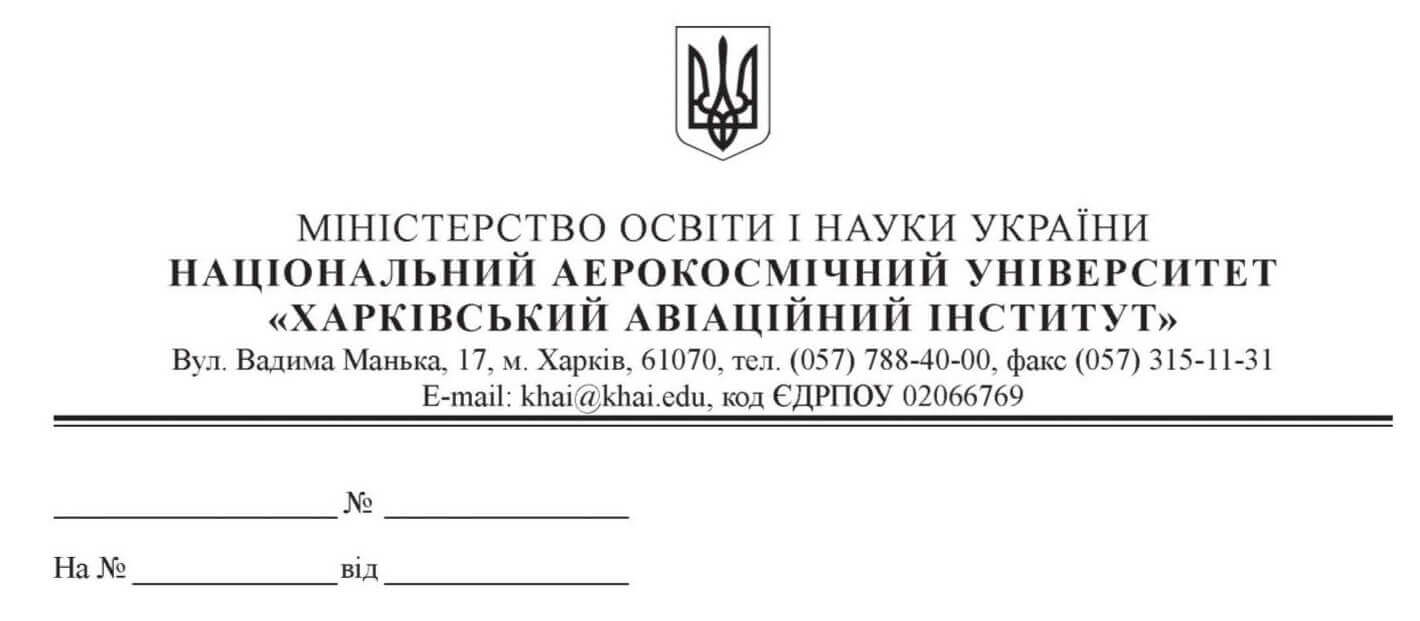
Annex 3 to Clause 2.12

Annex 4 to Clause 2.12
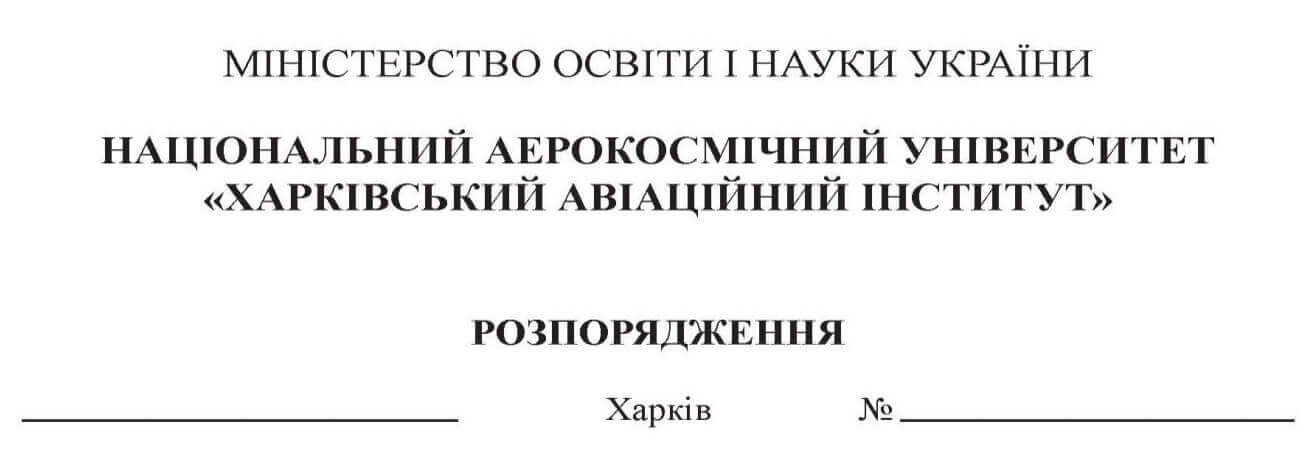
Annex 5 to Clause 2.29
Sample List of Documents Authorized to Be Approved by Applying an Approval Stamp
1. Acts (readiness of a facility for operation; write-offs; inventories; appraisals; withdrawal of files for destruction; transfer of files; liquidation of institutions, etc.).
2. Assignments (for the design of facilities, engineering structures, capital construction; for conducting research, design-engineering, and technological work; technical, etc.).
3. Cost estimates (for the maintenance of the administrative staff, buildings, premises, structures; for the preparation and deployment of new product manufacturing; for capital construction, etc.).
4. Lists (of positions for employees with non-standard working hours; standard, departmental [sectoral] documents with retention periods, etc.).
5. Rates for work execution.
6. Charters (regulations) of institutions.
7. Structure of the institution.
Annex 6 to Clause 2.59
Sample List of Documents Whose Signatures Are Affixed with the Great Seal of State if Created in Paper Form or Authenticated by a Qualified Electronic Seal of the Institution if Created in Electronic Form
1 Acts (work completion, write-off, appraisals, financial audits; withdrawal of files for destruction; transfer of files, etc.).
2 Conclusions and reviews of institutions on dissertations and abstracts submitted to the Higher Attestation Commission of Ukraine.
3 Certificates (limit certificates; on payment of insurance amounts; use of budget allocations for salaries; accrued salary, etc.).
4 Contracts (on financial liability, scientific and technical cooperation, subcontracts, lease of premises; execution of work, etc.).
5 Documents (certificates, credentials, etc.) certifying the rights of citizens and legal entities.
6 Powers of attorney for receiving inventory items, budget, bank, pension, payment orders.
7 Assignments (for the design of facilities, engineering structures, capital construction; technical, etc.).
8 Applications (for a letter of credit; non-acceptance declaration, etc.).
9 Requisitions (for equipment, inventions, etc.).
10 Specimen impression seals and signatures of employees authorized to conduct financial and economic transactions.
11 Cost estimate (for the maintenance of the administrative staff; preparation and deployment of new product manufacturing; contract calculation; capital construction, etc.).
12 Letters of guarantee (for execution of work, provision of services, etc.).
13 Submissions and petitions (for decoration with orders and medals; bonuses).
14 Protocols (approval of supply plans).
15 Registers (of checks, budget orders).
16 Specifications (of items, products, etc.).
17 Joint documents prepared on behalf of two or more institutions.
18 Charter of the University.
19 Title lists.
20 Work record books.
21 Approval sheets for draft regulatory legal acts.
Annex 7 to Clause 3.11
Sample List of Documents Not Subject to Registration by the Records Management and Archive Department
| No. p/p | Document Type | Special Accounting* |
| 1 | Summaries and information sent for guidance/information | Not subject to registration or accounting in any other way |
| 2 | Advertising notices, posters, meeting and conference programs, etc. | |
| 3 | Price lists (copies) | |
| 4 | Material consumption standards | |
| 5 | Greeting letters and invitations | |
| 6 | Monthly, quarterly, semi-annual reports | |
| 7 | Schedules, work orders, requisitions, distribution lists | |
| 8 | Statistical reporting forms | |
| 9 | Printed publications (books, magazines, bulletins) | Scientific and Technical Library |
| 10 | Scientific reports by topic | Research Department |
| 11 | Curricula, syllabi (copies) | – |
| 12 | Contracts | Accounting, Planning and Finance Department, Research Department |
Annex 8 to Clause 3.13
Approximate Content of the Incoming Document Registration Record
1 Document type.
2 Date and time of receipt of the document at the institution.
3 Document registration date.
4 Registration index of the document.
5 Correspondent.
6 Registration date and registration index of the correspondent.
7 Brief summary.
8 Department of the University designated in accordance with the established procedure as responsible for executing the document within the University.
9 Executor – an employee of the responsible department of the University appointed in accordance with the established procedure as responsible for executing the document within the University.
10 Note on document execution.
11 File No.
Annex 9 to Clause 3.13
Approximate Content of the Registration Record for Outgoing Documents Created at the University
1 Document registration date.
2 Registration index of the document.
3 Addressee.
4 Brief summary.
5 Responsible department of the University that prepared the document.
6 Responsible executor – an employee of the responsible department of the University who prepared the document.
7 Date and time of receipt of the document by the addressee.
8 Registration date and registration index of the addressee.
9 Note on document execution by the addressee.
10 File No.
Annex 10 to Clause 3.34
Execution Deadlines for Key Documents
1 Acts and instructions of the President of Ukraine – in accordance with the requirements of the Regulations on Control over the Execution of Decrees, Orders, and Instructions of the President of Ukraine, approved by Decree of the President of Ukraine dated February 19, 2002, No. 155.
2 Request or appeal:
- of a People's Deputy of Ukraine – in accordance with the requirements of the Law of Ukraine "On the Status of a People's Deputy of Ukraine";
- of a Deputy of the Verkhovna Rada of the Autonomous Republic of Crimea – in accordance with the requirements of the Law of Ukraine "On the Status of a Deputy of the Verkhovna Rada of the Autonomous Republic of Crimea";
- of a Local Council Deputy – in accordance with the requirements of the Law of Ukraine "On the Status of Local Council Deputies".
3 If a request (appeal) of a People's Deputy of Ukraine (Deputy of the Verkhovna Rada of the Autonomous Republic of Crimea, Local Council Deputy) cannot be considered within the established deadline due to objective reasons, a written notification is sent to the entities submitting the request (appeal) indicating the reasons for extending the review period. The period for considering a deputy's appeal, taking into account the extension period, cannot exceed 30 days from the moment of its receipt.
4 Decisions of the Cabinet of Ministers of Ukraine regarding the revision of draft regulatory legal acts – within 10 days from the date of adoption of the relevant decision, unless another deadline is set by this decision.
5 Resolutions and findings of the Board of the Accounting Chamber – within 15 days from the date of their registration at the institution, unless another deadline is specified therein.
6 Coordination of draft acts by interested bodies – within the time limit established by their primary developers in accordance with the requirements of the Rules of Procedure of the Cabinet of Ministers of Ukraine.
7 Request for public information from a natural person, legal entity, or association of citizens without legal entity status, except for public authorities, and providing a response to an information request – within the timeframe specified in Article 20 of the Law of Ukraine "On Access to Public Information".
8 Attorney's request – within the timeframe specified in Article 24 of the Law of Ukraine "On the Practice of Law and Legal Practice".
Annex 11 to Clause 4.1
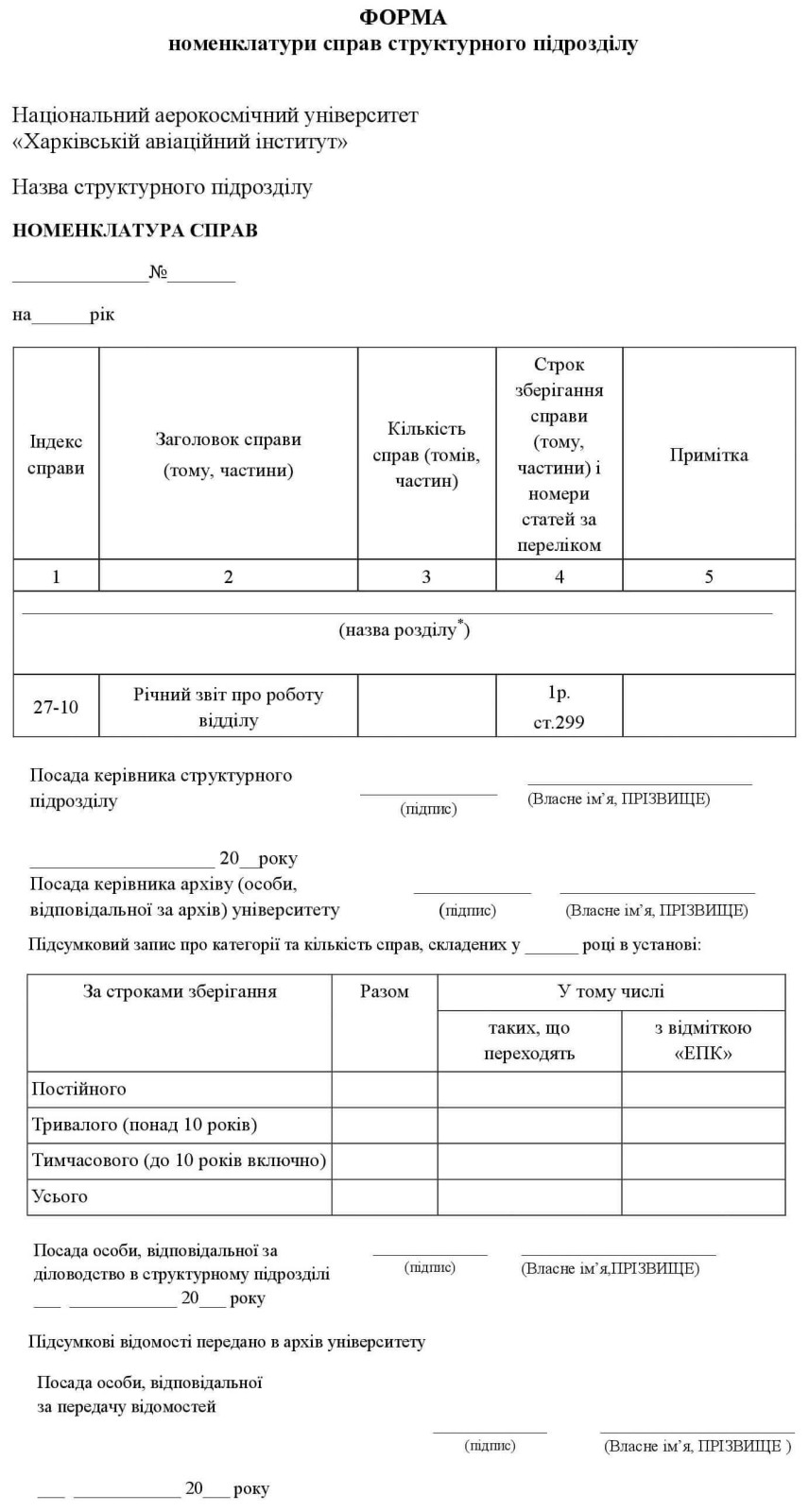

Annex 12 to Clause 4.1
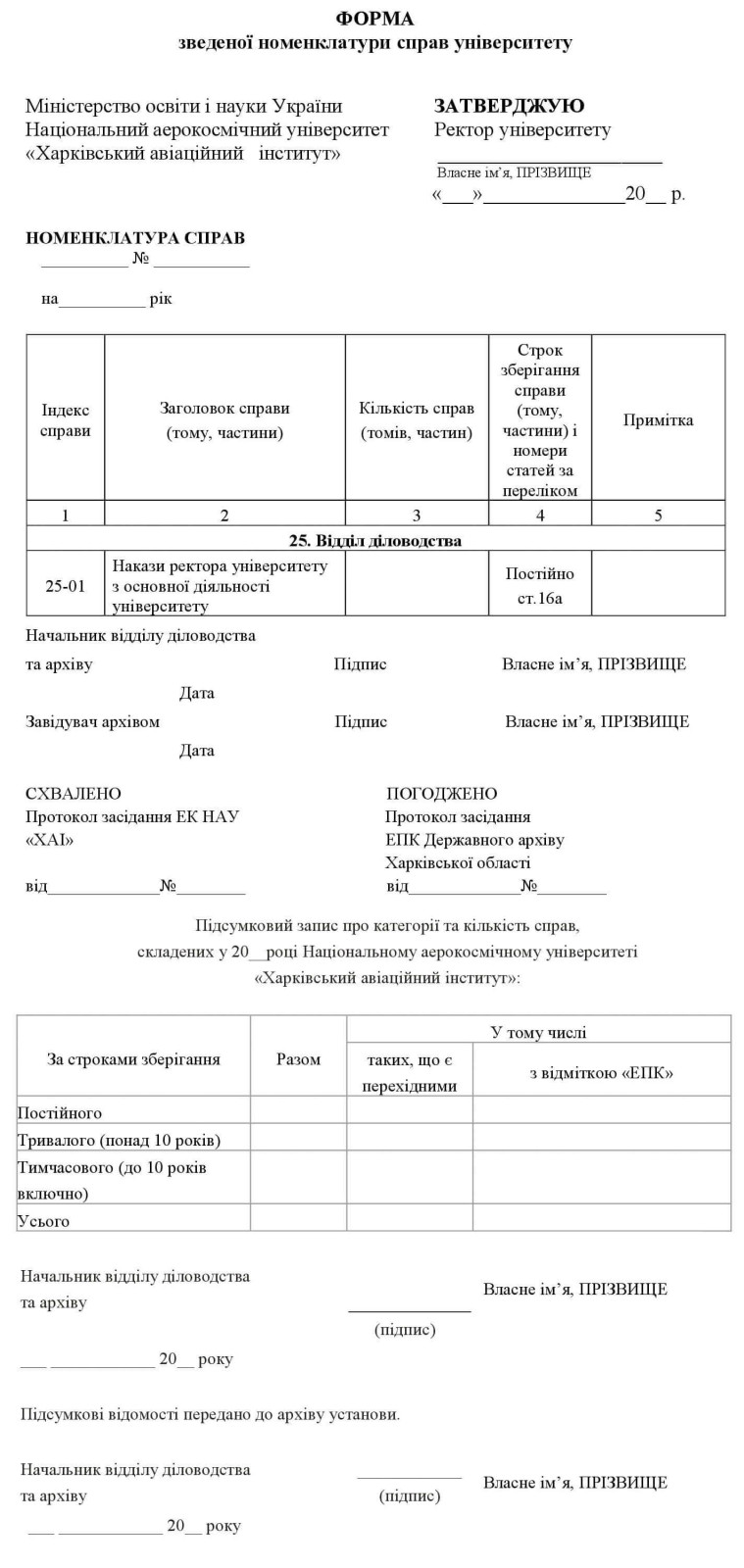

Annex 13 to Clause 5.6
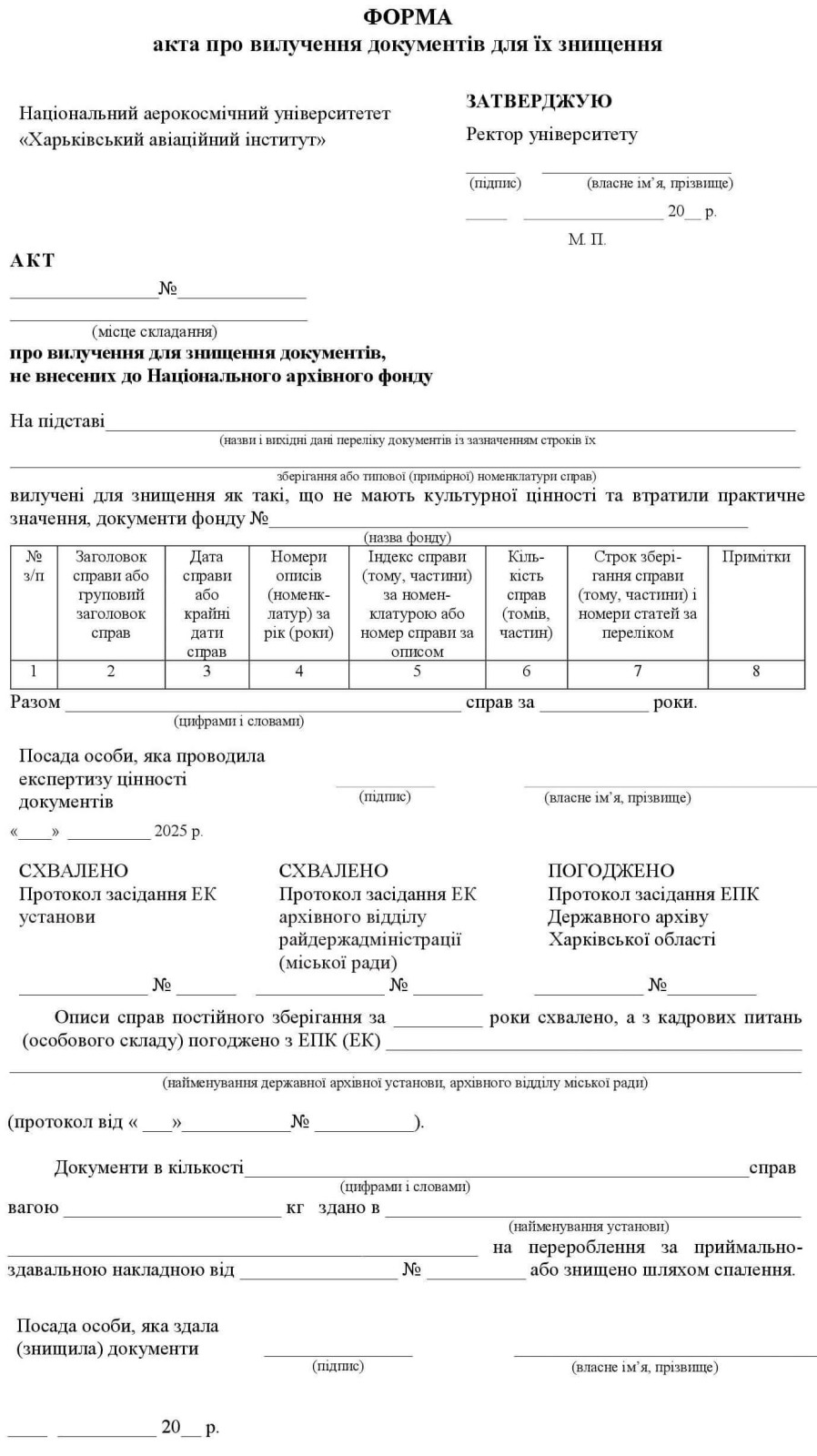
Annex 14 to Clause 5.11
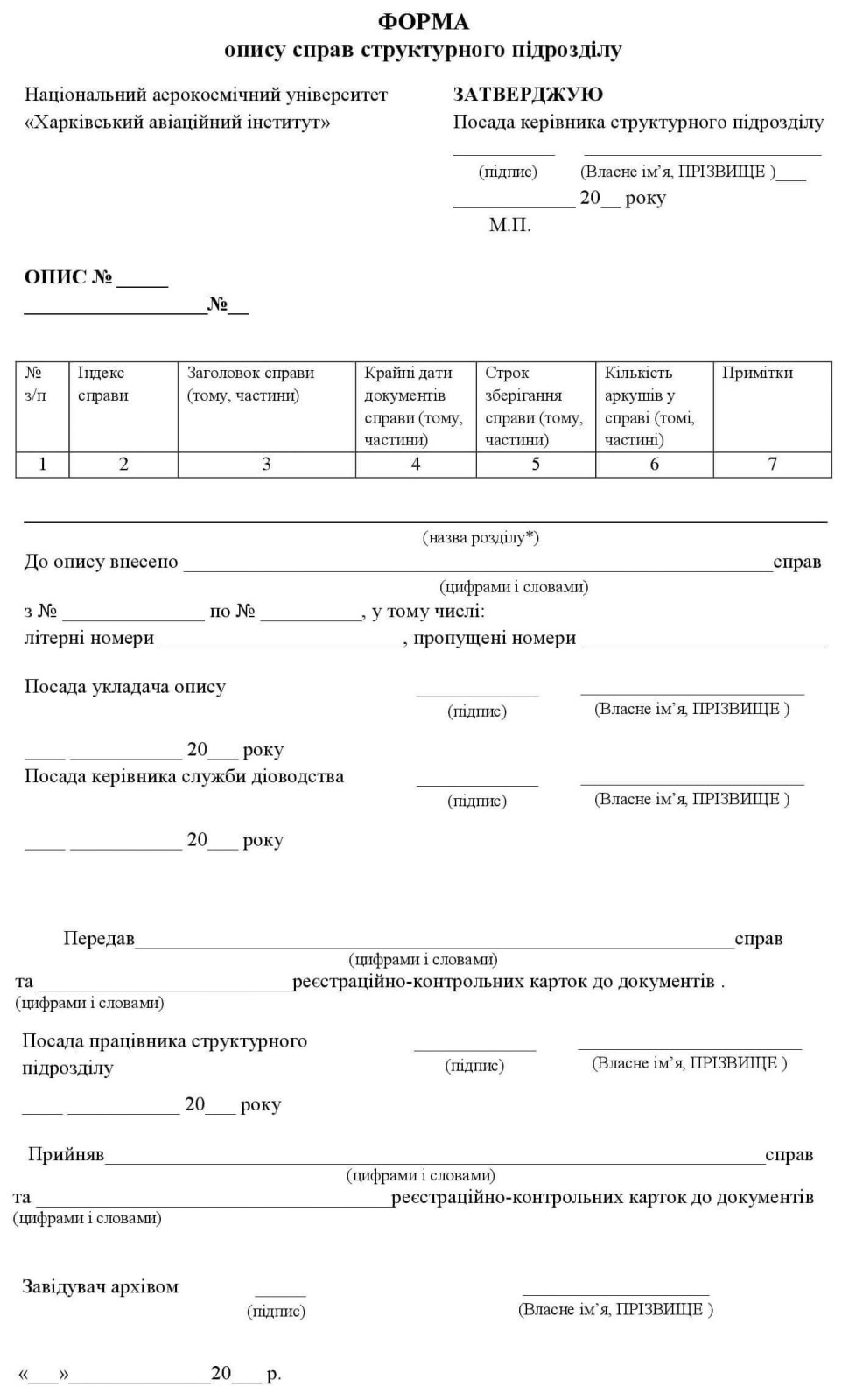
Annex 15 to Clause 5.18
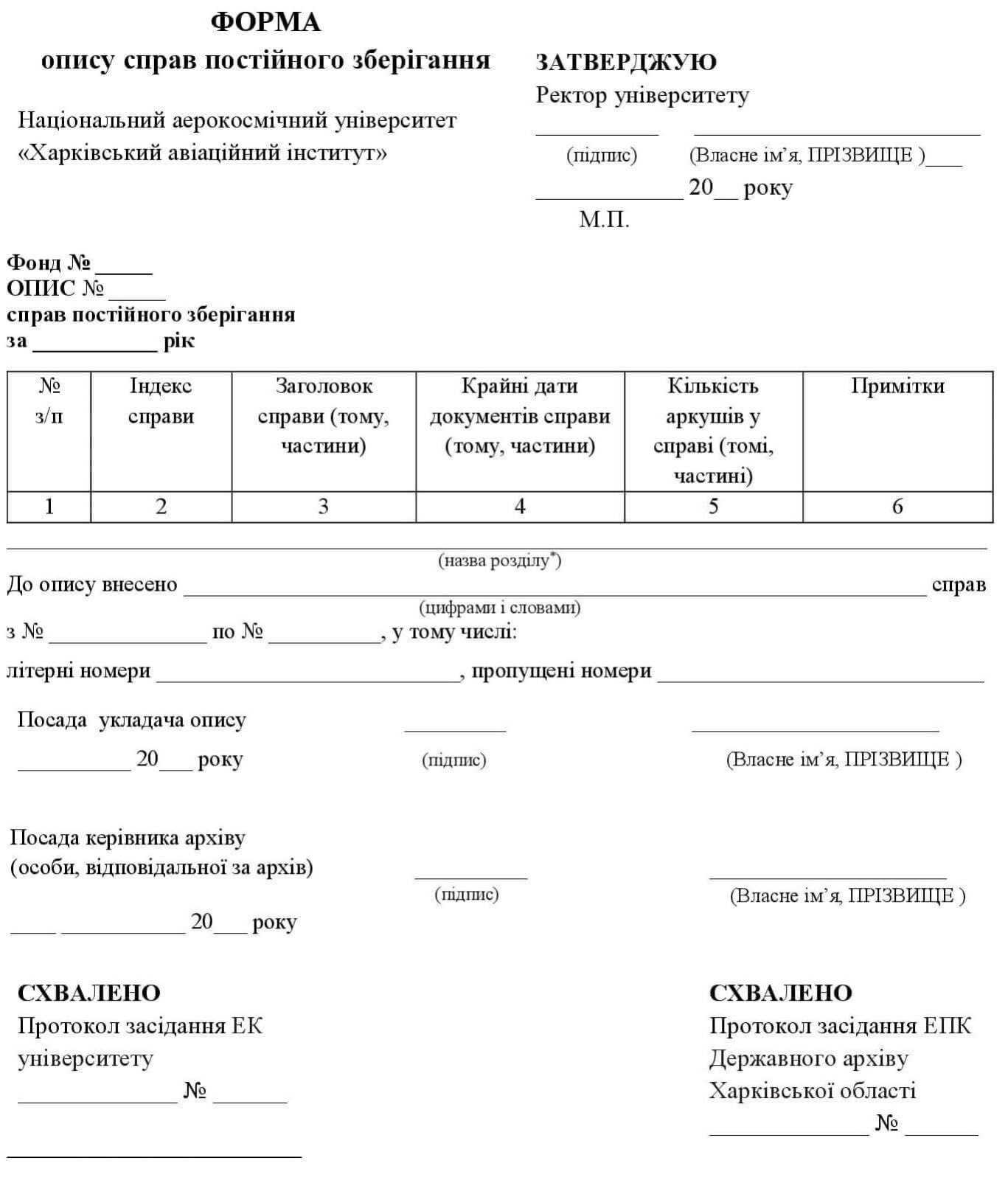
Annex 16 to Clause 5.18