
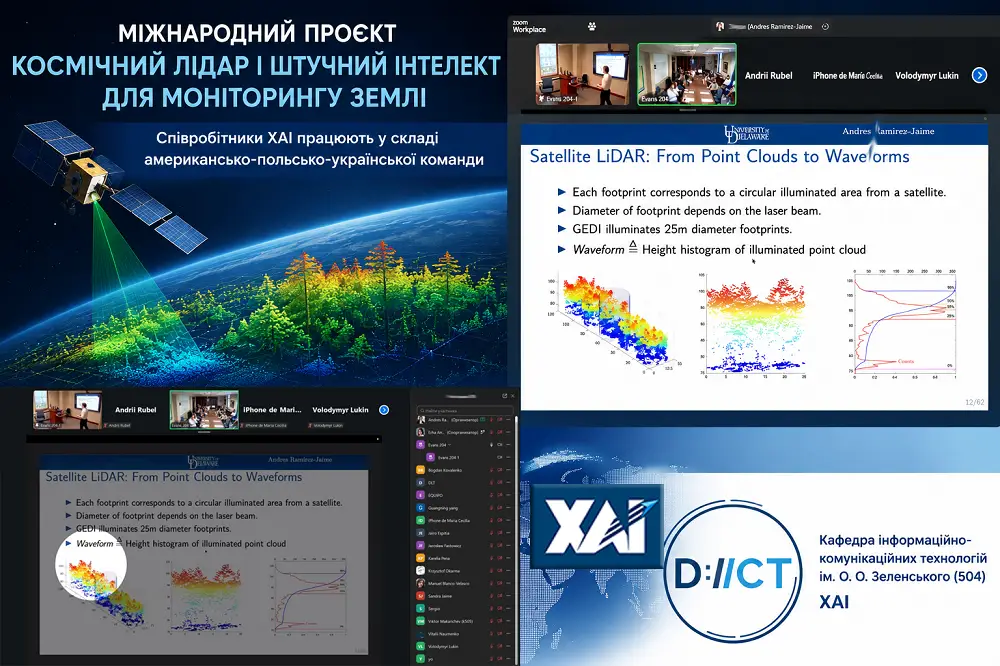
Employees of the Department of Information and Communication Technologies named after O. O. Zelensky (504) of the National Aerospace University “Kharkiv Aviation Institute” continue active international scientific cooperation within the framework of the American-Polish-Ukrainian project “Exploratory Research on Generative Compression for Compressive Lidar”, which is being implemented in 2024–2026.
Eight employees of the Khai Department, as well as three graduate students, are participating in the project. The research is aimed at developing the latest technologies for processing data from space lidars — remote sensing systems of the Earth, which are installed on space carriers.
Due to the significant distance between the satellite and the Earth’s surface, such systems face problems of low resolution and high noise levels. To improve the quality of the data obtained, project participants use modern artificial intelligence methods, in particular generative neural networks and data compression algorithms.
The results obtained allow for more efficient determination of forest height, estimation of their biomass, and creation of digital relief models of large areas, which is of great importance for ecological monitoring and study of environmental changes.
One of the results of international cooperation was the dissertation work of the graduate student of the University of Delaware (USA) Andres Ramirez-Jaime “Computational Lidar From Space: Volumetric Representations, Generative Reconstruction, and Joint Source-Channel Coding”, which used the results obtained during the implementation of the joint project.
To date, the project participants have already published three joint scientific articles in international journals of the Q1 quartile, and also presented the results of research at scientific conferences in Poland and Greece.
Participation in such projects confirms the high level of scientific research of Khai and opens up new opportunities for international cooperation, training of young scientists, and development of promising aerospace technologies.