
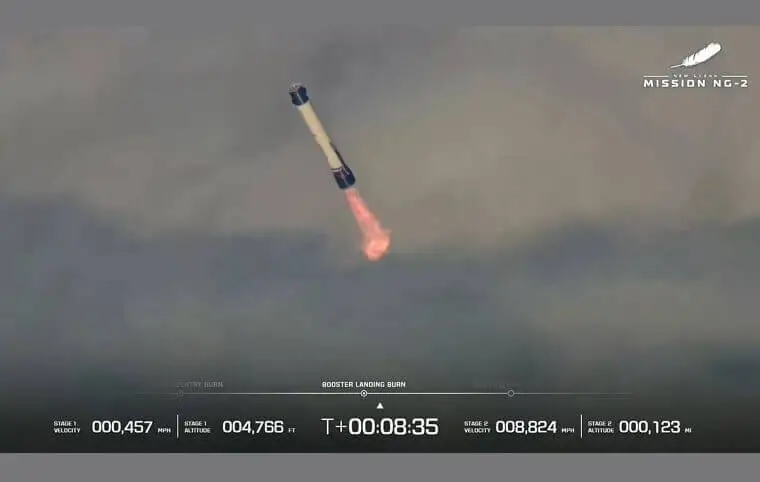
New Glenn is back. And it did it beautifully.
On November 13, Blue Origin not only launched the heavy New Glenn rocket with NASA’s ESCAPADE mission—a promising launch vehicle for interplanetary exploration—but also successfully landed a 185-foot-tall booster on the Jacklyn ocean platform for the first time.
The moment of landing looked almost unreal. The rocket seemed to be passing the target—but in a second it leveled out, “slipped” to the center, and literally froze above the deck, gently touching the metal with its legs.
This wasn’t just accuracy. This was a demonstration of the precision that Blue Origin had been working on for nearly a decade.
SPECIAL FEATURE: EXPLOSIVE WELDING
What the engineers wrote about was the real surprise of this landing.
To secure the giant accelerator to a platform in the open ocean — where waves, wind, and inertia can move even a 400-ton structure — Blue Origin used a unique system: Explosive Welding.
Disposable cartridges with metal and a mini-charge are located at the ends of the supports. When the step touches the deck: the cartridge is triggered; the explosion creates a local high-speed weld; the support is instantly welded to the steel surface.
The result is the step is literally nailed to the deck at several points.
No slipping. No risk of loss.
The technology is disposable, simple, super-strong — and almost ingenious.
Absolutely in the Blue Origin style: not copying SpaceX, but inventing your own.
Every breakthrough in space is a new impetus for those who dream of creating airplanes, rockets, and interplanetary missions.