
The history of the KhAI Student Design Bureau is inextricably linked with the history of the university itself. It was right here that ideas often ahead of their time were born, and students became designers, inventors, and researchers.
It all began with aircraft modeling. Then came new areas of aviation, air sports, and the creation of their own equipment. After graduation, many stayed to work at KhAI, particularly in the legendary Design Bureau, where they continued to realize their boldest engineering ideas.
Not all of these developments were properly appreciated at the time. Some remained merely experimental samples, while others never made it to mass production. But each of them became a part of the university's history and a testament to how creative and dedicated to their craft the KhAI alumni were.
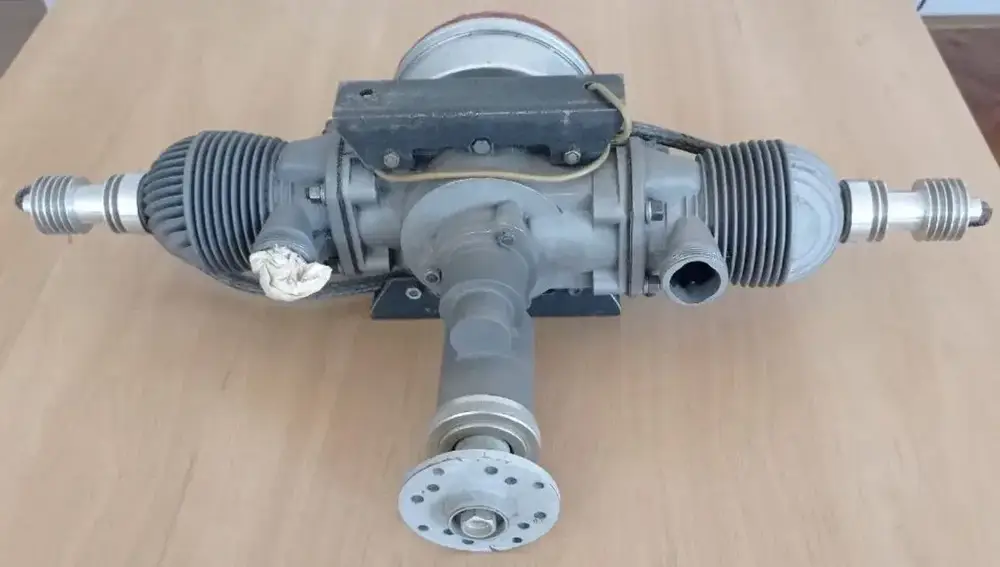
Recently, while sorting through the archives, the head of the KhAI Design Bureau, Serhii Parkhomenko, found several unique experimental engines. This discovery served as an occasion to remember one of KhAI's talented designers — Viktor BONDAR.
Viktor BONDAR came to KhAI already with a clear desire to create aviation equipment. He was an aircraft modeler, one of the first hang glider pilots not only at KhAI but across Ukraine, experimented with power plants for aircraft, and was among the first to equip hang gliders with internal combustion engines. At first, these were attempts to use existing engines, but it quickly became clear that to realize his own ideas, he needed to create his own designs.
Thus, a series of experimental opposed twin-cylinder engines was born, created using components from the “Druzhba-4” chainsaw. Crankcases, crankshafts, generators, ignition systems, and later a gearbox were manufactured independently for them. These engines were intended for unmanned aerial vehicles, which were already being developed at KhAI at that time, as well as for motorized hang gliders.
The next step was an even bolder development — a scotch-yoke (rodless) engine of original design. Its operating principle differed significantly from the classical crank-connecting rod mechanism.
The designer proposed his own technical solution for transmitting force from the piston to the output shaft, which was intended to ensure smaller dimensions and mass of the engine while maintaining its power.
In the mid-1980s, an experimental single-cylinder two-stroke engine with a working volume of 67 cm³ and a predicted power of up to 4 horsepower was created. The creation of a more powerful version for motorized hang gliders was also anticipated.
All this work was carried out practically on the designer's own initiative, in his free time, and largely at his own expense. Unfortunately, the economic changes of the early 1990s and the author's premature death prevented many promising projects from being completed.
However, Viktor BONDAR's ideas outlived their creator. Today, the found engines are not just interesting technical exhibits — they remind us of the generation of KhAI people who created, experimented, and boldly sought new engineering solutions.


