QMS KhAI-NMV-RI/001:2019
Effective Date: April 20, 2019
Revision No. 2
1. Purpose and Scope
1.1 This instruction establishes the procedure for the process of reviewing the quality management system (hereinafter referred to as QMS) conducted by top management of the National Aerospace University "Kharkiv Aviation Institute" (hereinafter referred to as the University) to evaluate educational and scientific activities in order to enhance the efficiency and effectiveness of QMS processes.
1.2 This instruction has been developed in accordance with the Regulations "On the Quality Management System" of the National Aerospace University "Kharkiv Aviation Institute" and the requirements of clause 9.3 of ISO 9001 and DSTU ISO 9001.
1.3 The requirements of this instruction apply to all process/structural unit managers participating in the review of the QMS and the performance results of the University and its units.
2. Normative References
This instruction contains references to the following normative documents:
1) QMS KhAI-NMV-P/013:2019 Regulations "On the Quality Management System";
2) QMS KhAI-NMV-P/012:2019 Regulations "On Quality Assurance of Educational Activities and Higher Education";
3) DSTU ISO 9001:2015 Quality management systems. Requirements;
4) DSTU ISO 9000:2015 Quality management systems. Fundamentals and vocabulary;
5) QMS KhAI-NMV-P/007:2019 Regulations "Risk Management".
3. Terms and Definitions
This instruction applies the terms and definitions given in DSTU ISO 9000, as well as the following:
3.1 top management - a person or group of people who directs and controls an organization at the highest level;
3.2 review - determination of the suitability, adequacy, or effectiveness of an object to achieve established objectives;
3.3 interested party; stakeholder - a person or organization that can affect, be affected by, or perceive itself to be affected by a decision or activity;
3.4 customer - a person or organization that could receive or receives a product or service intended for or required by this person or organization;
3.5 quality policy - intentions and direction of an organization as formally expressed by its top management related to quality;
3.6 risk - effect of uncertainty;
3.7 nonconformity - non-fulfillment of a requirement;
3.8 preventive action - action taken to eliminate the cause of a potential nonconformity or other potential undesirable situation;
3.9 corrective action - action taken to eliminate the cause of a nonconformity and to prevent recurrence;
3.10 audit - systematic, independent, and documented process for obtaining objective evidence and evaluating it objectively to determine the extent to which audit criteria are fulfilled;
3.11 complaint - expression of dissatisfaction made to an organization, relating to its product or service, or the complaints-handling process itself, where a response or resolution is explicitly or implicitly expected;
3.12 customer satisfaction - customer's perception of the degree to which customer expectations have been fulfilled;
3.13 efficiency - relationship between the result achieved and the resources used;
3.14 effectiveness - extent to which planned activities are realized and planned results are achieved.
4. Abbreviations
The following abbreviations are used in this instruction:
QMS - quality management system;
NMV - Educational and Methodological Department;
R&D - research and development work.
5. Procedure Description
5.1 Process Inputs and Outputs
5.1.1 Input Data for Quality Management System Review
The input data for reviewing the management system at the University includes information regarding the following:
a) the status of actions from previous management system reviews;
b) changes in external and internal issues that are relevant to the QMS of the University;
c) information on the performance and effectiveness of the QMS, including trends related to:
1) customer satisfaction level and feedback, complaints, and suggestions from relevant interested parties;
2) the extent to which objectives specified in the Quality Policy and Quality Objectives of the University have been met;
3) performance indicators for the operation of QMS processes and conformity of educational services provided by the University;
4) status of nonconformities and corrective actions;
5) monitoring and measurement results;
6) internal and external QMS audit results;
7) performance of external providers;
d) adequacy of resources;
e) effectiveness of actions taken to address risks and opportunities;
f) opportunities and recommendations for improvement provided by employees.
5.1.2 Output Data for Quality Management System Review
The output data resulting from the QMS review conducted by the University's top management includes decisions and actions related to:
a) improving the effectiveness of the QMS and its processes;
b) any need for changes to the QMS;
c) enhancement of educational services in accordance with customer requirements and expectations;
d) provision of necessary resources for processes.
The results of the critical QMS review are recorded in the minutes of the Academic Council meeting and used to establish objectives for the following year.
5.2 Responsibility and Authority
The owner of the process "Management Review of the QMS," who makes the necessary decisions regarding QMS improvement, is the Rector of the University.
The main executor responsible for analyzing, processing information, and formulating recommendations to improve the University's performance is the designated management representative, the Chief Quality Manager.
The main executor responsible for collecting information to conduct the management review is the Lead Auditor.
Heads of processes and/or structural units are responsible for providing information for the review at the process and/or structural unit level and ensuring its accuracy.
5.3 General Provisions
5.3.1 General Process Information
To ensure the continuing suitability, adequacy, effectiveness of the quality management system, and its alignment with the strategic direction of the University, the Rector annually conducts a review of the operational QMS according to an established schedule. The management review is carried out based on information and report data submitted by the heads of QMS processes, aimed at evaluating the effectiveness of the quality management system in achieving objectives, meeting requirements, and determining ways for improvement, as well as the need for changes, including in the Quality Policy and Quality Objectives.
The main criteria for evaluating the effectiveness and efficiency of QMS operations are as follows:
- stability of educational process quality indicators;
- an increase in the number of successful students as a result of improving the quality of the learning process;
- a reduction in the number and severity of nonconformities;
- an increase in demand for University graduates;
- an increase in R&D funding volume;
- an increase in the number of registered intellectual property objects and R&D development results implemented into educational processes and production;
- increased customer satisfaction.
The results of the critical management review are presented in the Rector's annual report and used when planning QMS improvement processes.
Vice-rectors in relevant activity areas, heads of processes, and/or heads of structural units exercise general management over the QMS review process within their respective processes and/or units. They are responsible for submitting to the Chief Quality Manager and/or Lead Auditor, in a timely manner, the QMS review results for their processes and/or units, reports and improvement proposals, as well as other reliable information on the QMS status within their scope required to review the University's QMS as a whole, upon request of the Chief Quality Manager or Lead Auditor.
Information on the status of processes and units is collected twice a year, depending on the operational specifics of structural units: in September — based on the results of the previous academic year, and in January — based on the results of the previous calendar year.
Review results are maintained in working order in the form of the Chief Quality Manager's report on QMS review results and corresponding appendices containing reports from heads of processes and/or structural units. The Chief Quality Manager submits the report to the Rector of the University and reports at the Academic Council meeting. Based on the report, top management evaluates QMS effectiveness, as well as clarifies, revises, updates the Quality Policy and Objectives, and plans resources to achieve them.
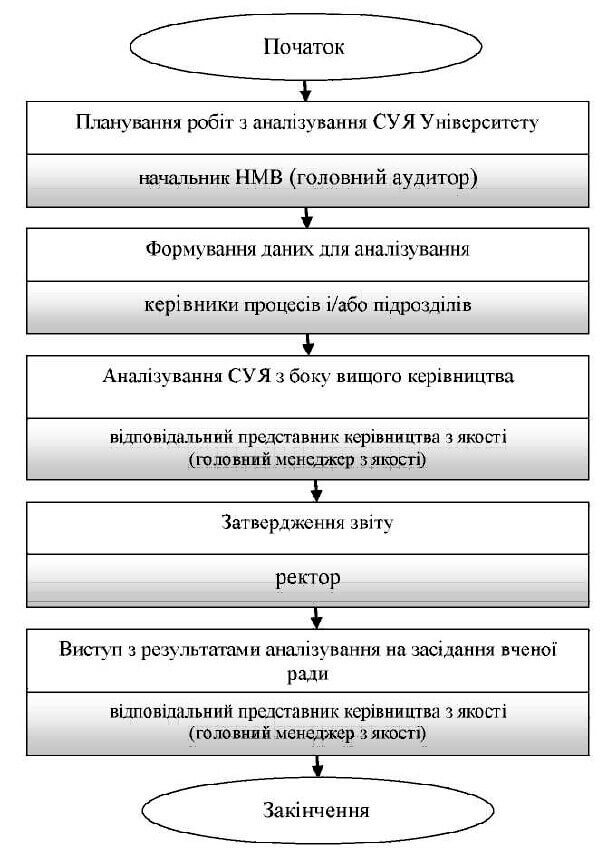
The process flowchart is provided in Appendix A.
5.3.2 Risks and Actions for Prevention
The list of potential risks that may arise during the stages of nonconformity management and corrective action processes, along with preventive actions, is given in Table 1. Risk management is carried out in accordance with the Regulations "Risk Management".
5.4 Order of Execution
5.4.1 Work Planning for University QMS Review
By September 1 of the current year, the Lead Auditor prepares an order to commence QMS review activities and a work plan for the QMS review covering the previous calendar/academic year, corresponding to the effective period of the adopted Quality Objectives (annexed to the order).
Table 1 - Process Stages, Risks, and Preventive Actions
| Risks | Risk Prevention Actions |
| Stage 1 Work Planning for University QMS Review | |
| Insufficient time and resources allocated for the development and implementation of QMS review activities | Determine QMS review activities taking into account past experience |
| Stage 2 Preparation of Data for Review | |
| Information submitted to the lead auditor is unreliable (information does not cover all nonconformities detected in the unit / review carried out superficially / status of corrective actions does not correspond to reality) | Additional control of review processes and nonconformity and corrective action management in units during internal audits |
| Information on QMS review results submitted late | Draw unit heads' attention to the need for timely submission of QMS review results |
| Stage 3 Management Review of QMS by Top Management | |
| Incorrectly defined criteria for evaluating the effectiveness and efficiency of QMS performance / The list of criteria is insufficient for a comprehensive QMS review | Periodic review and adjustment of the list of criteria used for QMS review |
| Stage 4 Approval of the Report by the University Rector | |
| Decision on the evaluation of QMS performance and efficiency is not effective | Take into account past experience of implementing corrective actions at the University, consider proposals from unit heads |
5.4.2 Preparation of Data for Review
5.4.2.1 Preparation of Data for Review by Heads of Processes and/or Units
Based on the order to commence QMS review activities, heads of processes and/or structural units shall assemble a package of required input data for reviewing the University's QMS, which must contain the following information:
- nonconformity reports for nonconformities detected in the unit (copies) during the reporting period;
- analysis of process effectiveness;
- process improvement measures;
- status of corrective action execution;
- results of actions taken to address risks;
- other information in accordance with clause 5.1.1 of this Instruction.
This information is submitted to the Lead Auditor.
5.4.2.2 Preparation of Data for Review
For the QMS review, the Lead Auditor provides the following information:
- results of internal and external audits;
- customer satisfaction monitoring results;
- analysis of nonconformities, status of executed corrective and preventive actions.
The collected information is transferred by the Lead Auditor to the Chief Quality Manager for the preparation of the report and analysis.
5.4.3 Management Review of QMS by Top Management
Within one month, the Chief Quality Manager reviews the submitted materials. Based on them, the Chief Quality Manager prepares a consolidated report on the QMS review results and submits it to the Rector.
5.4.4 Approval of the Report by the University Rector
Based on the consolidated report on QMS review results, decisions are formulated regarding the evaluation of QMS effectiveness and efficiency. This involves clarifying, revising, and updating the University's Quality Policy and Objectives, as well as implementing measures to improve the QMS or taking necessary corrective/preventive actions.
5.4.5 Presentation of Review Results at the Academic Council Meeting
The Chief Quality Manager presents the results of the University's QMS review at a regular meeting of the Academic Council (in accordance with the work plan).
6. Measurement and Monitoring
The Chief Quality Manager carries out the analysis of process effectiveness based on the following criteria:
- percentage of implementation of the action plan from the previous management review;
- ratio of the number of completed planned activities to the number of planned activities during the reporting period;
- effectiveness indicator of each planned activity during the reporting period.
7. Records / Documentation
The process of management review of the quality management system by the University management is accompanied by the following records:
- Rector's annual report;
- minutes of the Academic Council meeting, containing decisions and actions regarding:
a) improving the effectiveness of the QMS and its processes;
b) any need for changes to the QMS;
c) enhancement of educational services in accordance with customer requirements and expectations;
d) provision of necessary resources for processes.
- Lead Auditor's report;
- reports submitted to the Lead Auditor from structural units.
Control over the execution of the records specified in the Instruction is carried out in accordance with the Regulations "Management of Documented Information".
8. Final Provisions
8.1 The Instruction is signed by the Chief Quality Manager, approved by the Rector of the University, and enacted by the Rector's order.
8.2 Control over compliance with this Instruction is exercised by University officials within their powers set forth in job descriptions.
8.3 Amendments and additions to the Instruction are made following the procedure of its adoption.
Appendix A
Process Flowchart