Human Capital and Talent Development Strategy
of National Aerospace University
«Kharkiv Aviation Institute» for 2026–2030
Approved by:
The Academic Council of
National Aerospace University
«Kharkiv Aviation Institute»
Minutes No. 1 dated August 19, 2026
Enacted by Rector's Order No. 316 dated August 19, 2026
General Principles
The Human Capital and Talent Development Strategy of National Aerospace University «Kharkiv Aviation Institute» for 2026-2030 (hereinafter referred to as the Strategy) is developed in accordance with the Development Strategy of National Aerospace University «Kharkiv Aviation Institute» for 2026-2030 and serves as its functional component.
The Strategy takes into account the provisions of the Laws of Ukraine «On Education», «On Higher Education», the principles of the European Higher Education Area (EHEA), the European Research Area (ERA), the UN Sustainable Development Goals, and best international practices of strategic Human Capital Management and Talent Management. The Strategy defines the key principles, strategic directions, and priorities for the formation, development, retention, and effective utilization of human capital and talents of the university community, aimed at ensuring the implementation of its mission, vision, values, strategic goals, and key performance indicators.
In current conditions of global competition, dynamic development of science and technology, digital transformation, military challenges, and tasks of post-war recovery of Ukraine, human capital is one of the key strategic resources of the University. The development of the Strategy is driven by the need to respond to modern demographic, technological, security, and institutional challenges, enhance international competition for talent, integrate into the European Higher Education Area, and form a new university development model based on human-centeredness, innovation, and academic excellence.
The University's strategic human capital management system is a complex of strategic managerial decisions and measures aimed at building a highly professional, motivated, responsible, and competitive team capable of ensuring the quality of educational activities, research development, innovation implementation, effective management, and integration of the University into the global educational and scientific space.
Implementation of the Strategy involves introducing modern approaches to strategic human capital management, developing professional and managerial competencies of employees, forming an effective talent pool, improving the system of work motivation and incentives, ensuring organizational stability, and creating conditions for professional and personal development of members of the university community in resilient conditions. Professionalism, competence, motivation, adaptability, and cohesion of staff determine the quality of the educational process, effectiveness of scientific activity, efficiency of managerial processes, international reputation, and the University's capacity to ensure sustainable development.
In the process of staff development, every employee is considered an important participant in achieving the strategic goals of the University, a bearer of professional knowledge, experience, innovation potential, and academic values.
The University's strategic human capital management system relies on a set of interconnected principles that define strategic approaches to the formation, development, evaluation, and effective growth of University personnel. The Strategy is based on the concept of Human Capital and Talent Management, which covers the full employee life cycle — from recruitment and onboarding to professional development, performance evaluation, leadership development, succession planning, and long-term career support.
The University forms a modern staff development ecosystem as a tool for ensuring management continuity, developing leadership potential, and replacing vacant positions in a timely manner, transforming the University's internal environment into a space for continuous professional growth of every employee. Human capital management is carried out on the principles of human-centeredness, academic freedom, integrity, professional excellence, partnership, openness, innovation, equal opportunities, international integration, digital transformation, and organizational resilience. The substance of these principles is unfolded through the value system of the Strategy.
Implementation of the Strategy aims to ensure the formation of a modern, open, innovative, and resilient human capital management system that will serve as the foundation for the University's long-term competitiveness, development of its academic community, strengthening of international standing, technological development of the state, and recovery of Ukraine.
Mission
To build a human capital development ecosystem that ensures professional growth, academic leadership, innovation, and organizational resilience of the university.
Vision
By 2030, KhAI is a university with one of the most effective human capital development systems among universities in Central and Eastern Europe, built on the principles of human capital management excellence, digital transformation, academic leadership, and international integration.
Values
Human-centeredness. The employee is the primary value of the University. We create conditions for professional self-realization, talent development, well-being, safety, and support for every member of the university community.
Leadership. We cultivate responsible academic, scientific, and managerial leadership, support initiative, readiness for change, and the ability to inspire others to achieve shared strategic goals.
Academic Freedom. We guarantee freedom of teaching, scientific research, creative activity, and professional development, ensuring openness to new knowledge, ideas, and scientific inquiry.
Integrity. We adhere to high standards of academic, professional, and managerial ethics, ensuring transparency, honesty, accountability, and trust across all areas of activity.
Excellence. We strive for high quality in education, science, management, and professional performance, continuously improving competencies, processes, and work results.
Innovation. We support a culture of continuous development, implementation of modern technologies, digital transformation, and new management solutions that ensure the University's competitiveness.
Partnership and Cooperation. We build relationships based on mutual respect, open dialogue, teamwork, interdisciplinary interaction, and effective collaboration with Ukrainian and international partners.
Equality, Diversity, and Inclusivity. We provide equal opportunities for professional development, respect for human dignity, non-discrimination, accessibility, and an inclusive environment for all members of the university community.
Sustainable Development and Resilience. We develop human capital capable of acting effectively under conditions of change and challenges, ensuring long-term sustainability, social responsibility, and the University's contribution to sustainable societal development.
Service to Society and the State. We direct knowledge, professional activity, and human potential toward strengthening defense capabilities, technological development, post-war recovery of Ukraine, and increasing its international competitiveness.
Entrepreneurship. We foster initiative, responsibility, readiness to launch new projects, technology transfer, and the development of the University's innovation ecosystem.
Strategic Goals
1. Ensure HR resilience, succession, and talent development of the University through the formation of a modern talent pool system, development of the mentoring institute, implementation of HR succession mechanisms, support for professional growth of young employees, timely filling of key positions, and creation of conditions for identifying, developing, and retaining talent.
2. Form a modern system of motivation, performance evaluation, and professional development of staff through the implementation of a transparent key performance indicator (KPI) system, financial and non-financial incentives, recognition of professional achievements, development of career trajectories, continuous professional learning, and creation of conditions to unlock the potential of every employee.
3. Ensure the digital transformation of the human capital management system through the digitalization of HR processes, automation of workflow, development of modern HR services, implementation of HR analytics, and use of digital technologies to support management decisions and increase human capital management efficiency.
4. Build a modern corporate culture based on academic values, safety, and staff well-being through strengthening academic integrity, developing corporate culture, ensuring a safe, barrier-free, and inclusive educational environment, supporting staff psychological well-being, developing social partnership, and fostering an atmosphere of mutual trust, responsibility, and professional ethics.
5. Enhance international integration and global competitiveness of the University's human capital through the development of international academic mobility, staff participation in international scientific and educational projects, expansion of strategic partnerships, enhancement of foreign language proficiency, support for international publication activity, and integration of the university community into the European Higher Education and Research Area.
6. Develop the system of academic and managerial leadership through the formation of a managerial talent pool, development of leadership competencies, support for managerial mentoring, training of future heads of structural units, development of a culture of responsible leadership, and ensuring effective HR succession.
Strategic Tasks
Strategic Goal 1. Ensure HR resilience, succession, and talent development of the University.
Strategic Tasks
1.1. Introduce a modern talent pool management system at the University using digital technologies, ensuring the establishment of a unified electronic candidate register, continuous updating of HR profiles, and monitoring of human potential.
1.2. Create an HR succession system for critical positions by forecasting HR needs, monitoring the completion of administrative tenures, and training potential successors.
1.3. Develop the institute of mentoring as a tool for professional adaptation, knowledge transfer, and development of young scientific-pedagogical, administrative, and managerial personnel.
1.4. Implement a system for early identification, development, and support of talent among young scientists, PhD students, doctoral candidates, graduates, and promising employees, with their subsequent inclusion in the talent pool.
1.5. Ensure continuous professional development for individuals included in the talent pool through individual training programs, internships, advanced training, and participation in strategic University projects.
1.6. Improve the evaluation system for talent pool and mentoring efficiency using transparent performance criteria and mentor motivation mechanisms.
1.7. Establish a forecasting system for HR risks and University needs in line with strategic development directions, wartime challenges, demographic trends, and aerospace industry requirements.
Strategic Goal 2. Form a modern system of motivation, performance evaluation, and professional development of staff
Strategic Tasks
2.1. Introduce a unified staff performance evaluation system based on key performance indicators (KPIs), differentiated by staff categories and aligned with the University's strategic goals.
2.2. Create a comprehensive system of financial and non-financial staff incentives, combining bonuses, professional recognition, flexible working conditions, social guarantees, and modern motivational tools.
2.3. Improve the system of professional recognition for employees by introducing transparent procedures for recommendations for university, sectoral, state, and international awards, as well as developing intra-university professional excellence competitions.
2.4. Ensure the development of individual career trajectories and continuous professional learning for employees according to their competencies, strategic University needs, and modern labor market requirements.
2.5. Diversify funding sources for staff incentive programs by attracting grant funds, partner programs, commercial activities, and other non-budgetary resources.
2.6. Introduce a system of regular monitoring of satisfaction levels, engagement, and professional motivation of employees to ensure timely improvements in HR policy.
2.7. Ensure openness and transparency of the employee evaluation and incentive system through the development of digital services, electronic registers of professional achievements, and modern public recognition mechanisms.
Strategic Goal 3. Ensure the digital transformation of the human capital management system
Strategic Tasks
3.1. Create an integrated digital human capital management ecosystem uniting the talent pool, electronic document management, staff evaluation, professional development, and HR analytics.
3.2. Automate key HR processes, including recruitment, HR administration, leave management, certificates, advanced training, performance evaluation, and career management of employees.
3.3. Ensure the integration of HR information resources with the university-wide digital infrastructure to increase the efficiency of management processes.
3.4. Create digital employee profiles reflecting professional competencies, performance results, scientific interests, advanced training, and international activity.
3.5. Integrate modern digital technologies and elements of artificial intelligence into recruitment processes, HR data analysis, competency assessment, and human capital management support.
3.6. Ensure a high level of information security, cyber resilience, and personal data protection in accordance with Ukrainian legislation requirements and European standards.
Strategic Goal 4. Form a modern corporate culture
Strategic Tasks
4.1. Form a modern corporate culture based on principles of academic integrity, professional ethics, mutual respect, openness, and responsible leadership.
4.2. Ensure the development of a safe, barrier-free, inclusive, and human-centered working environment in accordance with modern national and European standards.
4.3. Develop the security infrastructure of the University, including the modernization of shelters, creating fully functional workplaces within them, and ensuring the continuity of educational and managerial processes under wartime risks.
4.4. Establish a comprehensive system to support the physical, psychological, and professional well-being of staff, prevent professional burnout, and build psychosocial resilience.
4.5. Improve mechanisms for ensuring academic integrity, preventing conflicts of interest, discrimination, mobbing, and other manifestations of unethical behavior.
4.6. Strengthen social partnership with the trade union organization, student self-government bodies, and other representative bodies regarding the development of social support for employees.
4.7. Develop the system of internal communications, corporate identity, and promotion of KhAI values as a modern innovative university and responsible employer.
Strategic Goal 5. Enhance international integration and global competitiveness of the University's human capital
Strategic Tasks
5.1. Expand employee participation in international academic mobility programs, scientific research, grant projects, and activities of international professional networks.
5.2. Create a system of institutional support for international project activities and guidance for employee participation in international competitions.
5.3. Develop strategic partnerships with foreign universities, scientific institutions, aerospace industry enterprises, and international organizations.
5.4. Stimulate international publication activity of employees by improving the incentive system, supporting publications in Scopus and Web of Science journals, and advancing open science.
5.5. Ensure the systematic development of foreign language competencies of staff for effective participation in international educational, scientific, and project activities.
5.6. Expand the practice of involving foreign scientists, professors, and representatives of high-tech business in the educational process, scientific research, and student training.
5.7. Ensure the integration of KhAI employees into the international academic space by developing scientometric profiles (ORCID, Scopus, Web of Science, Google Scholar), supporting international certification, and harmonizing HR policy with European standards of human resource management.
Strategic Goal 6. Develop the system of academic and managerial leadership
Strategic Tasks
6.1. Establish a multi-level system for developing academic and managerial leadership for employees of all categories.
6.2. Introduce a training program for future heads of faculties, departments, scientific centers, and administrative units based on modern university management models.
6.3. Develop a system of managerial mentoring, coaching, and transfer of managerial experience between generations of leaders.
6.4. Ensure the development of strategic thinking, digital leadership, project management, change management, and crisis management among the University management team.
6.5. Introduce a system for evaluating and developing leadership competencies of employees using modern methods of potential assessment and talent pool formation for management positions.
6.6. Build a culture of responsible, ethical, and service-oriented leadership based on the principles of academic autonomy, openness, partnership, and teamwork.
6.7. Ensure the preparation of managerial personnel for implementing KhAI's development strategy, post-war recovery, digital transformation, and integration into the European Higher Education and Research Area.
Priority Areas of Strategy Implementation
1. HR sustainability, resilience, and succession. Orientation towards preserving the scientific, pedagogical, and intellectual potential of the University under current challenges. This area includes comprehensive support for the professional development of young teachers, planned rejuvenation of personnel, organizational monitoring of terms spent in administrative positions, as well as the development of academic mentoring and systematic maintenance of the University's unified talent pool.
2. IT support and optimization of HR processes. Gradual development of the University's information ecosystem within the overall coordination of HR processes. The vector is directed toward systematic methodical expansion of electronic document workflow, analytical support for individual performance indicator (KPI) tracking systems, and coordinating the interaction of talent pool tools with the internal information portal.
3. Analytical monitoring of motivation and achievement recognition systems. Proper maintenance and optimization of financial and non-financial incentive systems in accordance with the Collective Agreement. The area focuses on balanced use of reward tools for high performance, as well as ensuring a collegial, transparent, and objective approach to nominating candidates for state, sectoral, and university awards or honorary titles.
4. Strengthening corporate culture, academic integrity, and safety space. Creating a stable and safe microclimate based on human-centeredness, mutual respect, and partnership with the Primary Trade Union Organization. The priority entails organizational assistance in upholding Code of Academic Integrity standards, supporting proper working conditions and civil protection, and providing counseling and psychological assistance to University staff.
5. Development of international openness and HR integration. Promoting integration into the European and global educational space. The vector includes informational and methodical support for language certification, exploring international internship opportunities, and attracting leading foreign experts to joint initiatives.
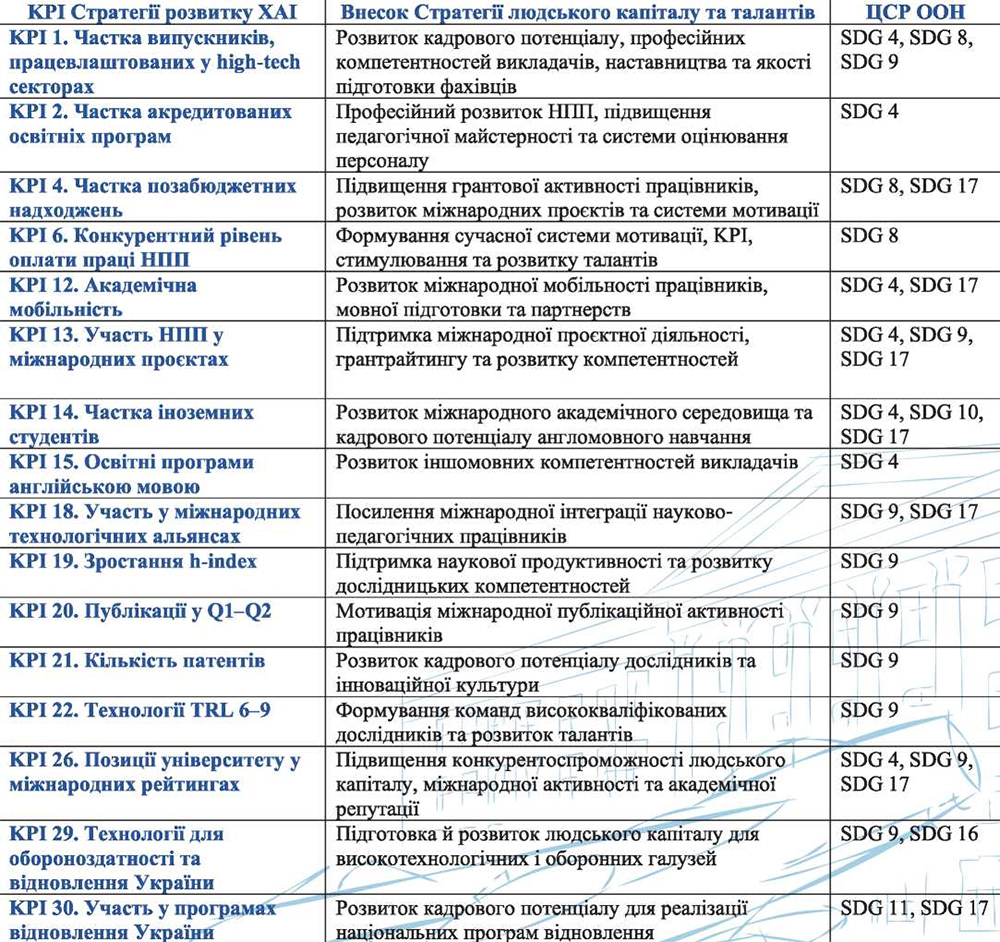
Matrix of Key Performance Indicators (KPI) and Their Alignment with the Human Capital and Talent Strategy
Evaluating the performance of the Strategy implementation is carried out through a system of key performance indicators (KPIs) defined by the Development Strategy of National Aerospace University «Kharkiv Aviation Institute» for 2026-2030. Implementation of the measures of this Strategy ensures the achievement of the following KPIs: